







Question: QUESTION #3: OPTIONS (20%) Setup: Suppose stock ABC trades at $125 and the current 1-year risk free rate rf = 5%. Consider the following 1-year
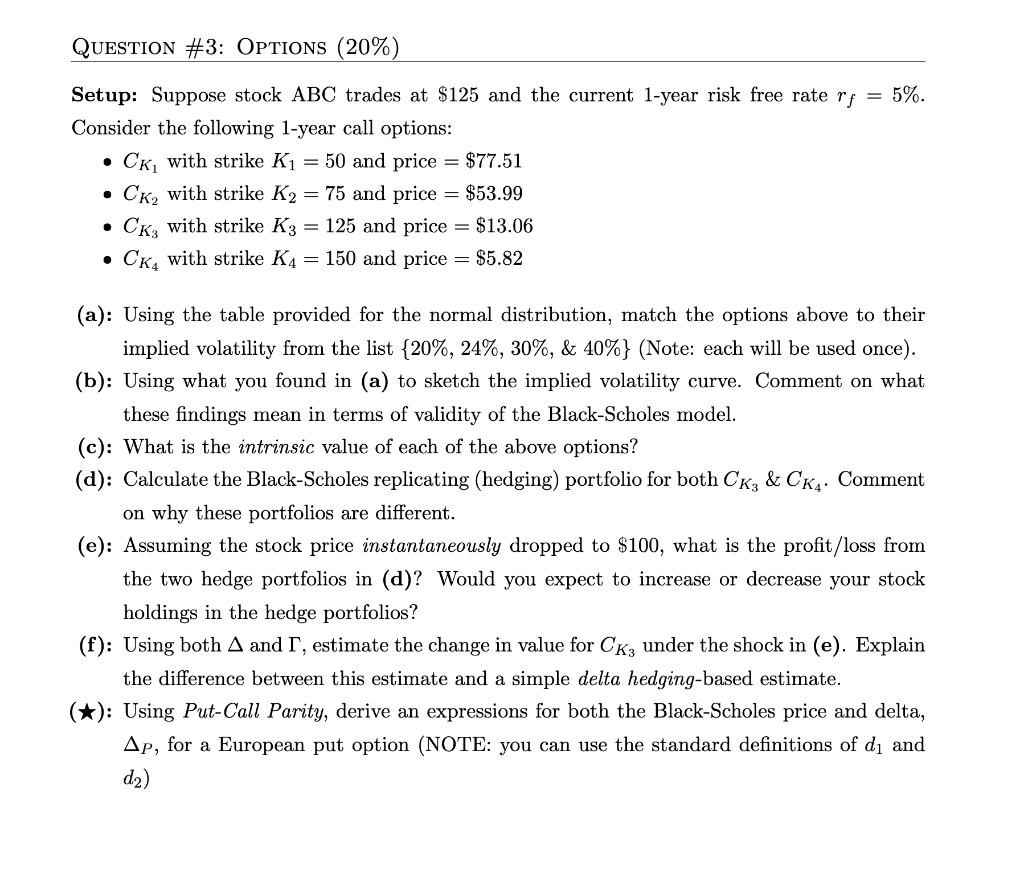
QUESTION #3: OPTIONS (20%) Setup: Suppose stock ABC trades at $125 and the current 1-year risk free rate rf = 5%. Consider the following 1-year call options: Ck, with strike K1 = 50 and price = $77.51 Ck, with strike K2= 75 and price = $53.99 Ck, with strike K3 = 125 and price = $13.06 Cka with strike K4 = 150 and price = $5.82 (a): Using the table provided for the normal distribution, match the options above to their implied volatility from the list {20%, 24%, 30%, & 40%} (Note: each will be used once). (b): Using what you found in (a) to sketch the implied volatility curve. Comment on what these findings mean in terms of validity of the Black-Scholes model. (c): What is the intrinsic value of each of the above options? (d): Calculate the Black-Scholes replicating (hedging) portfolio for both CK & Ck. Comment on why these portfolios are different. (e): Assuming the stock price instantaneously dropped to $100, what is the profit/loss from the two hedge portfolios in (d)? Would you expect to increase or decrease your stock holdings in the hedge portfolios? (f): Using both A and T, estimate the change in value for Ck; under the shock in (e). Explain the difference between this estimate and a simple delta hedging-based estimate. (*): Using Put-Call Parity, derive an expressions for both the Black-Scholes price and delta, Ap, for a European put option (NOTE: you can use the standard definitions of d and d2) QUESTION #3: OPTIONS (20%) Setup: Suppose stock ABC trades at $125 and the current 1-year risk free rate rf = 5%. Consider the following 1-year call options: Ck, with strike K1 = 50 and price = $77.51 Ck, with strike K2= 75 and price = $53.99 Ck, with strike K3 = 125 and price = $13.06 Cka with strike K4 = 150 and price = $5.82 (a): Using the table provided for the normal distribution, match the options above to their implied volatility from the list {20%, 24%, 30%, & 40%} (Note: each will be used once). (b): Using what you found in (a) to sketch the implied volatility curve. Comment on what these findings mean in terms of validity of the Black-Scholes model. (c): What is the intrinsic value of each of the above options? (d): Calculate the Black-Scholes replicating (hedging) portfolio for both CK & Ck. Comment on why these portfolios are different. (e): Assuming the stock price instantaneously dropped to $100, what is the profit/loss from the two hedge portfolios in (d)? Would you expect to increase or decrease your stock holdings in the hedge portfolios? (f): Using both A and T, estimate the change in value for Ck; under the shock in (e). Explain the difference between this estimate and a simple delta hedging-based estimate. (*): Using Put-Call Parity, derive an expressions for both the Black-Scholes price and delta, Ap, for a European put option (NOTE: you can use the standard definitions of d and d2)
Step by Step Solution
There are 3 Steps involved in it

Get step-by-step solutions from verified subject matter experts
 Study Help