







Question: question 3 pls Question 3: (5 points) Suppose a two-person household. Person, has h, units of time available and takes I, units of leisure time,
question 3 pls
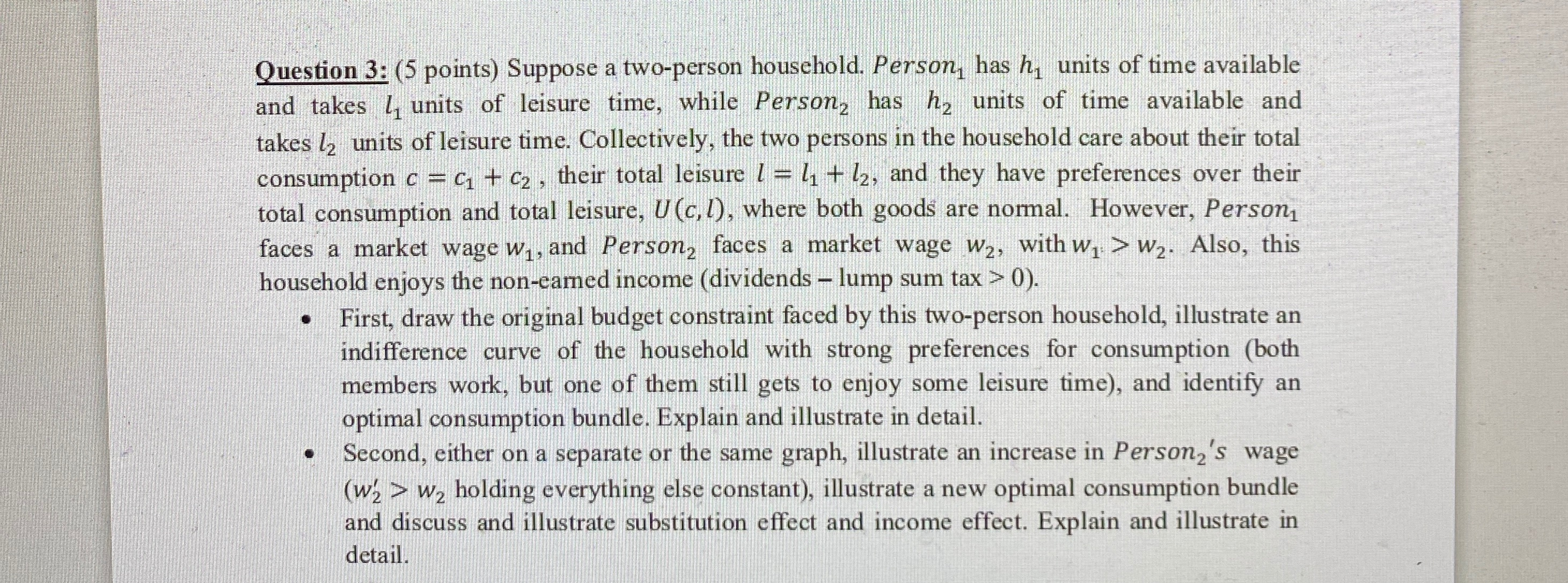
Question 3: (5 points) Suppose a two-person household. Person, has h, units of time available and takes I, units of leisure time, while Person, has h2 units of time available and takes l2 units of leisure time. Collectively, the two persons in the household care about their total consumption c - c1 + c2 , their total leisure I = 1 + /2, and they have preferences over their total consumption and total leisure, U (c, [), where both goods are normal. However, Person, faces a market wage w, , and Person, faces a market wage w2, with w, > W2. Also, this household enjoys the non-earned income (dividends - lump sum tax > 0). . First, draw the original budget constraint faced by this two-person household, illustrate an indifference curve of the household with strong preferences for consumption (both members work, but one of them still gets to enjoy some leisure time), and identify an optimal consumption bundle. Explain and illustrate in detail. . Second, either on a separate or the same graph, illustrate an increase in Person2's wage (W2 > w2 holding everything else constant), illustrate a new optimal consumption bundle and discuss and illustrate substitution effect and income effect. Explain and illustrate in detail
Step by Step Solution
There are 3 Steps involved in it

Get step-by-step solutions from verified subject matter experts
 Study Help