



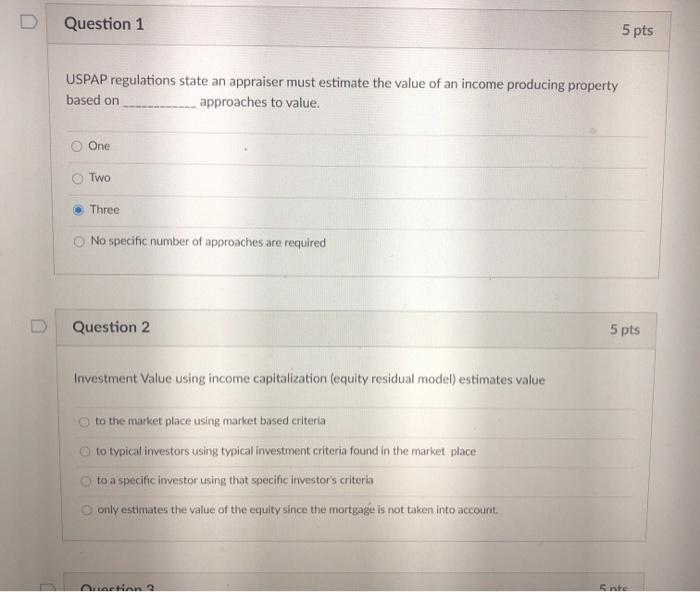
Question: question 3 Question 1 5 pts USPAP regulations state an appraiser must estimate the value of an income producing property based on approaches to value.
 question 3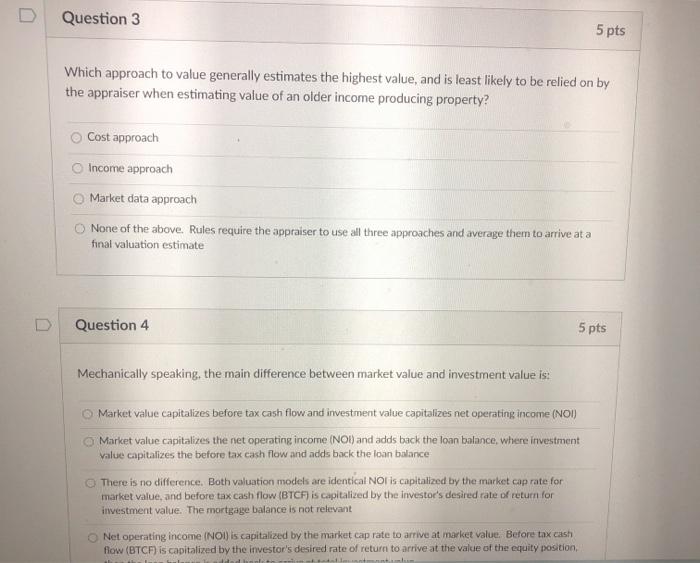
Question 1 5 pts USPAP regulations state an appraiser must estimate the value of an income producing property based on approaches to value. One Two Three No specific number of approaches are required Question 2 5 pts Investment Value using income capitalization (equity residual model) estimates value to the market place using market based criteria to typical investors using typical investment criteria found in the market place to a specific investor using that specific investor's criteria only estimates the value of the equity since the mortgage is not taken into account Arabian 5 ne U Question 3 5 pts Which approach to value generally estimates the highest value, and is least likely to be relied on by the appraiser when estimating value of an older income producing property? Cost approach Income approach Market data approach None of the above. Rules require the appraiser to use all three approaches and average them to arrive at a final valuation estimate Question 4 5 pts Mechanically speaking, the main difference between market value and investment value is: Market value capitalizes before tax cash flow and investment value capitalizes net operating income (NOI) Market value capitalizes the net operating income (Not) and adds back the loan balance, where investment value capitalizes the before tax cash flow and adds back the loan balance There is no difference. Both valuation models are identical Nol is capitalized by the market cap rate for market value, and before tax cash flow (BTCF) is capitalized by the Investor's desired rate of return for investment value. The mortgage balance is not relevant Net operating income (NO) is capitalized by the market cap rate to arrive at market value. Before tax cash flow (BTCF) is capitalized by the investor's desired rate of return to arrive at the value of the equity position
Step by Step Solution
There are 3 Steps involved in it

Get step-by-step solutions from verified subject matter experts