







Question: QUESTION 3 s points Chapter 3 Communication with the Media (50 points) Write a text of around 200 words and answer the following questions. You
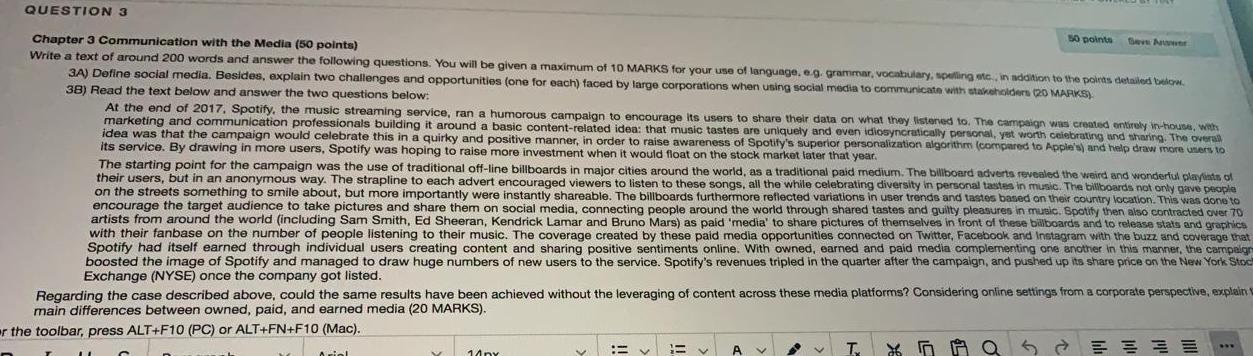
QUESTION 3 s points Chapter 3 Communication with the Media (50 points) Write a text of around 200 words and answer the following questions. You will be given a maximum of 10 MARKS for your use of language. 9. grammar, vocabulary, spilling to in addition to the points detailed below. 3A) Define social media. Besides, explain two challenges and opportunities (one for each) faced by large corporations when using social media to communicate with stakeholders (20 MARKS) 38) Read the text below and answer the two questions below: At the end of 2017, Spotify, the music streaming service, ran a humorous campaign to encourage its users to share their data on what they listened to. The campaign was created entirely in-houss, with marketing and communication professionals building it around a basic content-related idea that music tastes are uniquely and even idiosyncratically personal, yet worth cuiebrating and sharing. The overall idea was that the campaign would celebrate this in a quirky and positive manner, in order to raise awareness of Spotify's superior personalization algorithm (compared to Apple's) and help draw more uners to its service. By drawing in more users, Spotify was hoping to raise more investment when it would float on the stock market later that year. The starting point for the campaign was the use of traditional off-line billboards in major cities around the world, as a traditional paid medium. The billboard adverts revealed the weird and wonderful playlists of their users, but in an anonymous way. The strapline to each advert encouraged viewers to listen to these songs, all the while celebrating diversity in personal tastes in music. The billboards not only gave people on the streets something to smile about, but more importantly were instantly shareable. The billboards furthermore reflected variations in user trends and tastes based on their country location. This was done to encourage the target audience to take pictures and share them on social media, connecting people around the world through shared tastes and guilty pleasures in music. Spotity then also contracted over 70 artists from around the world (including Sam Smith, Ed Sheeran, Kendrick Lamar and Bruno Mars) as paid "media" to share pictures of themselves in front of these billboards and to release stats and graphics with their fanbase on the number of people listening to their music. The coverage created by these paid media opportunities connected on Twitter, Facebook and Instagram with the buzz and coverage that Spotify had itself earned through individual users creating content and sharing positive sentiments online. With owned, earned and paid media complementing one another in this manner, the campaign boosted the image of Spotify and managed to draw huge numbers of new users to the service. Spotify's revenues tripled in the quarter after the campaign, and pushed up its share price on the New York Styc Exchange (NYSE) once the company got listed. Regarding the case described above, could the same results have been achieved without the leveraging of content across these media platforms? Considering online settings from a corporate perspective, explain main differences between owned, paid, and earned media (20 MARKS). or the toolbar, press ALT+F10 (PC) or ALT+FN+F10 (Mac). A T 6=== Ariol 10ny QUESTION 3 s points Chapter 3 Communication with the Media (50 points) Write a text of around 200 words and answer the following questions. You will be given a maximum of 10 MARKS for your use of language. 9. grammar, vocabulary, spilling to in addition to the points detailed below. 3A) Define social media. Besides, explain two challenges and opportunities (one for each) faced by large corporations when using social media to communicate with stakeholders (20 MARKS) 38) Read the text below and answer the two questions below: At the end of 2017, Spotify, the music streaming service, ran a humorous campaign to encourage its users to share their data on what they listened to. The campaign was created entirely in-houss, with marketing and communication professionals building it around a basic content-related idea that music tastes are uniquely and even idiosyncratically personal, yet worth cuiebrating and sharing. The overall idea was that the campaign would celebrate this in a quirky and positive manner, in order to raise awareness of Spotify's superior personalization algorithm (compared to Apple's) and help draw more uners to its service. By drawing in more users, Spotify was hoping to raise more investment when it would float on the stock market later that year. The starting point for the campaign was the use of traditional off-line billboards in major cities around the world, as a traditional paid medium. The billboard adverts revealed the weird and wonderful playlists of their users, but in an anonymous way. The strapline to each advert encouraged viewers to listen to these songs, all the while celebrating diversity in personal tastes in music. The billboards not only gave people on the streets something to smile about, but more importantly were instantly shareable. The billboards furthermore reflected variations in user trends and tastes based on their country location. This was done to encourage the target audience to take pictures and share them on social media, connecting people around the world through shared tastes and guilty pleasures in music. Spotity then also contracted over 70 artists from around the world (including Sam Smith, Ed Sheeran, Kendrick Lamar and Bruno Mars) as paid "media" to share pictures of themselves in front of these billboards and to release stats and graphics with their fanbase on the number of people listening to their music. The coverage created by these paid media opportunities connected on Twitter, Facebook and Instagram with the buzz and coverage that Spotify had itself earned through individual users creating content and sharing positive sentiments online. With owned, earned and paid media complementing one another in this manner, the campaign boosted the image of Spotify and managed to draw huge numbers of new users to the service. Spotify's revenues tripled in the quarter after the campaign, and pushed up its share price on the New York Styc Exchange (NYSE) once the company got listed. Regarding the case described above, could the same results have been achieved without the leveraging of content across these media platforms? Considering online settings from a corporate perspective, explain main differences between owned, paid, and earned media (20 MARKS). or the toolbar, press ALT+F10 (PC) or ALT+FN+F10 (Mac). A T 6=== Ariol 10ny
Step by Step Solution
There are 3 Steps involved in it

Get step-by-step solutions from verified subject matter experts
 Study Help