







Question: Question 3. Scheduling (20 marks) Art Work is a graphic design company. All jobs it receives must go through sketching (Process X) and then colouring
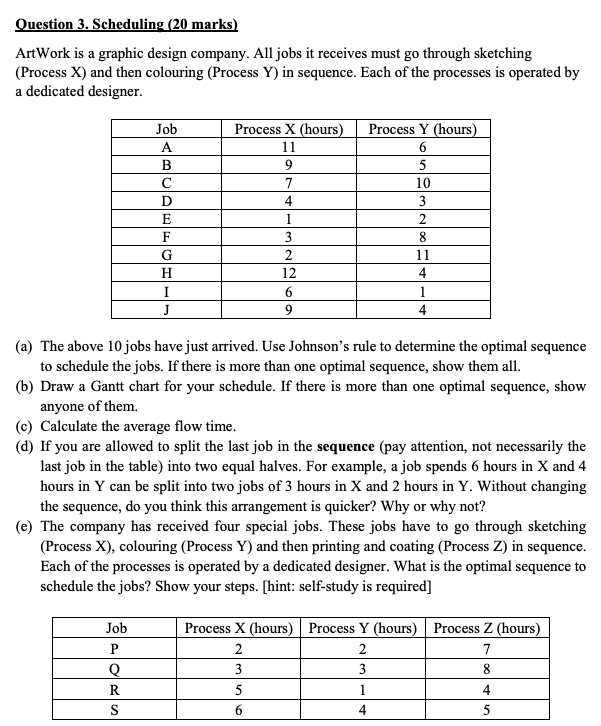
Question 3. Scheduling (20 marks) Art Work is a graphic design company. All jobs it receives must go through sketching (Process X) and then colouring (Process Y) in sequence. Each of the processes is operated by a dedicated designer. Job Process X (hours) Process Y (hours) 11 15 10 4 13 1 18 D E F H 14 12 6 (a) The above 10 jobs have just arrived. Use Johnson's rule to determine the optimal sequence to schedule the jobs. If there is more than one optimal sequence, show them all. (b) Draw a Gantt chart for your schedule. If there is more than one optimal sequence, show anyone of them. (c) Calculate the average flow time. (d) If you are allowed to split the last job in the sequence (pay attention, not necessarily the last job in the table) into two equal halves. For example, a job spends 6 hours in X and 4 hours in Y can be split into two jobs of 3 hours in X and 2 hours in Y. Without changing the sequence, do you think this arrangement is quicker? Why or why not? (e) The company has received four special jobs. These jobs have to go through sketching (Process X), colouring (Process Y) and then printing and coating (Process Z) in sequence. Each of the processes is operated by a dedicated designer. What is the optimal sequence to schedule the jobs? Show your steps. [hint: self-study is required] Job Process X (hours) Process Y (hours) Process Z (hours) Question 3. Scheduling (20 marks) Art Work is a graphic design company. All jobs it receives must go through sketching (Process X) and then colouring (Process Y) in sequence. Each of the processes is operated by a dedicated designer. Job Process X (hours) Process Y (hours) 11 15 10 4 13 1 18 D E F H 14 12 6 (a) The above 10 jobs have just arrived. Use Johnson's rule to determine the optimal sequence to schedule the jobs. If there is more than one optimal sequence, show them all. (b) Draw a Gantt chart for your schedule. If there is more than one optimal sequence, show anyone of them. (c) Calculate the average flow time. (d) If you are allowed to split the last job in the sequence (pay attention, not necessarily the last job in the table) into two equal halves. For example, a job spends 6 hours in X and 4 hours in Y can be split into two jobs of 3 hours in X and 2 hours in Y. Without changing the sequence, do you think this arrangement is quicker? Why or why not? (e) The company has received four special jobs. These jobs have to go through sketching (Process X), colouring (Process Y) and then printing and coating (Process Z) in sequence. Each of the processes is operated by a dedicated designer. What is the optimal sequence to schedule the jobs? Show your steps. [hint: self-study is required] Job Process X (hours) Process Y (hours) Process Z (hours)
Step by Step Solution
There are 3 Steps involved in it

Get step-by-step solutions from verified subject matter experts
 Study Help