







Question: Question 3. Table 1 shows data collected on a runner's decision to go for a run or not go for a run depending on the
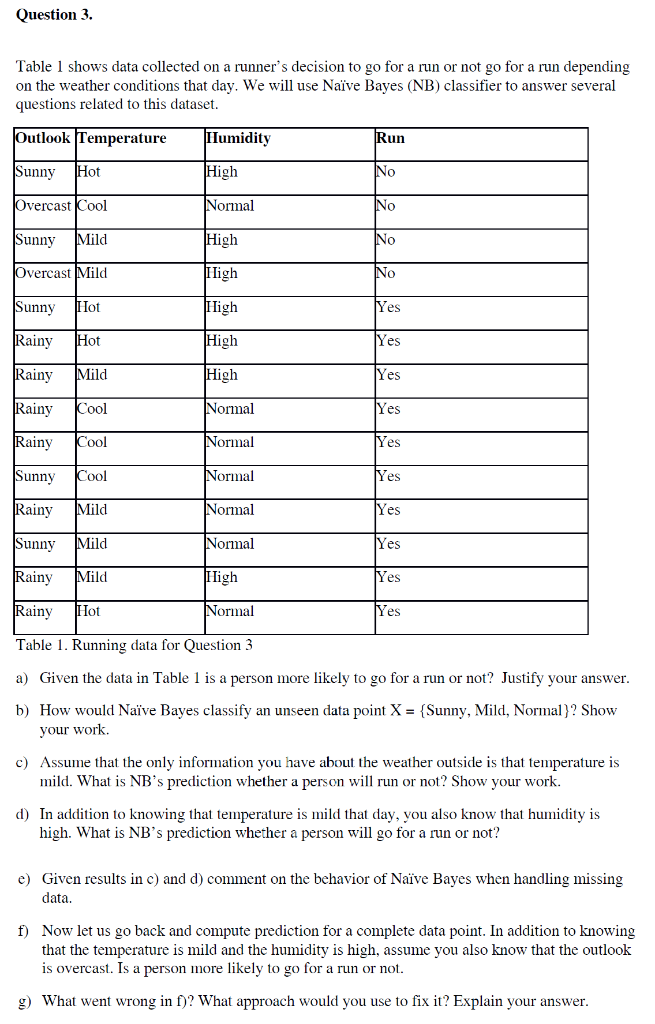
Question 3. Table 1 shows data collected on a runner's decision to go for a run or not go for a run depending on the weather conditions that day. We will use Nave Bayes (NB) classifier to answer several questions related to this dataset. utlook Temperature Humidity un unny Hot 1g 0 Normal vercast Cool Sunny Mild vercast Mild unny Hot 0 0 ligh igh ain es ainy Mild es Normal Normal ormal Normal Normal ainy Cool es es unny Cool ainy Mild Sunny Mild ny Mild es es es High es ot Normal Table 1. Running data for Question 3 a) Given the data in Table 1 is a person more likely to go for a run or not? Justify your answer b) How would Nave Bayes classify an unseen data point X- {Sunny, Mild, Normal)? Show your work. c) Assume that the only information you have about the weather outside is that temperature is mild. What is NB's prediction whether a person will run or not? Show your work. d) In addition to knowing that temperature is mild that day, you also know that humidity is high. What is NB's prediction whether a person will go for a run or not? e) Given results in c) and d) comment on the behavior of Nave Bayes when handling missing data f) Now let us go back and compute prediction for a complete data point. In addition to knowing that the temperature is mild and the humidity is high, assume you also know that the outlook is overcast. Is a person more likely to go for a run or not. g) What went wrong in f)? What approach would you use to fix it? Explain your
Step by Step Solution
There are 3 Steps involved in it

Get step-by-step solutions from verified subject matter experts
 Study Help