







Question: Question 3: The Doppler effect is the perceived change in frequency that hap- pens when a wave source and a wave observer are moving relative
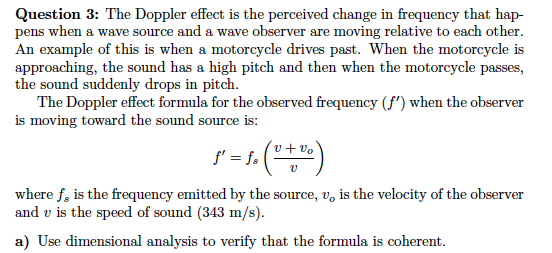
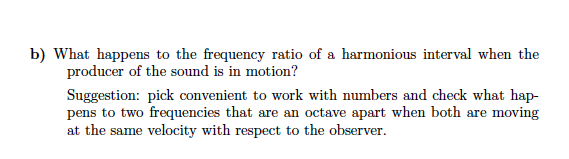
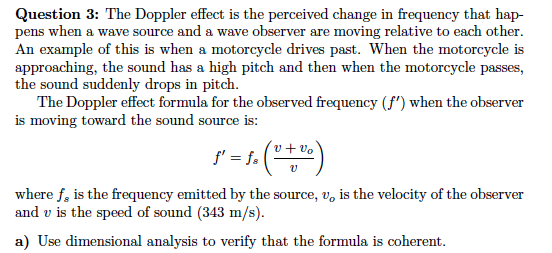
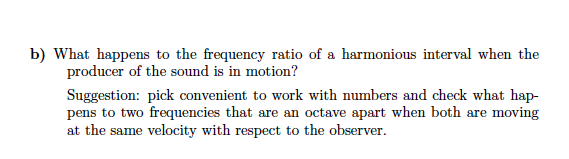
Question 3: The Doppler effect is the perceived change in frequency that hap- pens when a wave source and a wave observer are moving relative to each other. An example of this is when a motorcycle drives past. When the motorcycle is approaching, the sound has a high pitch and then when the motorcycle passes, the sound suddenly drops in pitch. The Doppler effect formula for the observed frequency ( f') when the observer is moving toward the sound source is: . U+ Up g () where f, is the frequency emitted by the source, v, is the velocity of the observer and v is the speed of sound (343 m/s). a) Use dimensional analysis to verify that the formula is coherent. b) What happens to the frequency ratio of a harmonious interval when the producer of the sound is in motion? Suggestion: pick convenient to work with numbers and check what hap- pens to two frequencies that are an octave apart when both are moving at the same velocity with respect to the observer
Step by Step Solution
There are 3 Steps involved in it

Get step-by-step solutions from verified subject matter experts
 Study Help