


Question: Question 3: The following piece of code shows a problem with using IEEE 754 single-precision floating point representation. The code is written in the C
 Question 3: The following piece of code shows a problem with

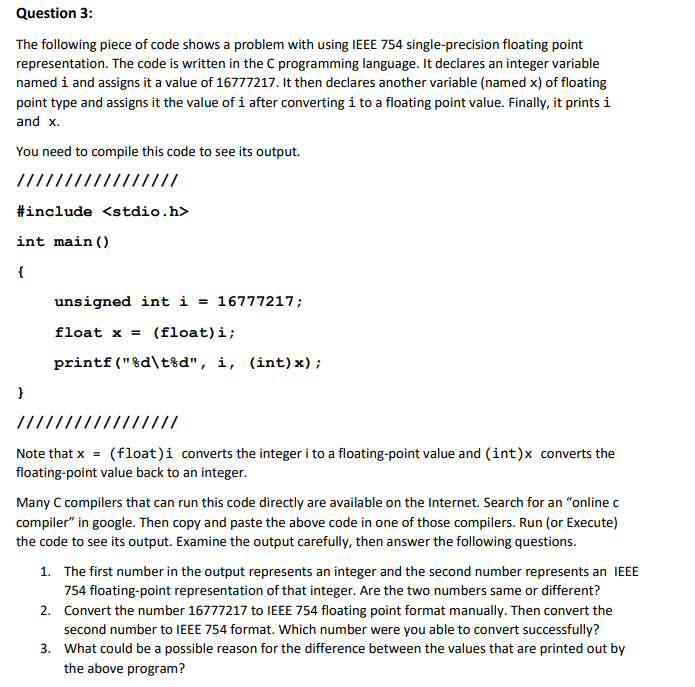
Question 3: The following piece of code shows a problem with using IEEE 754 single-precision floating point representation. The code is written in the C programming language. It declares an integer variable named i and assigns it a value of 16777217. It then declares another variable (named x) of floating point type and assigns it the value of i after converting i to a floating point value. Finally, it prints i and x You need to compile this code to see its output. UWWUTUUI1 #include int main) unsigned int i16777217; float x - (float)i; printf ("%d\t%d", i, (int) x); BRBBRBRB Note that x = (float) i converts the integer i to a floating-point value and (int) x converts the floating-point value back to an integer. Many C compilers that can run this code directly are available on the Internet. Search for an "online c compiler" in google. Then copy and paste the above code in one of those compilers. Run (or Execute) the code to see its output. Examine the output carefully, then answer the following questions. The first number in the output represents an integer and the second number represents an IEEE 754 floating-point representation of that integer. Are the two numbers same or different? Convert the number 16777217 to IEEE 754 floating point format manually. Then convert the second number to IEEE 754 format. Which number were you able to convert successfully? What could be a possible reason for the difference between the values that are printed out by the above program? 1. 2. 3

Step by Step Solution

There are 3 Steps involved in it

1 Expert Approved Answer
Step: 1 Unlock blur-text-image
Question Has Been Solved by an Expert!

Get step-by-step solutions from verified subject matter experts

Step: 2 Unlock
Step: 3 Unlock

Students Have Also Explored These Related Databases Questions!