







Question: QUESTION #3 - Total Cost Analysis Primo Caf Inc. has been doing well. Revenue from its three lines of coffee makers have exceeded expectations. In
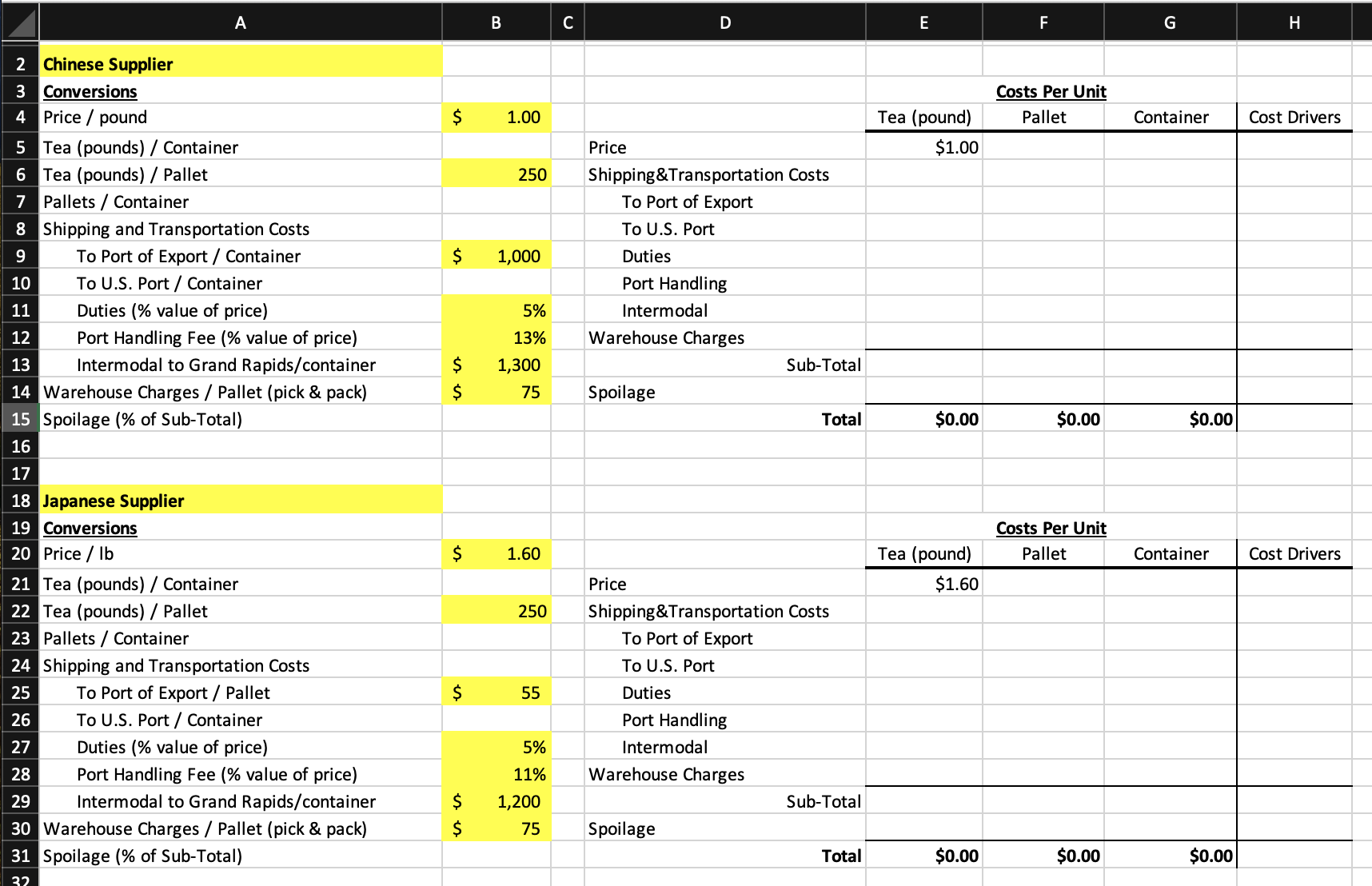
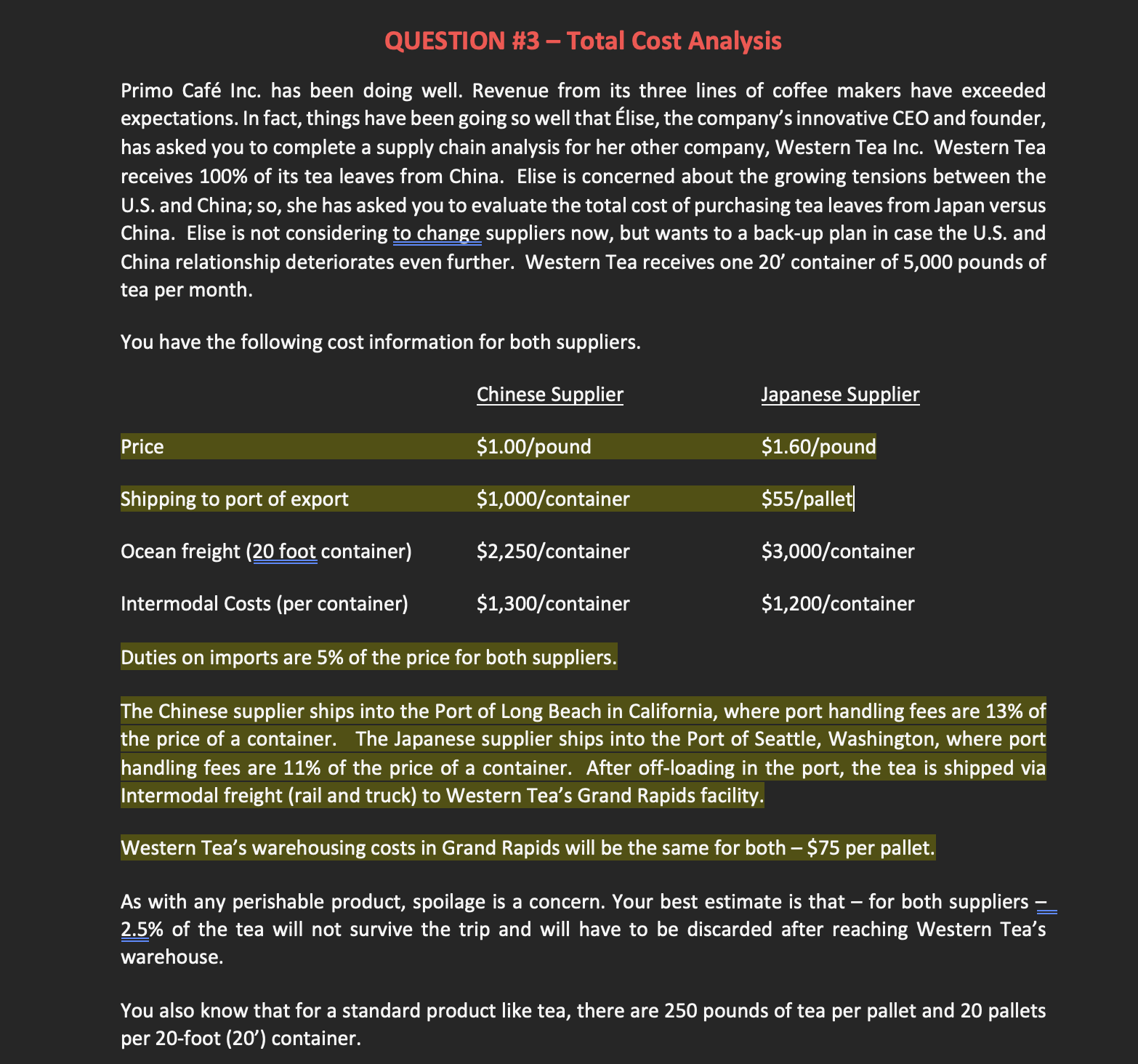
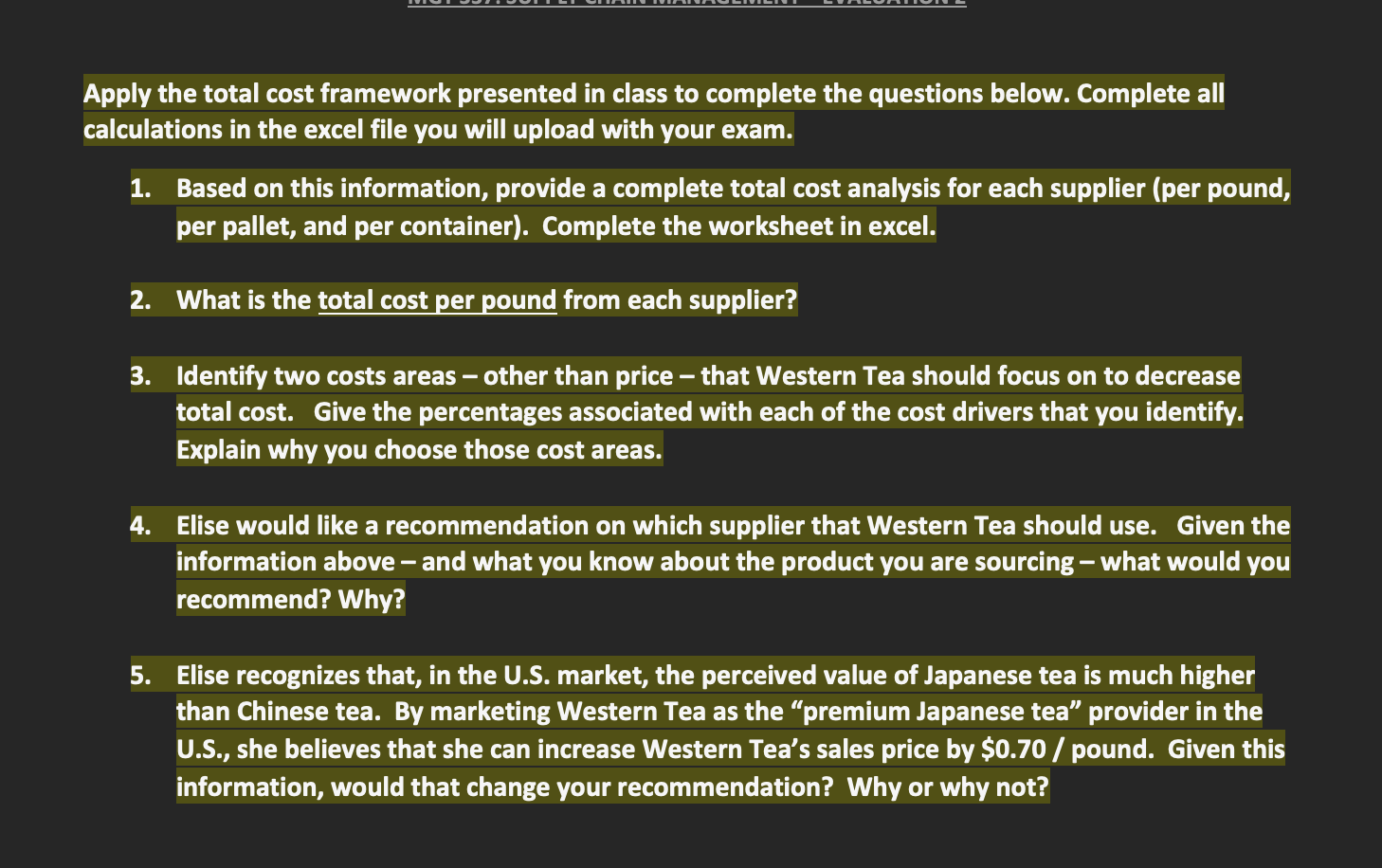
QUESTION \#3 - Total Cost Analysis Primo Caf Inc. has been doing well. Revenue from its three lines of coffee makers have exceeded expectations. In fact, things have been going so well that lise, the company's innovative CEO and founder, has asked you to complete a supply chain analysis for her other company, Western Tea Inc. Western Tea receives 100% of its tea leaves from China. Elise is concerned about the growing tensions between the U.S. and China; so, she has asked you to evaluate the total cost of purchasing tea leaves from Japan versus China. Elise is not considering to change suppliers now, but wants to a back-up plan in case the U.S. and China relationship deteriorates even further. Western Tea receives one 20 container of 5,000 pounds of tea per month. You have the following cost information for both suppliers. \begin{tabular}{lll} & Chinese Supplier & Japanese Supplier \\ Price & $1.00/ pound & $1.60/ pound \\ Shipping to port of export & $1,000/ container & $55/ pallet \\ Ocean freight (20 foot container) & $2,250/ container & $3,000/ container \\ Intermodal Costs (per container) & $1,300/ container & $1,200/ container \end{tabular} Duties on imports are 5% of the price for both suppliers. The Chinese supplier ships into the Port of Long Beach in California, where port handling fees are 13% of the price of a container. The Japanese supplier ships into the Port of Seattle, Washington, where port handling fees are 11% of the price of a container. After off-loading in the port, the tea is shipped via Intermodal freight (rail and truck) to Western Tea's Grand Rapids facility. Western Tea's warehousing costs in Grand Rapids will be the same for both $75 per pallet. As with any perishable product, spoilage is a concern. Your best estimate is that - for both suppliers 2.5\% of the tea will not survive the trip and will have to be discarded after reaching Western Tea's warehouse. \begin{tabular}{|c|c|c|c|c|c|c|c|} \hline \multicolumn{8}{|l|}{ Chinese Supplier } \\ \hline Conversions & & & & \multicolumn{3}{|c|}{ Costs Per Unit } & \multirow[b]{2}{*}{ Cost Drivers } \\ \hline Price / pound & $ & 1.00 & & Tea (pound) & Pallet & Container & \\ \hline Tea (pounds) / Container & & & Price & $1.00 & & & \\ \hline Tea (pounds) / Pallet & & 250 & Shipping\&Transportation Costs & & & & \\ \hline Pallets / Container & & & To Port of Export & & & & \\ \hline Shipping and Transportation Costs & & & To U.S. Port & & & & \\ \hline To Port of Export / Container & $ & 1,000 & Duties & & & & \\ \hline To U.S. Port / Container & & & Port Handling & & & & \\ \hline Duties (\% value of price) & & 5% & Intermodal & & & & \\ \hline Port Handling Fee (\% value of price) & & 13% & Warehouse Charges & & & & \\ \hline Intermodal to Grand Rapids/container & $ & 1,300 & Sub-Total & & & & \\ \hline Warehouse Charges / Pallet (pick \& pack) & $ & 75 & Spoilage & & & & \\ \hline Spoilage (\% of Sub-Total) & & & Total & $0.00 & $0.00 & $0.00 & \\ \hline \multicolumn{8}{|l|}{ Japanese Supplier } \\ \hline Conversions & & & & \multicolumn{3}{|c|}{ Costs Per Unit } & \\ \hline Price / lb & $ & 1.60 & & Tea (pound) & Pallet & Container & Cost Drivers \\ \hline Tea (pounds) / Container & & & Price & $1.60 & & & \\ \hline Tea (pounds) / Pallet & & 250 & Shipping\&Transportation Costs & & & & \\ \hline Pallets / Container & & & To Port of Export & & & & \\ \hline Shipping and Transportation Costs & & & To U.S. Port & & & & \\ \hline To Port of Export / Pallet & $ & 55 & Duties & & & & \\ \hline To U.S. Port / Container & & & Port Handling & & & & \\ \hline Duties (\% value of price) & & 5% & Intermodal & & & & \\ \hline Port Handling Fee (\% value of price) & & 11% & Warehouse Charges & & & & \\ \hline Intermodal to Grand Rapids/container & $ & 1,200 & Sub-Total & & & & \\ \hline Warehouse Charges / Pallet (pick \& pack) & $ & 75 & Spoilage & & & & \\ \hline Spoilage (\% of Sub-Total) & & & Total & $0.00 & $0.00 & $0.00 & \\ \hline \end{tabular} Apply the total cost framework presented in class to complete the questions below. Complete all calculations in the excel file you will upload with your exam. 1. Based on this information, provide a complete total cost analysis for each supplier (per pound, per pallet, and per container). Complete the worksheet in excel. 2. What is the total cost per pound from each supplier? 3. Identify two costs areas - other than price - that Western Tea should focus on to decrease total cost. Give the percentages associated with each of the cost drivers that you identify. Explain why you choose those cost areas. 4. Elise would like a recommendation on which supplier that Western Tea should use. Given the information above - and what you know about the product you are sourcing - what would you recommend? Why? 5. Elise recognizes that, in the U.S. market, the perceived value of Japanese tea is much higher than Chinese tea. By marketing Western Tea as the "premium Japanese tea" provider in the U.S., she believes that she can increase Western Tea's sales price by $$0.70/ pound. Given this information, would that change your recommendation? Why or why not
Step by Step Solution
There are 3 Steps involved in it

Get step-by-step solutions from verified subject matter experts
 Study Help