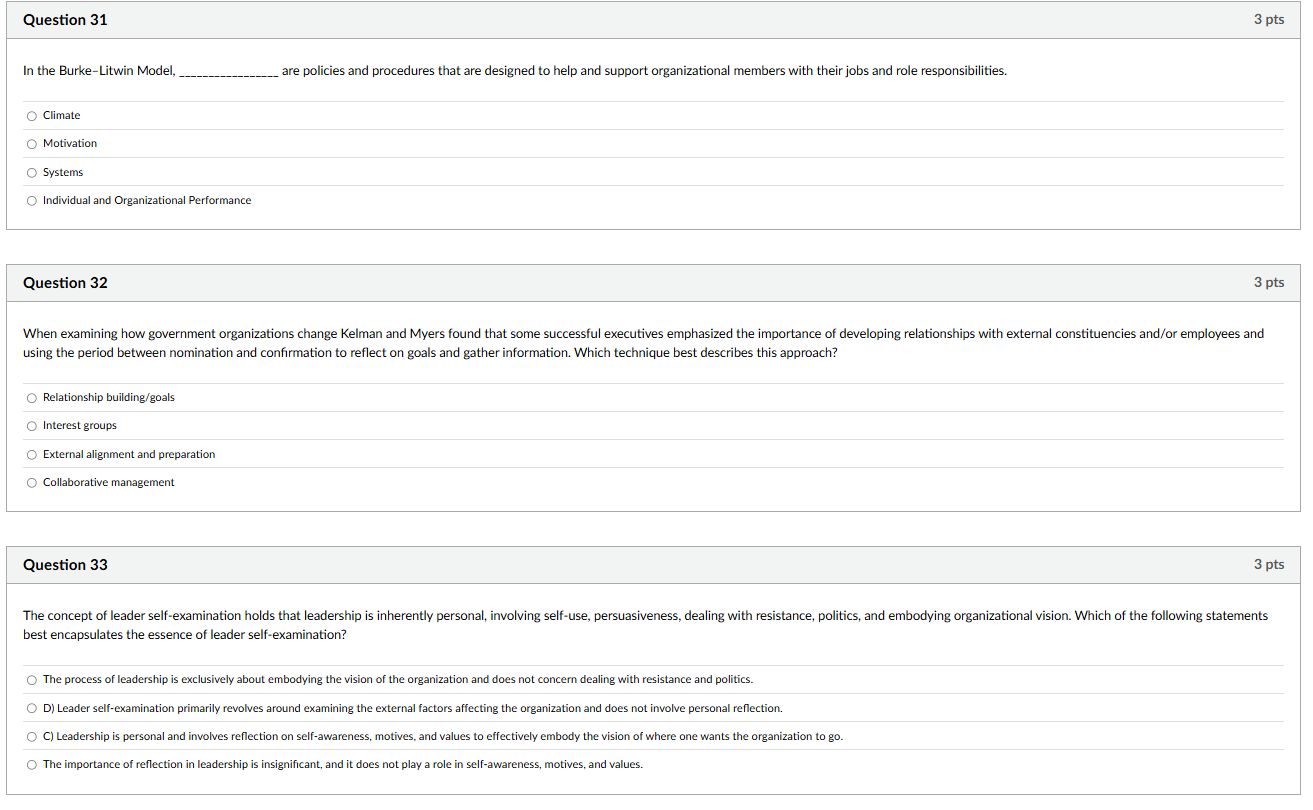
Question: Question 31 3 pts In the Burke-Litwin Model, ______ ar policies and procedures that are designed to help and support organizational members with their jobs
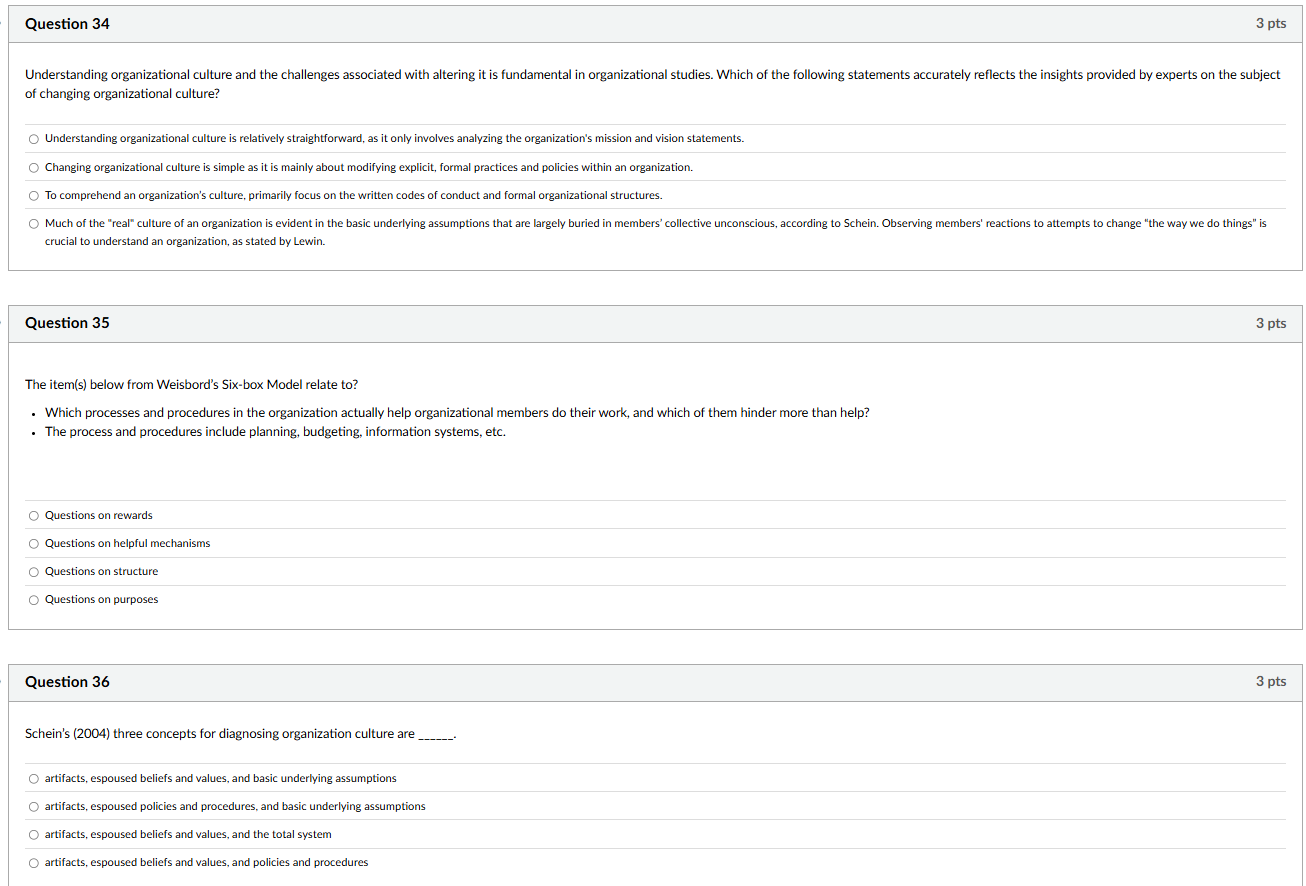
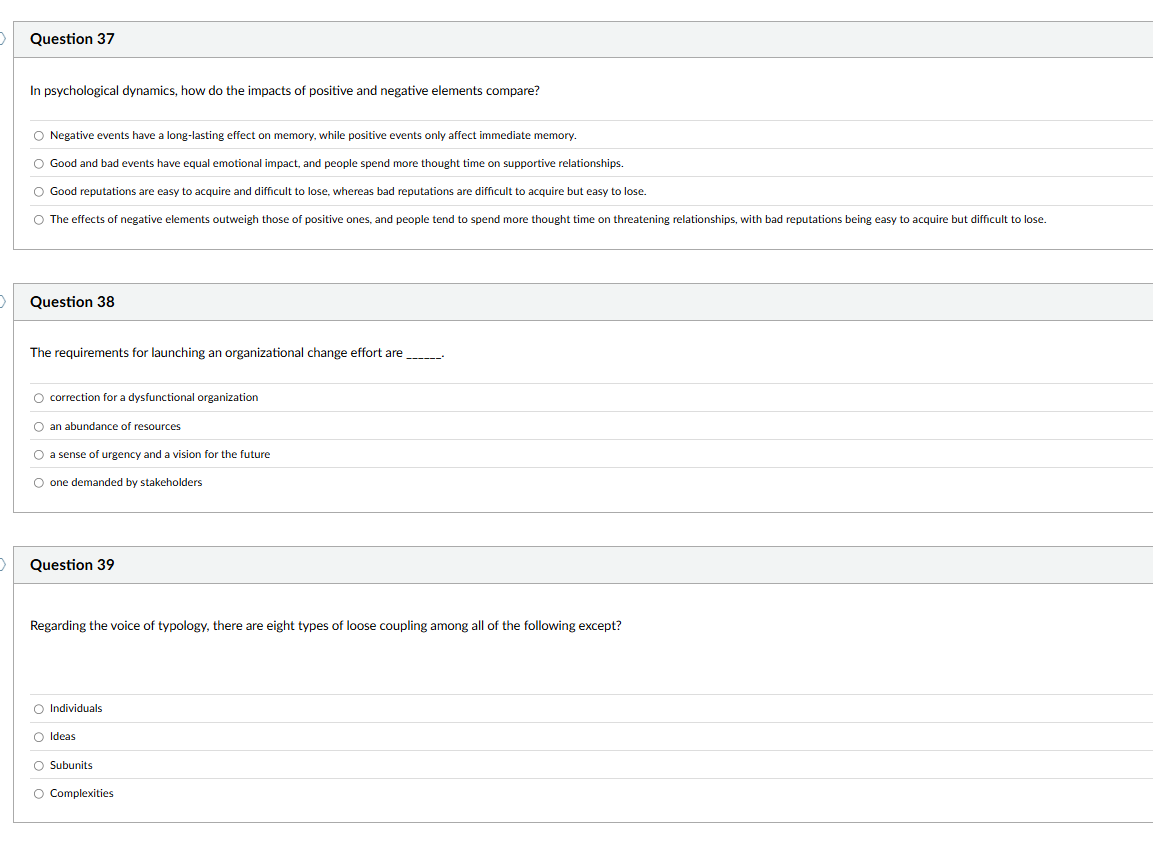
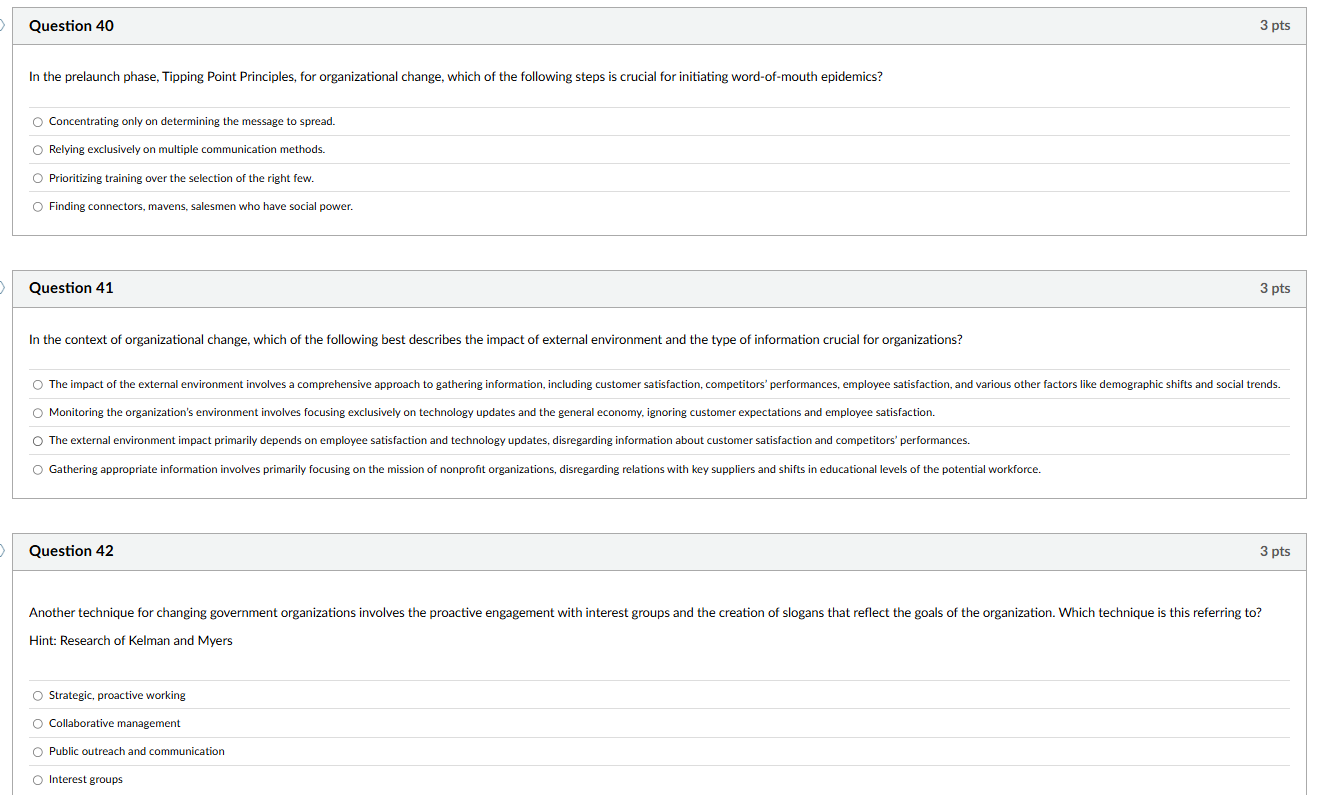
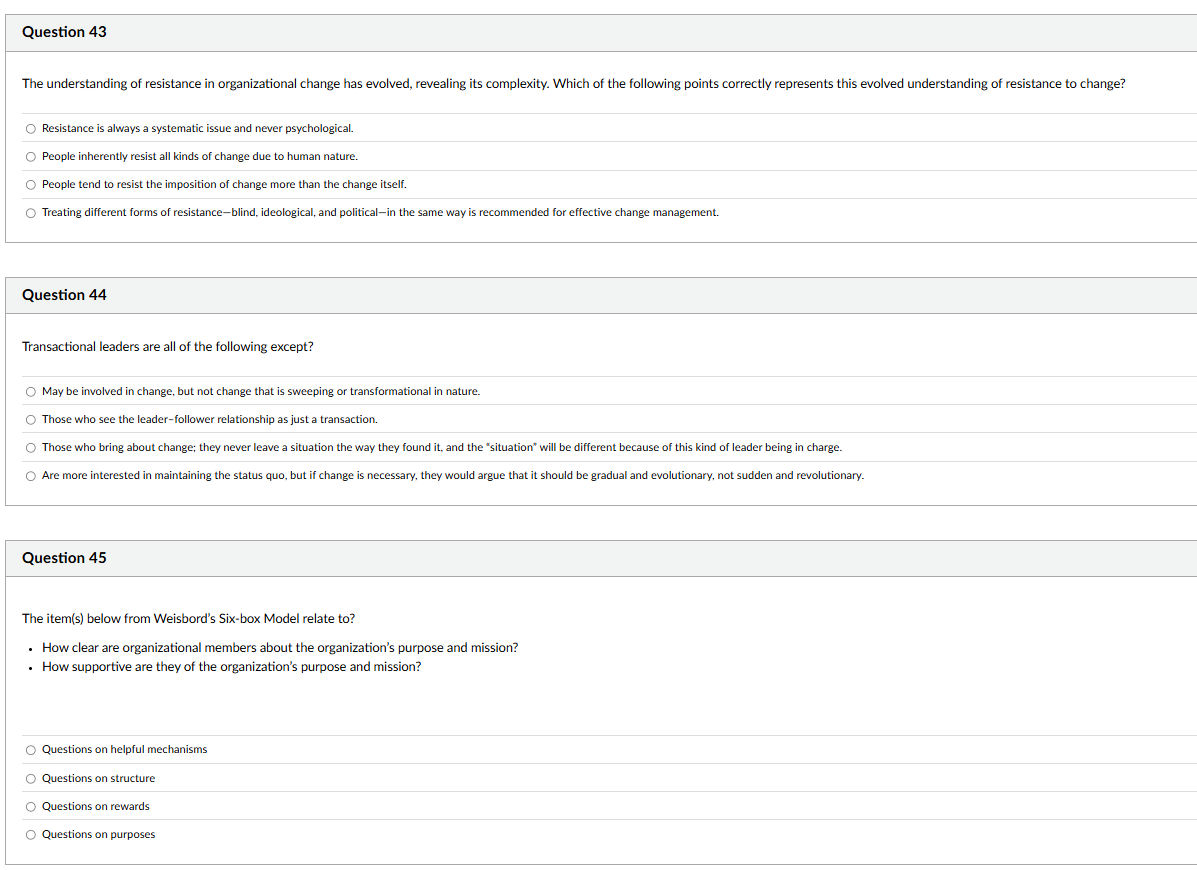
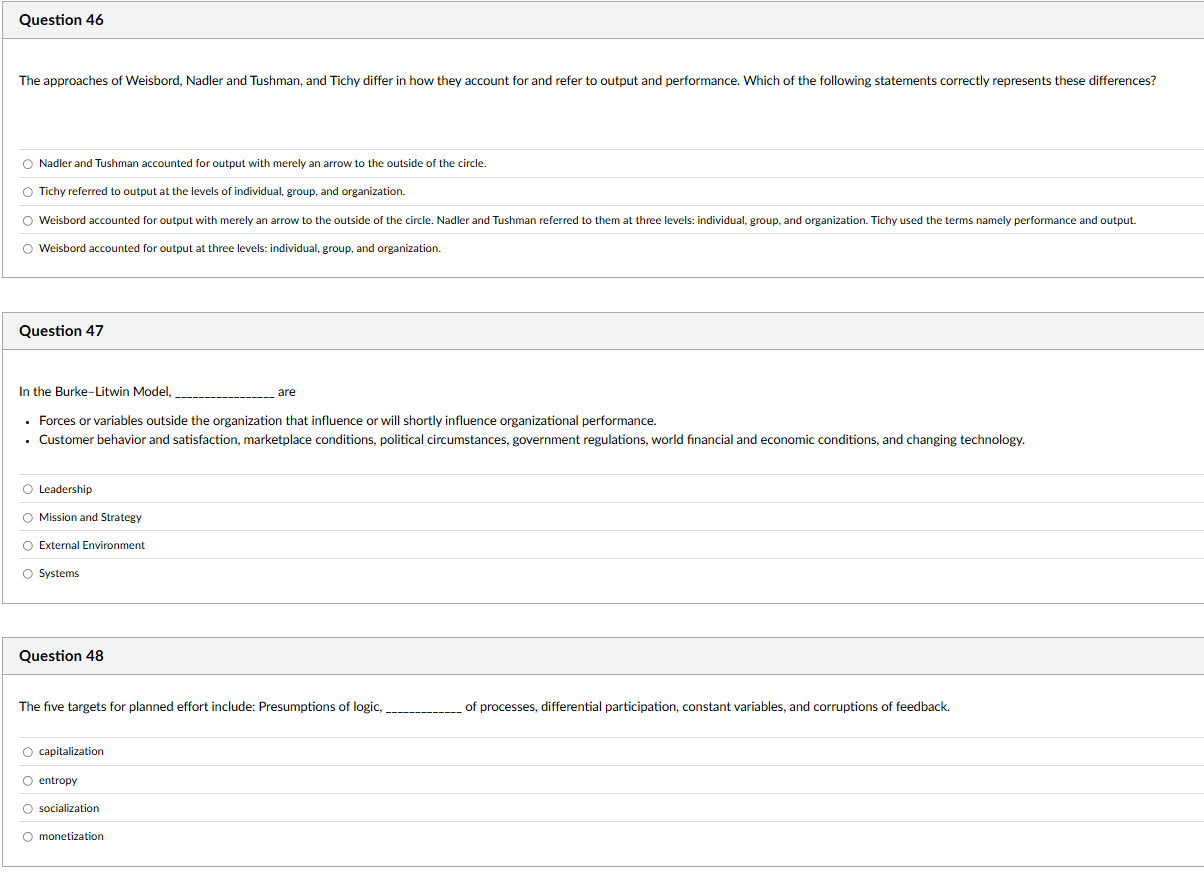
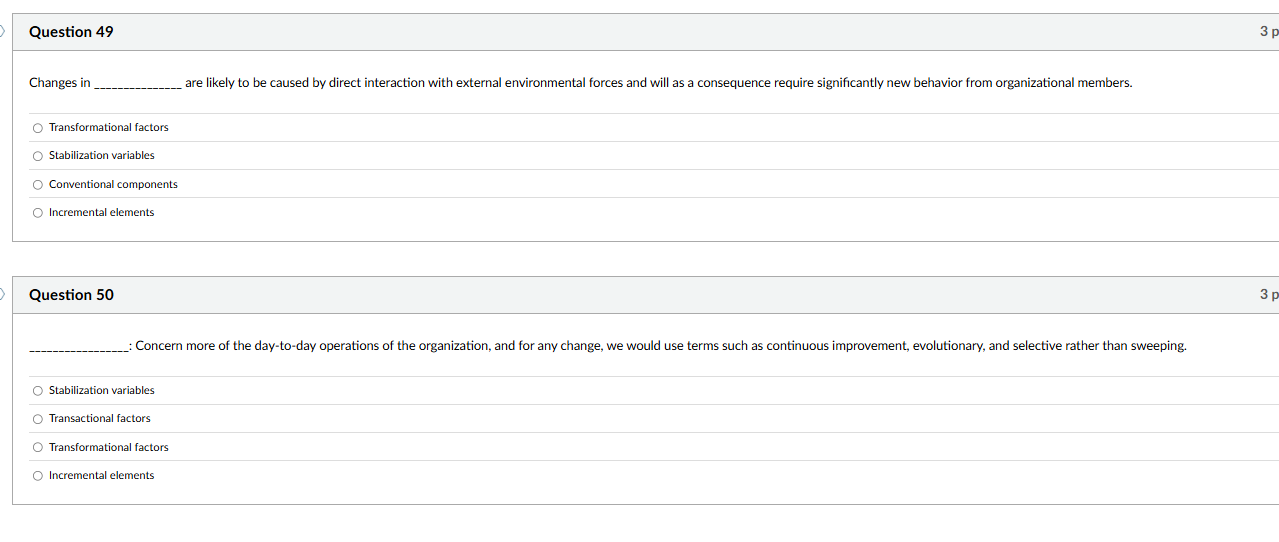
Question 31 3 pts In the Burke-Litwin Model, ______ ar policies and procedures that are designed to help and support organizational members with their jobs and role responsibilities. Climate Mativation Systems Individual and Organizational Performance Question 32 3 pts When examining how government organizations change Kelman and Myers found that some successful executives emphasized the importance of developing relationships with external constituencies and/or employees and using the period between nomination and confirmation to reflect on goals and gather information. Which technique best describes this approach? Relationship building/goals Interest groups External alignment and preparation Collaborative management Question 33 3 pts The concept of leader self-examination holds that leadership is inherently personal, involving self-use, persuasiveness, dealing with resistance, politics, and embodying organizational vision. Which of the following statements best encapsulates the essence of leader self-examination? The process of leadership is exclusively about embodying the vision of the organization and does not concern dealing with resistance and politics. D) Leader self-examination primarily revolves around examining the external factors affecting the organization and does not invelve personal reflection. ) Leadership is personal and involves reflection on self-awareness, motives, and values to effectively embody the vision of where one wants the organization te go. The importance of reflection in leadership is insignificant, and it does not play a role in self-awareness, motives, and values. Question 34 3 pts Understanding organizational culture and the challenges associated with altering it is fundamental in organizational studies. Which of the following statements accurately reflects the insights provided by experts on the subject of changing organizational culture? Understanding organizational culture is relatively straightforward, as it only involves analyzing the organization's mission and vision statements. (>) Changing organizational culture is simple as itis mainly about modifying explicit, formal practices and policies within an organization. To comprehend an organization's culture, primarily focus on the written codes of conduct and formal organizational structures. ( Much of the \"real\" culture of an organization is evident in the basic underlying assumptions that are largely buried in members' collective unconscious, according to Schein. Observing members' reactions to attempts to change \"the way we do things" is crucial to understand an organization, as stated by Lewin. Question 35 3 pts The item(s) below from Weisbord's Six-box Model relate to? Which processes and procedures in the organization actually help organizational members do their work, and which of them hinder more than help? + The process and procedures include planning, budgeting, information systems, etc. Questions on rewards Questions on helpful mechanisms Questions on structure Questions on purposes Question 36 3 pts Schein's (2004) three concepts for diagnosing organization culture are artifacts, espoused beliefs and values, and basic underlying assumptions artifacts, espoused policies and procedures, and basic underlying assumptions artifacts, espoused beliefs and values, and the total system artifacts, espoused beliefs and values. and policies and procedures a a a Question 37 In psychological dynamics, how do the impacts of positive and negative elements cormpare? ( Negative events have a long-lasting effect on memory, while positive events only affect immediate memory. Good and bad events have equal emotional impact, and people spend more thought time on supportive relationships. ( Good reputations are easy to acquire and difficult to lose, whereas bad reputations are difficult to acquire but easy to lose. ( The effects of negative elements outweigh those of positive ones, and people tend to spend more thought time on threatening relationships, with bad reputations being easy to acquire but difficult to lose. Question 38 The requirements for launching an organizational change effort are _ correction for a dysfunctional organization ( an abundance of resources ( asense of urgency and a vision for the future ( one demanded by stakeholders Question 39 Regarding the voice of typology, there are eight types of loose coupling among all of the following except? Individuals Ideas Subunits Complexities Question 40 3 pts In the prelaunch phase, Tipping Point Principles, for organizational change. which of the following steps is crucial for initiating word-of-mouth epidemics? Concentrating only on determining the message to spread. Relying exclusively on multiple communication methods. Prioritizing training over the selection of the right few. Finding connectors, mavens, salesmen who have social power. Question 41 3 pts In the context of organizational change, which of the following best describes the impact of external environment and the type of information crucial for organizations? The impact of the external environment involves a comprehensive approach to gathering information, including customer satisfaction, competitors' performances, employee satisfaction, and various other factors like demographic shifts and social trends. Monitoring the organization's environment involves focusing exclusively on technology updates and the general economy, ignoring customer expectations and employee satisfaction. The external environment impact primarily depends on employee satisfaction and technology updates, disregarding information about customer satisfaction and competitors' performances. Gathering appropriate information involves primarily focusing on the mission of nonprofit organizations, disregarding relations with key suppliers and shifts in educational levels of the potential workforce. Question 42 3 pts Another technique for changing government organizations involves the proactive engagement with interest groups and the creation of slogans that reflect the goals of the organization. Which technique is this referring to? Hint: Research of Kelman and Myers Strategic, proactive working Collaborative management Public outreach and communication Interest groups Question 43 The understanding of resistance in organizational change has evolved, revealing its complexity. Which of the following points correctly represents this evolved understanding of resistance to change? Resistance is always a systematic issue and never psychological. People inherently resist all kinds of change due to human nature. People tend to resist the imposition of change more than the change itself. ) Treating different forms of resistanceblind, ideological, and politicalin the same way is recommended for effective change management. Question 44 Transactional leaders are all of the following except? ( May be involved in change, but not change that is sweeping or transformational in nature. ( Those who see the leader-follower relationship as just a transaction. ( Those who bring about change; they never leave a situation the way they found it, and the \"situation\" will be different because of this kind of leader being in charge. Are more interested in maintaining the status quo, but if change is necessary, they would argue that it should be gradual and evolutionary, not sudden and revolutionary. Question 45 The item(s) below from Weisbord's Six-box Model relate to? How clear are organizational members about the organization's purpose and mission? + How supportive are they of the organization's purpose and mission? ( Questions on helpful mechanisms ( Questions on structure ( Questions on rewards Questions on purposes Question 46 The approaches of Weisbord, Nadler and Tushman, and Tichy differ in how they account for and refer to output and performance. Which of the following staternents correctly represents these differences? Nadler and Tushman accounted for output with merely an arrow to the outside of the circle. Tichy referred to output at the levels of individual, group, and organization. ) Weisbord accounted for output with merely an arrow to the outside of the circle. Nadler and Tushman referred to them at three levels: individual. group, and organization. Tichy used the terms namely performance and output. ) Weisbord accounted for output at three levels: individual, group, and organization. Question 47 In the Burke-Litwin Model, __ are + Forces or variables outside the organization that influence or will shortly influence organizational performance. Customer behavior and satisfaction, marketplace conditions, political circumstances, government regulations, world financial and economic conditions, and changing technology. Leadership Mission and Strategy External Environment Systems Question 48 The five targets for planned effort include: Presumptions of logic, __ _____ of processes, differential participation, constant variables, and corruptions of feedback. ) capitalization entropy socialization monetization Question 49 3p Changes in _____ __. __ are likely to be caused by direct interaction with external environmental forces and will as a consequence require significantly mew behavior from organizational members. () Transformational factors ) Stabilization variables Conventional components Incremental elements Question 50 3p ___: Concern more of the day-to-day operations of the organization, and for any change, we would use terms such as continuous improvement, evolutionary, and selective rather than sweeping. ( Stabilization variables ) Transactional factors Transformational factors Incremental elements
Step by Step Solution
There are 3 Steps involved in it
1 Expert Approved Answer
Step: 1 Unlock
Question Has Been Solved by an Expert!
Get step-by-step solutions from verified subject matter experts
Step: 2 Unlock
Step: 3 Unlock
Students Have Also Explored These Related General Management Questions!









 Study Help