







Question: Question 31 % Based on the information below and knowing that the project planned completion duration is 20 days, answer the following: 1. Estimat project
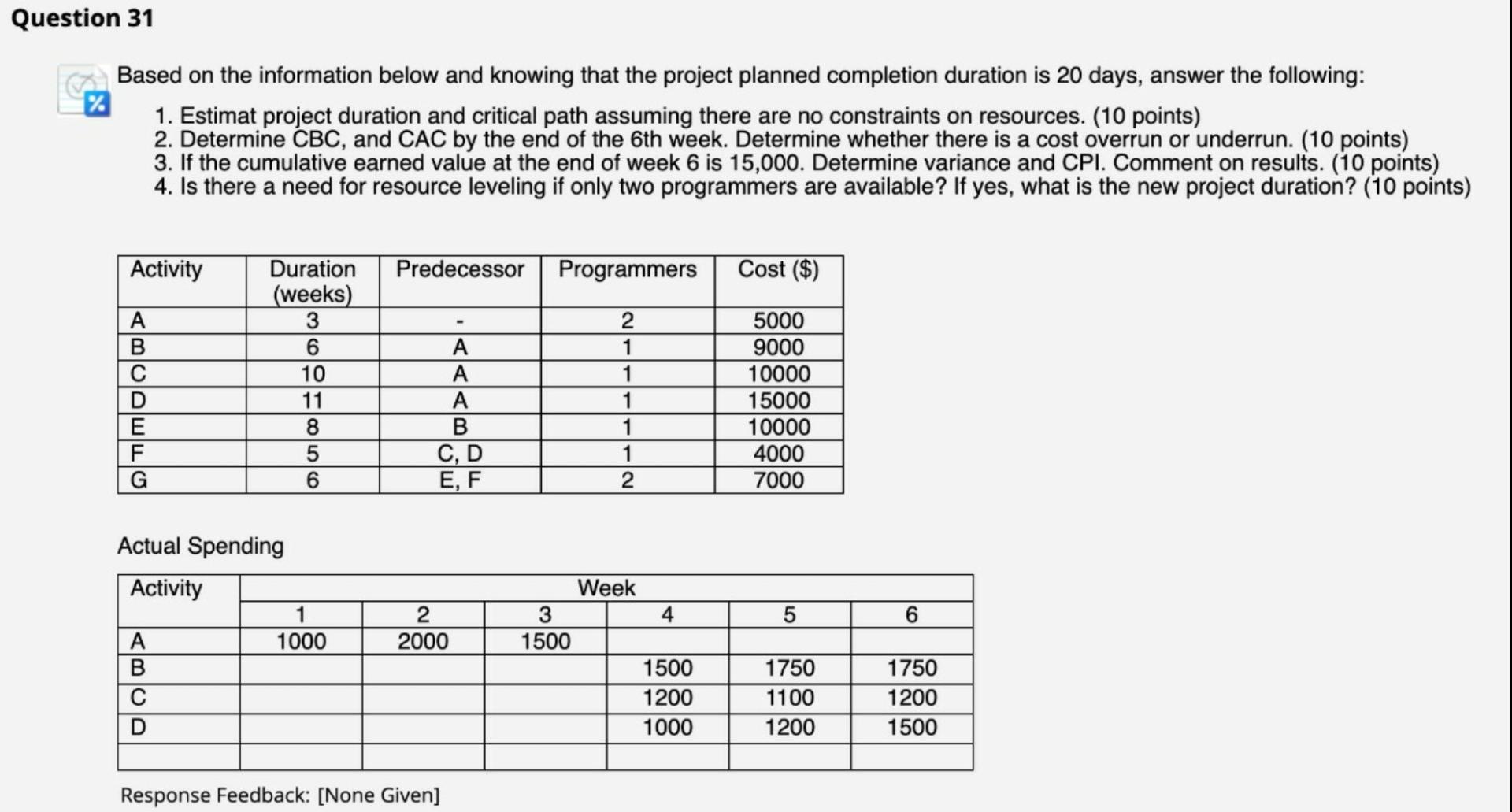
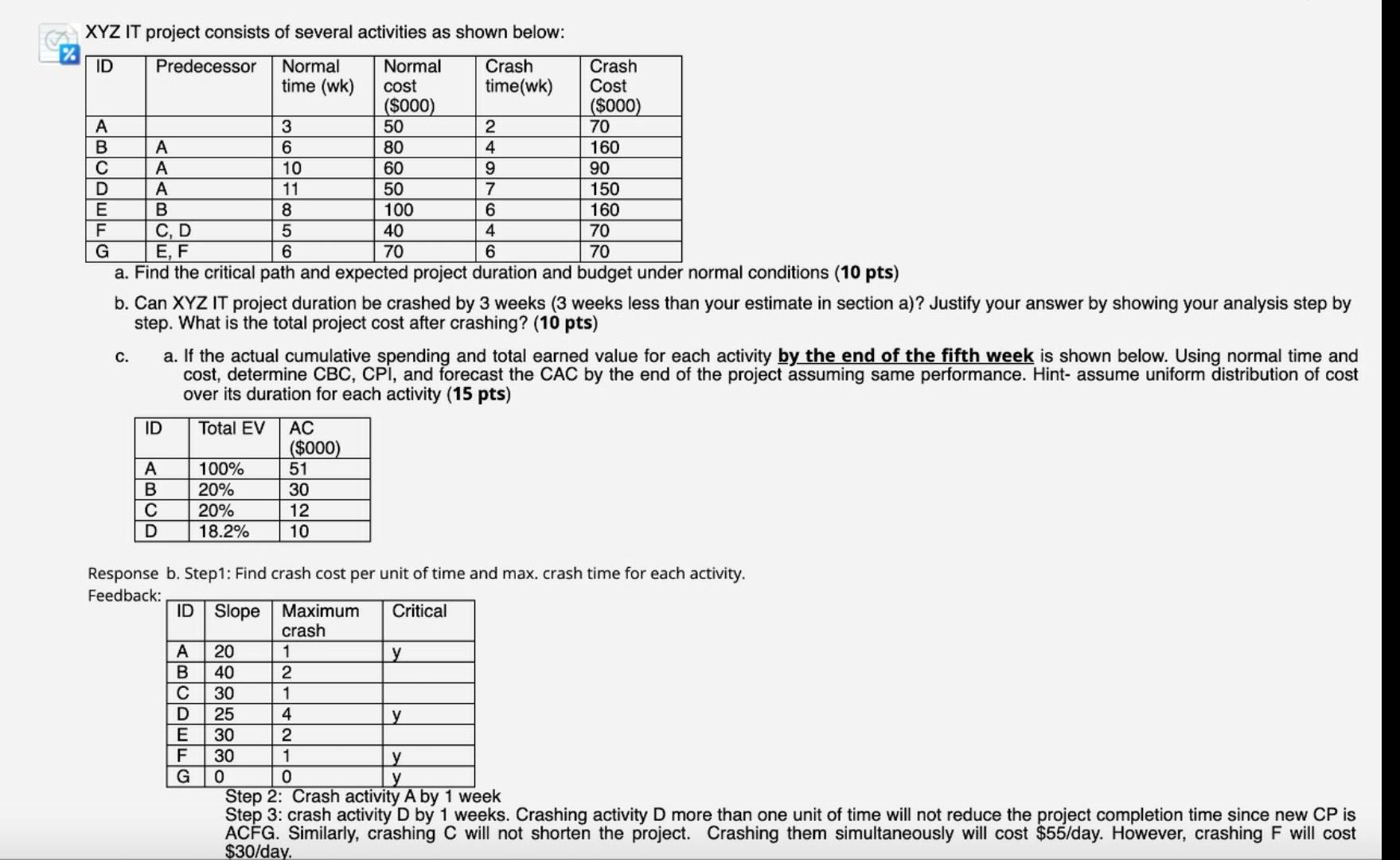
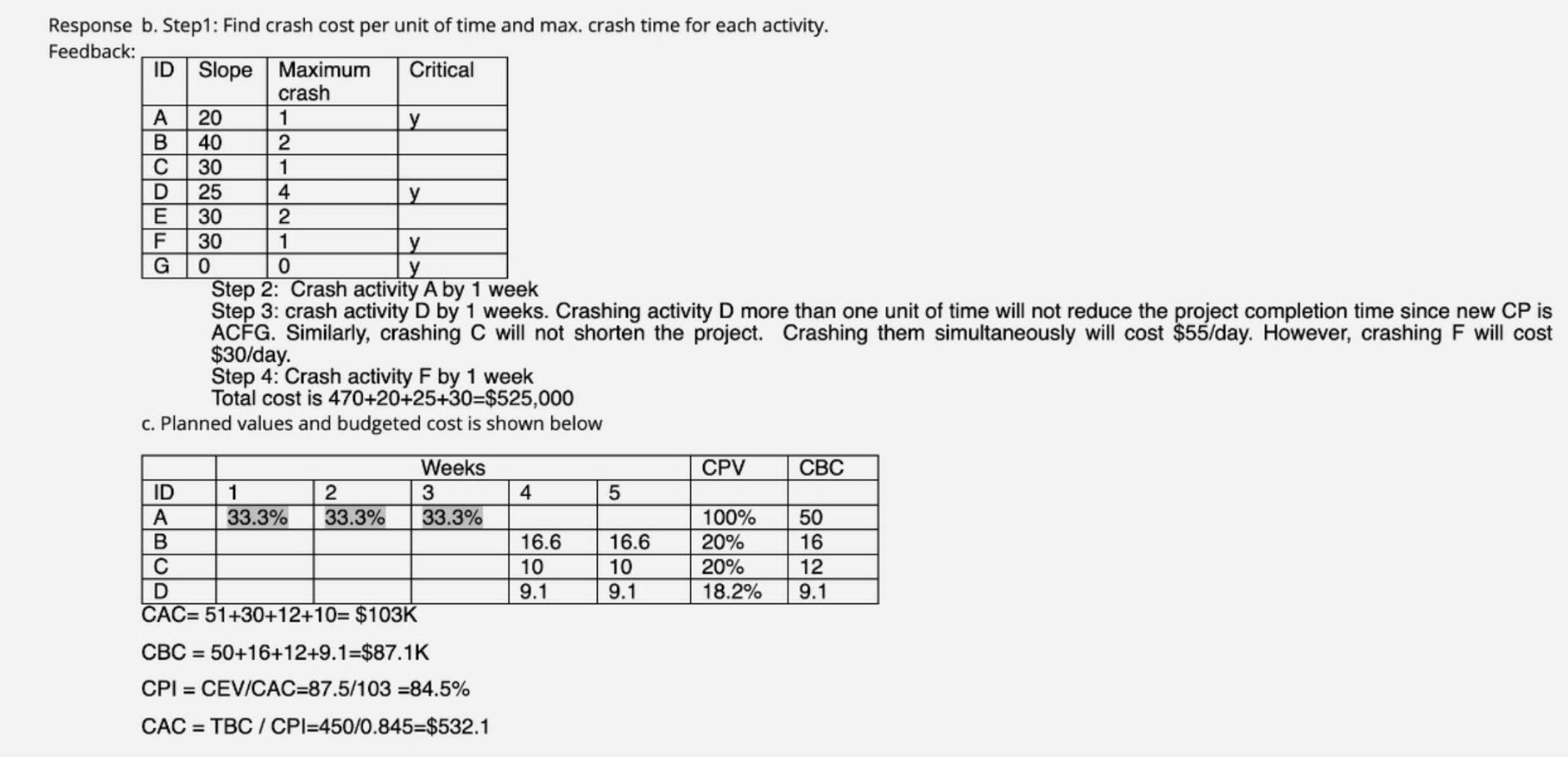
Question 31 % Based on the information below and knowing that the project planned completion duration is 20 days, answer the following: 1. Estimat project duration and critical path assuming there are no constraints on resources. (10 points) 2. Determine CBC, and CAC by the end of the 6th week. Determine whether there is a cost overrun or underrun. (10 points) 3. If the cumulative earned value at the end of week 6 is 15,000. Determine variance and CPI. Comment on results. (10 points) 4. Is there a need for resource leveling if only two programmers are available? If yes, what is the new project duration? (10 points) Activity Predecessor Programmers Cost ($) B C D Duration (weeks) 3 6 10 11 8 5 6 A B C D E, F 2 1 1 1 1 1 2 5000 9000 10000 15000 10000 4000 7000 F G Week 4 5 6 Actual Spending Activity 1 A 1000 B C D 2 2000 1500 1500 1200 1000 1750 1100 1200 1750 1200 1500 Response Feedback: [None Given] % Cost 2 XYZ IT project consists of several activities as shown below: ID Predecessor Normal Normal Crash Crash time (wk) cost time(wk) ($000) ($000) A 3 50 70 B 6 80 4 160 A 10 60 9 90 D A 11 50 7 150 E B 8 100 160 F C D 5 40 4 70 G E, F 6 70 70 a. Find the critical path and expected project duration and budget under normal conditions (10 pts) b. Can XYZ IT project duration be crashed by 3 weeks (3 weeks less than your estimate in section a)? Justify your answer by showing your analysis step by step. What is the total project cost after crashing? (10 pts) C. a. If the actual cumulative spending and total earned value for each activity by the end of the fifth week is shown below. Using normal time and cost, determine CBC, CPI, and forecast the CAC by the end of the project assuming same performance. Hint- assume uniform distribution of cost over its duration for each activity (15 pts) 6 6 ID Total EV A B D 100% 20% 20% 18.2% AC ($000) 51 30 12 10 Response b. Step1: Find crash cost per unit of time and max. crash time for each activity. Feedback: ID Slope Maximum Critical crash A 20 1 B 40 2 C 30 1 D 25 4 E 30 2 F 30 1 y G 0 0 y Step 2: Crash activity A by 1 week Step 3: crash activity D by 1 weeks. Crashing activity D more than one unit of time will not reduce the project completion time since new CP is ACFG. Similarly, crashing C will not shorten the project. Crashing them simultaneously will cost $55/day. However, crashing F will cost $30/day. Response b. Step1: Find crash cost per unit of time and max. crash time for each activity. Feedback: ID Slope Maximum Critical crash A 20 1 B 40 2 30 1 D 25 4 y E 30 2 F 30 1 G 0 0 y Step 2: Crash activity A by 1 week Step 3: crash activity D by 1 weeks. Crashing activity D more than one unit of time will not reduce the project completion time since new CP is ACFG. Similarly, crashing C will not shorten the project. Crashing them simultaneously will cost $55/day. However, crashing F will cost $30/day. Step 4: Crash activity F by 1 week Total cost is 470+20+25+30=$525,000 c. Planned values and budgeted cost is shown below CPV CBC 4 5 Weeks ID 1 2 3 33.3% 33.3% 33.3% B D CAC= 51+30+12+10= $103K 16.6 10 9.1 16.6 10 9.1 100% 20% 20% 18.2% 50 16 12 9.1 CBC = 50+16+12+9.1=$87.1K CPI = CEV/CAC=87.5/103 =84.5% CAC = TBCCPI=450/0.845=$532.1
Step by Step Solution
There are 3 Steps involved in it
1 Expert Approved Answer
Step: 1 Unlock

Question Has Been Solved by an Expert!
Get step-by-step solutions from verified subject matter experts
Step: 2 Unlock
Step: 3 Unlock
 Study Help