







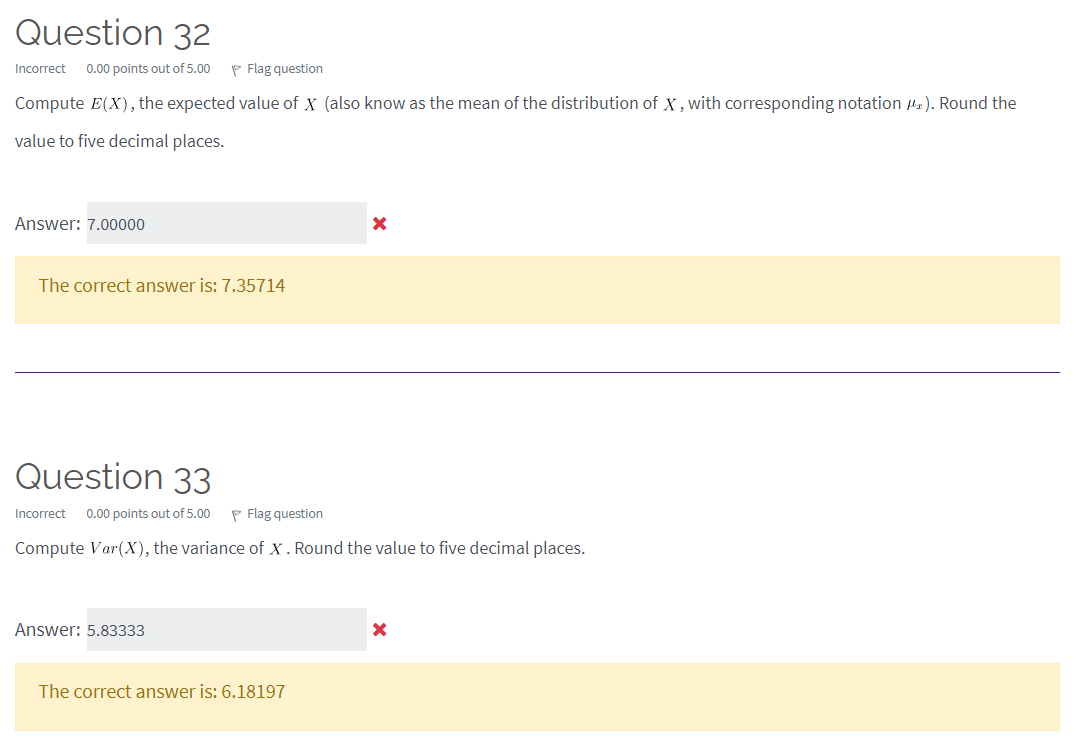
Question: Question 32 Incorrect 0.00 points out of5.00 v.57 Flag question Compute E{X} , the expected value of X {also know as the mean of the
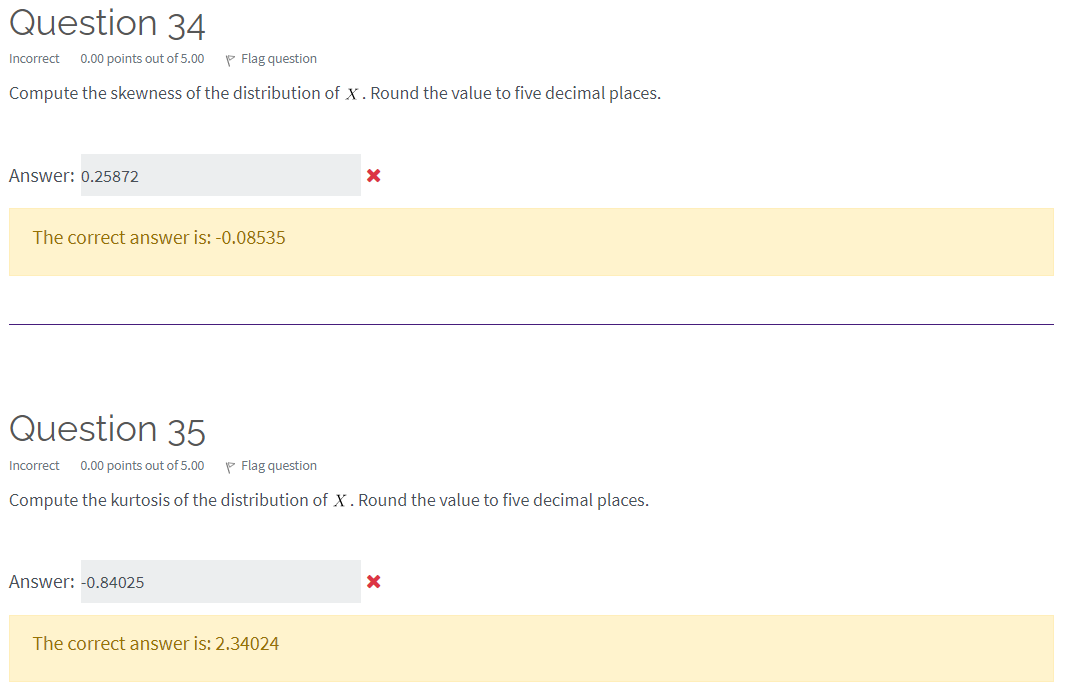
![Vav{X]I, the variance of X . Round the value to ve decimal](https://s3.amazonaws.com/si.experts.images/answers/2024/06/66781e50b1684_11266781e50a0a6d.jpg)
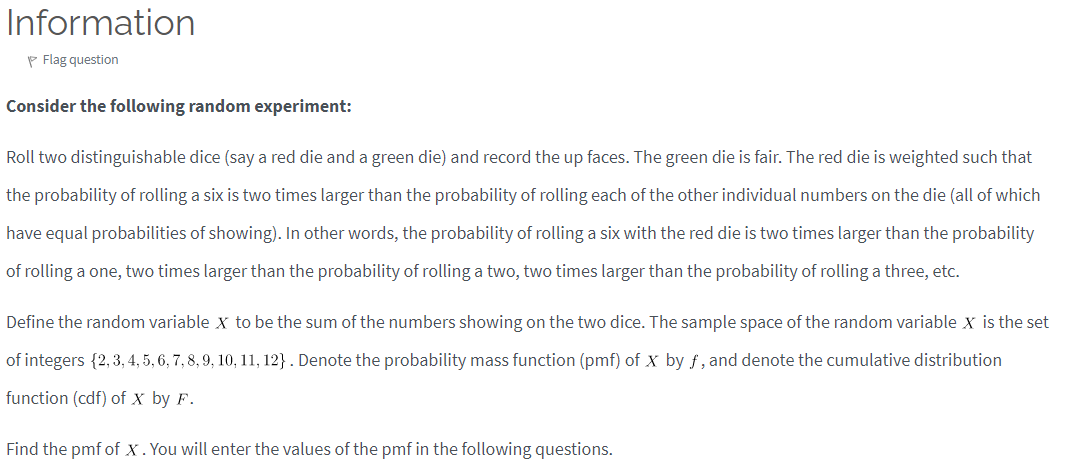
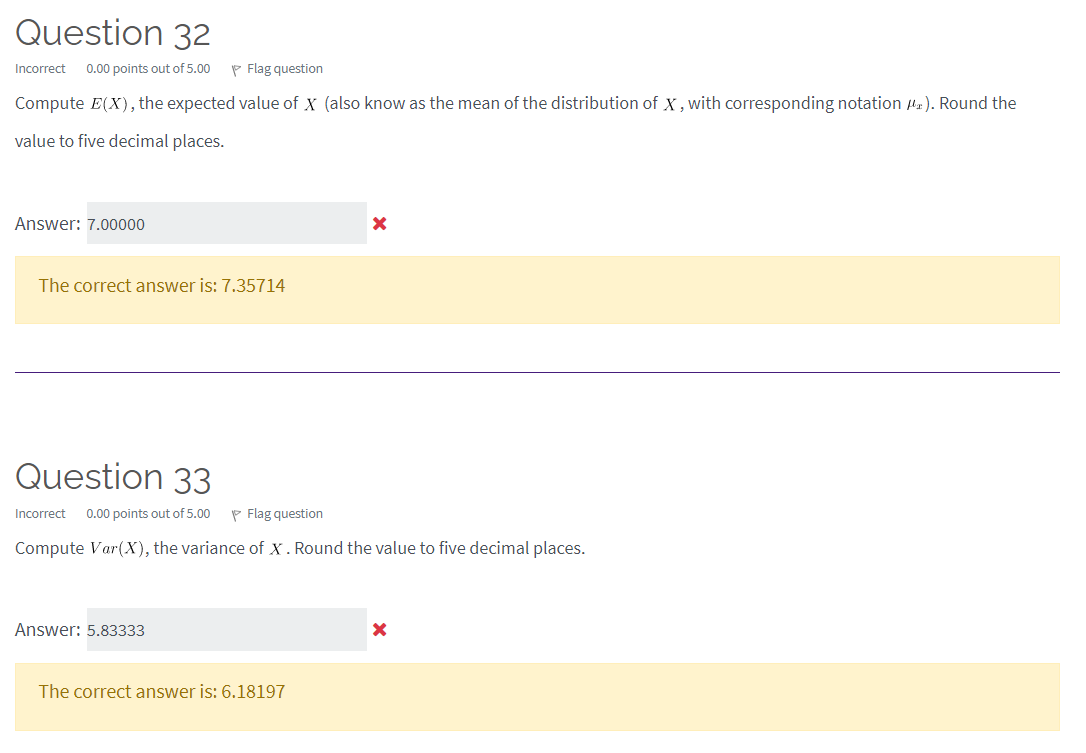
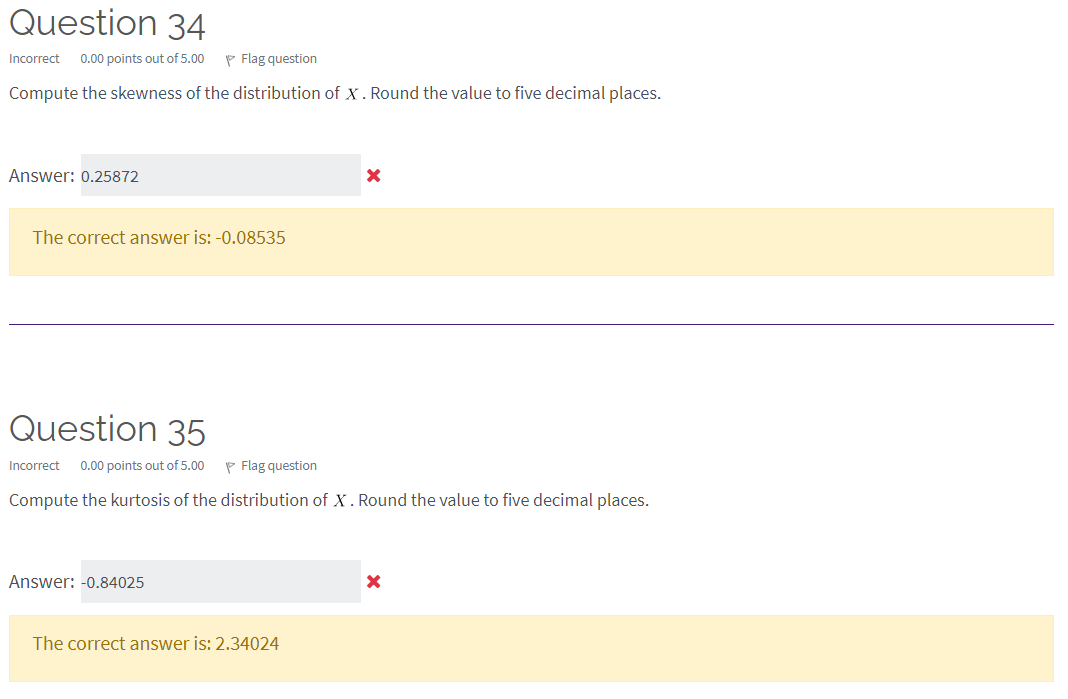
Question 32 Incorrect 0.00 points out of5.00 v.57 Flag question Compute E{X} , the expected value of X {also know as the mean of the distribution of X , with corresponding notation #1}. Round the value to ve decimal places. Answer: 7.00000 3' The correct answer is: 7.35714 Question 33 Incorrect 0.00 points out of5.00 1,57 Flag question Compute Vav{X]I, the variance of X . Round the value to ve decimal places. Answer: 5.83333 3' The correct answer is: 6.1819? Question 34 Incorrect 0.00 points out of 5.00 1? Flag question Compute the skewness of the distribution of X. Round the value to five decimal places. Answer: 0.25872 8 The correct answer is: 0.08535 Question 35 Incorrect 0.00 points out of 5.00 '5 Flag question Compute the ku rtosis of the distribution of X . Round the value to five decimal places. Answer: 4184025 8 The correct answer is: 2.34024 Information f- Flag question Consider the following random experiment: Roll two distinguishable dice {say a red die and a green die) and record the up faces. The green die is fair. The red die is weighted such that the probability of rolling a six is two times larger than the probability of rolling each ofthe other individual numbers on the die {all of which have equal probabilities ofshowing). In other words, the probability of rolling a six with the red die is two times la rger than the probability of rolling a one, two times larger than the probability of rolling a two, two times larger than the probability of rolling a three, etc. Dene the random variable X to be the sum of the numbers showing on the two dice. The sample space ofthe random variable X is the set of integers {2. 3,4. 5,6, 7', 8,9, 10, 11, 12} . Denote the probability mass function {pmf} of X by f, and denote the cumulative distribution function (cdf) of X by F. Find the pmf of X . You will enter the values of the pmf in the following questions
Step by Step Solution
There are 3 Steps involved in it

Get step-by-step solutions from verified subject matter experts
 Study Help