







Question: Question 4 (1 point) Given P(E) = 0.64, what is P(E')? Your Answer: Answer Question 5 (1 point) Given P(E) = 0.22, P(F) = 0.17,
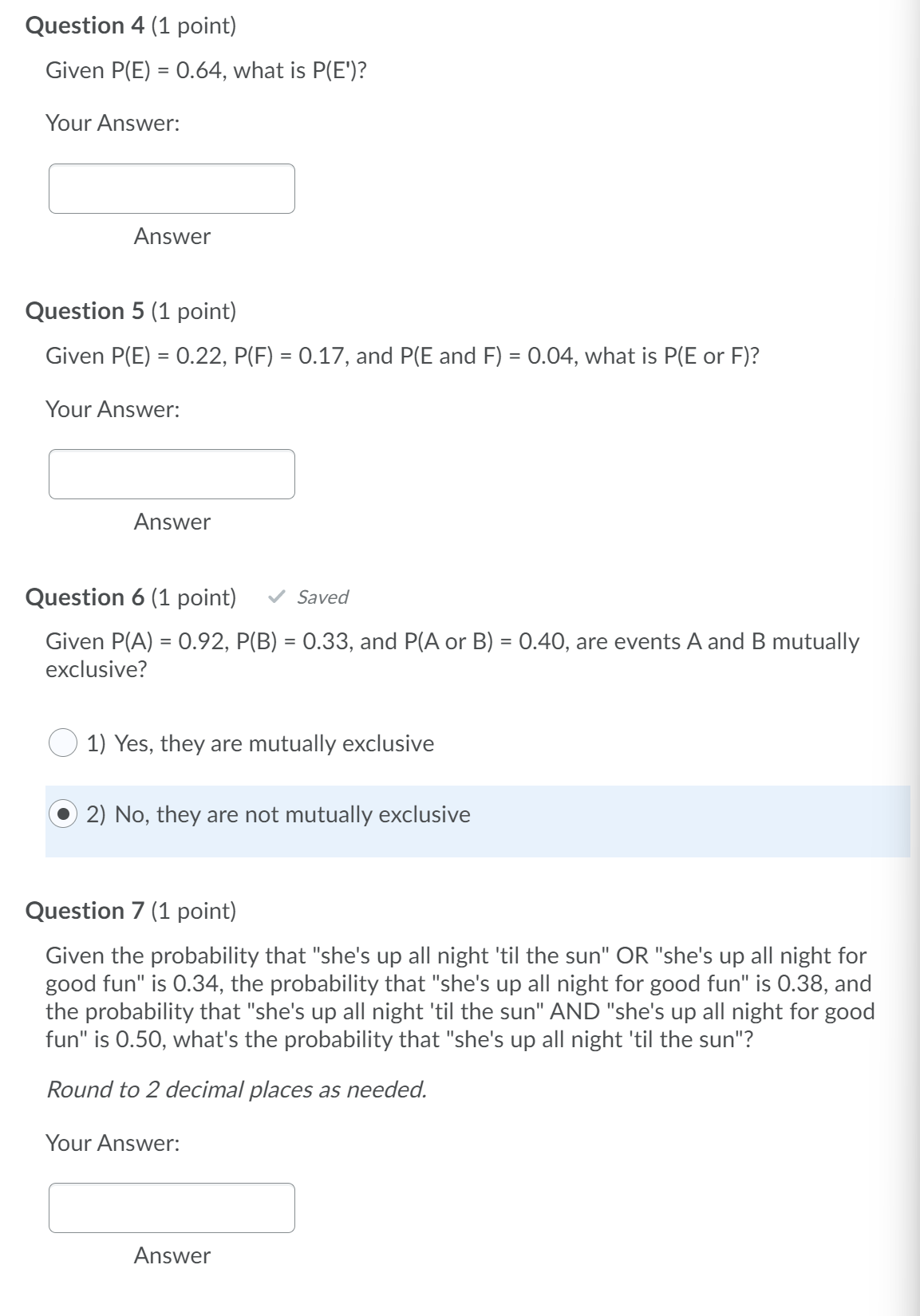
Question 4 (1 point) Given P(E) = 0.64, what is P(E')? Your Answer: Answer Question 5 (1 point) Given P(E) = 0.22, P(F) = 0.17, and P(E and F) = 0.04, what is P(E or F)? Your Answer: Answer Question 6 (1 point) v Saved Given P(A) = 0.92, P(B) = 0.33, and P(A or B) = 0.40, are events A and B mutually exclusive? 0 1) Yes, they are mutually exclusive 6) 2) No, they are not mutually exclusive Question 7 (1 point) Given the probability that "she's up all night 'til the sun" OR "she's up all night for good fun" is 0.34, the probability that "she's up all night for good fun" is 0.38, and the probability that "she's up all night 'til the sun" AND "she's up all night for good fun" is 0.50, what's the probability that "she's up all night 'til the sun\"? Round to 2 decimal places as needed. Your
Step by Step Solution
There are 3 Steps involved in it

Get step-by-step solutions from verified subject matter experts
 Study Help