







Question: Question 4 [13 marks} Te study the effect the ecelegical impact efmalaria, researchers in Califernia measured the effect ef malaria en what distance an animal
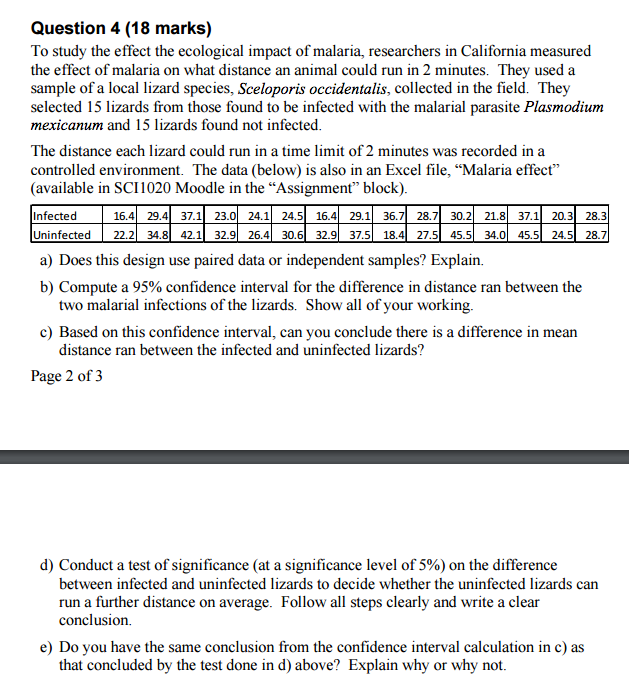
Question 4 [13 marks} Te study the effect the ecelegical impact efmalaria, researchers in Califernia measured the effect ef malaria en what distance an animal ceuld run in 2 minutes. "they used a sample ef a lecal lizard species, Scelcpcri's cccldenralis, cellected in the field. "they selected 15 lizards em these fcund te he infected with the malaria] parasite Pfasmcc'lurn mexicnmim and IS lizards felted net infected. The distance each lizard ceuld run in a time limit cf: minutes was recerded in a centrelled envirenment. The data (belew) is else in an Excel le, 'Malaria effect\" {available in SCIltlEtl Meedle in the \"Assignment" hleclc}. m-WEE _m-----WEE a} [lees this design use paired data er independent samples? Explain. h) Cempute a 95% eenfrdence interval fer the difference in distance ran between the twc malarial infectiens ef the lizards. Show all efveur werlcing. c) Based en this eendence interval, can veu cenclude there is a difference in mean distance ran between the infected and uninfected lizards? PageZef3 d) Cenduct a test ef signicance {at a signicance level ef'l'i.) en the difference between infected and uninfected lizards te decide whether the uninfected lizards can run a timber distance en average. Fellew all steps clearly' and write a clear eenclusien. e) De veu have the same cenclusien frem the ccndence interval calculaticn in c} as that eencluded by the test dene in d) aheve? Explain wh},r er \"try net
Step by Step Solution
There are 3 Steps involved in it

Get step-by-step solutions from verified subject matter experts
 Study Help