







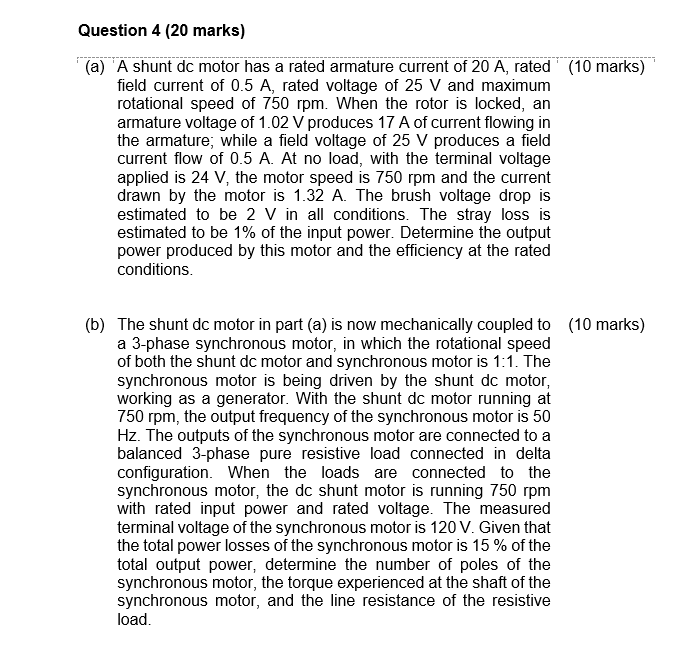
Question: Question 4 ( 2 0 marks ) ( a ) A shunt dc motor has a rated armature current of 2 0 A , rated
Question marks
a A shunt dc motor has a rated armature current of A rated
marks field current of A rated voltage of V and maximum rotational speed of rpm When the rotor is locked, an armature voltage of V produces A of current flowing in the armature; while a field voltage of V produces a field current flow of A At no load, with the terminal voltage applied is V the motor speed is rpm and the current drawn by the motor is A The brush voltage drop is estimated to be V in all conditions. The stray loss is estimated to be of the input power. Determine the output power produced by this motor and the efficiency at the rated conditions.
b The shunt dc motor in part a is now mechanically coupled to
a phase synchronous motor, in which the rotational speed of both the shunt dc motor and synchronous motor is : The synchronous motor is being driven by the shunt dc motor, working as a generator. With the shunt dc motor running at rpm the output frequency of the synchronous motor is Hz The outputs of the synchronous motor are connected to a balanced phase pure resistive load connected in delta configuration. When the loads are connected to the synchronous motor, the dc shunt motor is running rpm with rated input power and rated voltage. The measured terminal voltage of the synchronous motor is V Given that the total power losses of the synchronous motor is of the total output power, determine the number of poles of the synchronous motor, the torque experienced at the shaft of the synchronous motor, and the line resistance of the resistive load.
Step by Step Solution
There are 3 Steps involved in it
1 Expert Approved Answer
Step: 1 Unlock

Question Has Been Solved by an Expert!
Get step-by-step solutions from verified subject matter experts
Step: 2 Unlock
Step: 3 Unlock
 Study Help