







Question: Question 4: (20 points) A company needs to plan the warehouse for over the next 5 months. The demand for each month is given as
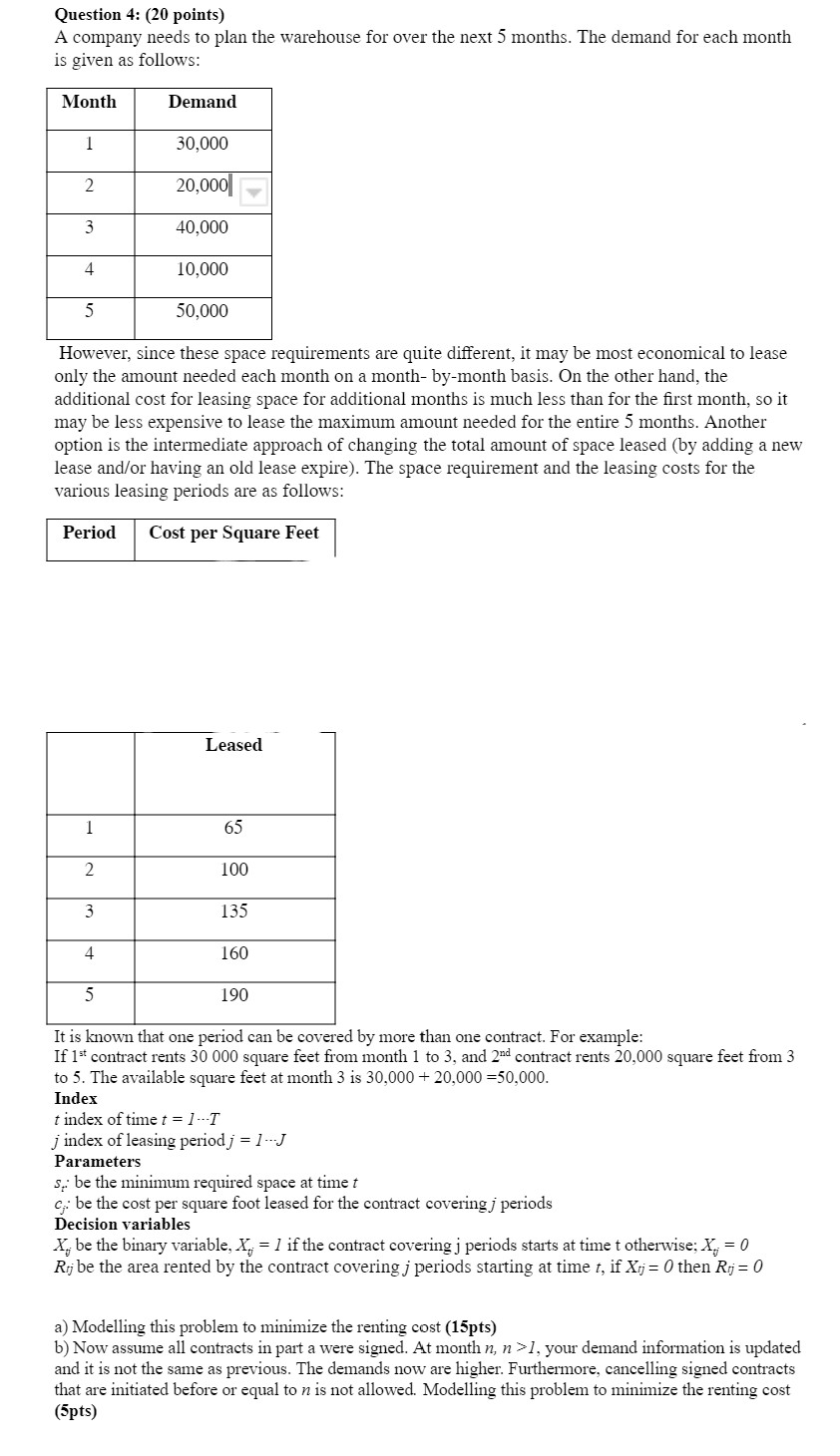
Question 4: (20 points) A company needs to plan the warehouse for over the next 5 months. The demand for each month is given as follows: Month Demand 1 30,000 2 20,000 3 40,000 4 10,000 5 50,000 However, since these space requirements are quite different, it may be most economical to lease only the amount needed each month on a month-by-month basis. On the other hand, the additional cost for leasing space for additional months is much less than for the first month, so it may be less expensive to lease the maximum amount needed for the entire 5 months. Another option is the intermediate approach of changing the total amount of space leased (by adding a new lease and/or having an old lease expire). The space requirement and the leasing costs for the various leasing periods are as follows: Period Cost per Square Feet Leased 1 65 2 100 3 135 4 160 5 190 It is known that one period can be covered by more than one contract. For example: If 1* contract rents 30 000 square feet from month 1 to 3, and 2nd contract rents 20,000 square feet from 3 to 5. The available square feet at month 3 is 30,000+ 20,000 =50,000. Index t index of time t = 1.T j index of leasing period j = 1-) Parameters so be the minimum required space at timet c;: be the cost per square foot leased for the contract covering i periods Decision variables X, be the binary variable, X = 1 if the contract covering i periods starts at time t otherwise; X, = 0 Rrj be the area rented by the contract covering i periods starting at time t, if Xrj = 0 then Rij = 0 a) Modelling this problem to minimize the renting cost (15pts) b) Now assume all contracts in part a were signed. At month n, n>), your demand information is updated and it is not the same as previous. The demands now are higher. Furthermore, cancelling signed contracts that are initiated before or equal to n is not allowed. Modelling this problem to minimize the renting cost (5pts) Question 4: (20 points) A company needs to plan the warehouse for over the next 5 months. The demand for each month is given as follows: Month Demand 1 30,000 2 20,000 3 40,000 4 10,000 5 50,000 However, since these space requirements are quite different, it may be most economical to lease only the amount needed each month on a month-by-month basis. On the other hand, the additional cost for leasing space for additional months is much less than for the first month, so it may be less expensive to lease the maximum amount needed for the entire 5 months. Another option is the intermediate approach of changing the total amount of space leased (by adding a new lease and/or having an old lease expire). The space requirement and the leasing costs for the various leasing periods are as follows: Period Cost per Square Feet Leased 1 65 2 100 3 135 4 160 5 190 It is known that one period can be covered by more than one contract. For example: If 1* contract rents 30 000 square feet from month 1 to 3, and 2nd contract rents 20,000 square feet from 3 to 5. The available square feet at month 3 is 30,000+ 20,000 =50,000. Index t index of time t = 1.T j index of leasing period j = 1-) Parameters so be the minimum required space at timet c;: be the cost per square foot leased for the contract covering i periods Decision variables X, be the binary variable, X = 1 if the contract covering i periods starts at time t otherwise; X, = 0 Rrj be the area rented by the contract covering i periods starting at time t, if Xrj = 0 then Rij = 0 a) Modelling this problem to minimize the renting cost (15pts) b) Now assume all contracts in part a were signed. At month n, n>), your demand information is updated and it is not the same as previous. The demands now are higher. Furthermore, cancelling signed contracts that are initiated before or equal to n is not allowed. Modelling this problem to minimize the renting cost (5pts)
Step by Step Solution
There are 3 Steps involved in it

Get step-by-step solutions from verified subject matter experts
 Study Help