







Question: Question 4 and 5 please QUALITY IN PRACTICE IMPROVING PATIENT SERVICES AT MIDDLETOWN REGIONAL HOSPITAL? REMU TMR Site Middletown Regional Hospital (MRH) is a licensed
Question 4 and 5 please
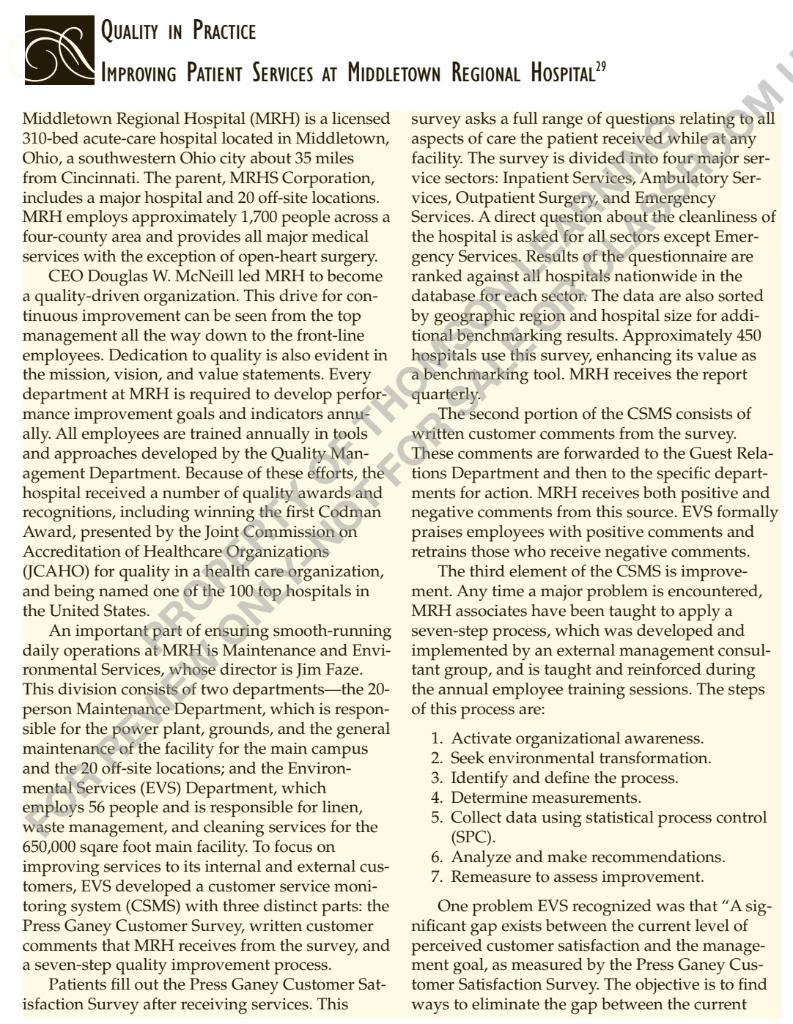
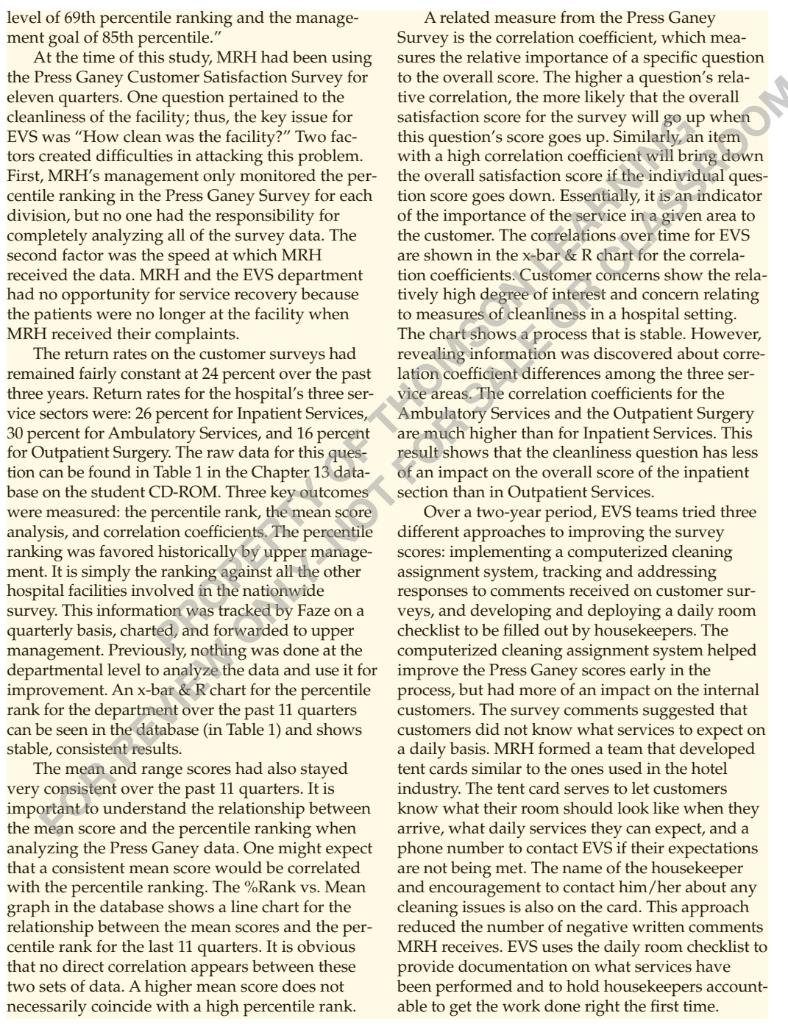
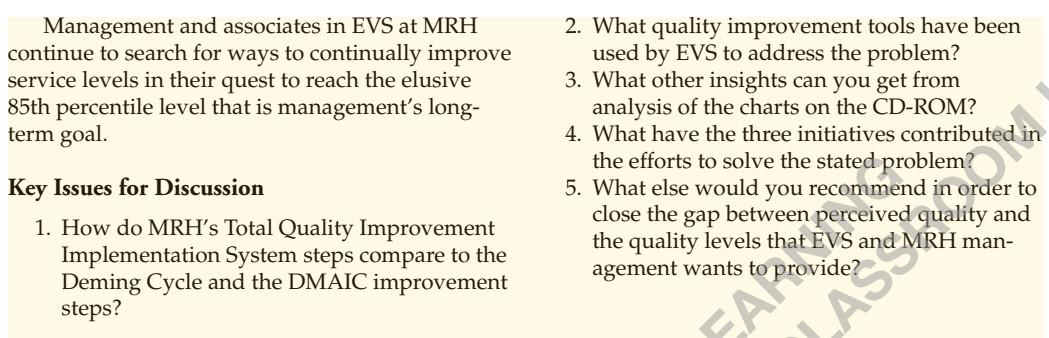
QUALITY IN PRACTICE IMPROVING PATIENT SERVICES AT MIDDLETOWN REGIONAL HOSPITAL? REMU TMR Site Middletown Regional Hospital (MRH) is a licensed survey asks a full range of questions relating to all 310-bed acute-care hospital located in Middletown, aspects of care the patient received while at any Ohio, a southwestern Ohio city about 35 miles facility. The survey is divided into four major ser- from Cincinnati. The parent, MRHS Corporation, vice sectors: Inpatient Services, Ambulatory Ser- includes a major hospital and 20 off-site locations. vices, Outpatient Surgery, and Emergency MRH employs approximately 1,700 people across a Services. A direct question about the cleanliness of four-county area and provides all major medical the hospital is asked for all sectors except Emer- services with the exception of open-heart surgery. gency Services. Results of the questionnaire are CEO Douglas W. McNeill led MRH to become ranked against all hospitals nationwide in the a quality-driven organization. This drive for con- database for each sector. The data are also sorted tinuous improvement can be seen from the top by geographic region and hospital size for addi- management all the way down to the front-line tional benchmarking results. Approximately 450 employees. Dedication to quality is also evident in hospitals use this survey, enhancing its value as the mission, vision, and value statements. Every a benchmarking tool. MRH receives the report department at MRH is required to develop perfor- quarterly. mance improvement goals and indicators annu- The second portion of the CSMS consists of ally. All employees are trained annually in tools written customer comments from the survey. These comments are forwarded to the Guest Rela- agement Department. Because of these efforts, the tions Department and then to the specific depart- hospital received a number of quality awards and ments for action. MRH receives both positive and recognitions, including winning the first Codman negative comments from this source. EVS formally Award, presented by the Joint Commission on praises employees with positive comments and Accreditation of Healthcare Organizations retrains those who receive negative comments. JCAHO) for quality in a health care organization, The third element of the CSMS is improve- and being named one of the 100 top hospitals in ment. Any time a major problem is encountered, the United States. MRH associates have been taught to apply a An important part of ensuring smooth-running seven-step process, which was developed and daily operations at MRH is Maintenance and Envi- implemented by an external management consul- ronmental Services, whose director is Jim Faze. tant group, and is taught and reinforced during This division consists of two departmentsthe 20- the annual employee training sessions. The steps person Maintenance Department, which is respon- of this process are: sible for the power plant, grounds, and the general maintenance of the facility for the main campus 1. Activate organizational awareness. 2. Seek environmental transformation. and the 20 off-site locations, and the Environ- 3. Identify and define the process. mental Services (EVS) Department, which 4. Determine measurements. employs 56 people and is responsible for linen, 5. Collect data using statistical process control waste management, and cleaning services for the (SPC). 650,000 sqare foot main facility. To focus on 6. Analyze and make recommendations. improving services to its internal and external cus- 7. Remeasure to assess improvement. tomers, EVS developed a customer service moni- toring system (CSMS) with three distinct parts: the One problem EVS recognized was that "A sig- Press Ganey Customer Survey, written customer nificant gap exists between the current level of comments that MRH receives from the survey, and perceived customer satisfaction and the manage- a seven-step quality improvement process. ment goal, as measured by the Press Ganey Cus- Patients fill out the Press Ganey Customer Sat- tomer Satisfaction Survey. The objective is to find isfaction Survey after receiving services. This ways to eliminate the gap between the current OM level of 69th percentile ranking and the manage- A related measure from the Press Ganey ment goal of 85th percentile." Survey is the correlation coefficient, which mea- At the time of this study, MRH had been using sures the relative importance of a specific question the Press Ganey Customer Satisfaction Survey for to the overall score. The higher a question's rela- eleven quarters. One question pertained to the tive correlation, the more likely that the overall cleanliness of the facility; thus, the key issue for satisfaction score for the survey will go up when EVS was "How clean was the facility?" Two fac- this question's score goes up. Similarly, an item tors created difficulties in attacking this problem. with a high correlation coefficient will bring down First, MRH's management only monitored the per- the overall satisfaction score if the individual ques- centile ranking in the Press Ganey Survey for each tion score goes down. Essentially, it is an indicator division, but no one had the responsibility for of the importance of the service in a given area to completely analyzing all of the survey data. The the customer. The correlations over time for EVS second factor was the speed at which MRH are shown in the x-bar & R chart for the correla- received the data. MRH and the EVS department tion coefficients. Customer concerns show the rela- had no opportunity for service recovery because tively high degree of interest and concern relating the patients were no longer at the facility when to measures of cleanliness in a hospital setting. MRH received their complaints. The chart shows a process that is stable. However, The return rates on the customer surveys had revealing information was discovered about corre- remained fairly constant at 24 percent over the past lation coefficient differences among the three ser- three years. Return rates for the hospital's three ser- vice areas. The correlation coefficients for the vice sectors were: 26 percent for Inpatient Services, Ambulatory Services and the Outpatient Surgery 30 percent for Ambulatory Services, and 16 percent are much higher than for Inpatient Services. This for Outpatient Surgery. The raw data for this ques- result shows that the cleanliness question has less tion can be found in Table 1 in the Chapter 13 data- of an impact on the overall score of the inpatient base on the student CD-ROM. Three key outcomes section than in Outpatient Services. were measured: the percentile rank, the mean score Over a two-year period, EVS teams tried three analysis, and correlation coefficients. The percentile different approaches to improving the survey ranking was favored historically by upper manage- scores: implementing a computerized cleaning ment. It is simply the ranking against all the other assignment system, tracking and addressing hospital facilities involved in the nationwide responses to comments received on customer sur- survey. This information was tracked by Faze on a veys, and developing and deploying a daily room quarterly basis, charted, and forwarded to upper checklist to be filled out by housekeepers. The management. Previously, nothing was done at the computerized cleaning assignment system helped departmental level to analyze the data and use it for improve the Press Ganey scores early in the improvement. An x-bar & R chart for the percentile process, but had more of an impact on the internal rank for the department over the past 11 quarters customers. The survey comments suggested that can be seen in the database (in Table 1) and shows customers did not know what services to expect on stable, consistent results. a daily basis. MRH formed a team that developed The mean and range scores had also stayed tent cards similar to the ones used in the hotel very consistent over the past 11 quarters. It is industry. The tent card serves to let customers important to understand the relationship between know what their room should look like when they the mean score and the percentile ranking when arrive, what daily services they can expect, and a analyzing the Press Ganey data. One might expect phone number to contact EVS if their expectations that a consistent mean score would be correlated are not being met. The name of the housekeeper with the percentile ranking. The %Rank vs. Mean and encouragement to contact him/her about any graph in the database shows a line chart for the cleaning issues is also on the card. This approach relationship between the mean scores and the per- reduced the number of negative written comments centile rank for the last 11 quarters. It is obvious MRH receives. EVS uses the daily room checklist to that no direct correlation appears between these provide documentation on what services have two sets of data. A higher mean score does not been performed and to hold housekeepers account- necessarily coincide with a high percentile rank. able to get the work done right the first time. Management and associates in EVS at MRH continue to search for ways to continually improve service levels in their quest to reach the elusive 85th percentile level that is management's long- term goal. 2. What quality improvement tools have been used by EVS to address the problem? 3. What other insights can you get from analysis of the charts on the CD-ROM? 4. What have the three initiatives contributed in the efforts to solve the stated problem? 5. What else would you recommend in order to close the gap between 2 perceived A quality and the quality levels that EVS and MRH man- agement wants to Key Issues for Discussion 1. How do MRH's Total Quality Improvement Implementation System steps compare to the Deming Cycle and the DMAIC improvement steps? FAMILIE ASSStep by Step Solution
There are 3 Steps involved in it
1 Expert Approved Answer
Step: 1 Unlock

Question Has Been Solved by an Expert!
Get step-by-step solutions from verified subject matter experts
Step: 2 Unlock
Step: 3 Unlock
 Study Help