



Question: Question 4. Consider a modified version of Glosten & Milgrom's Bid-Ask model: Two dates, t = 0, 1. A trade occurs at t = 0,
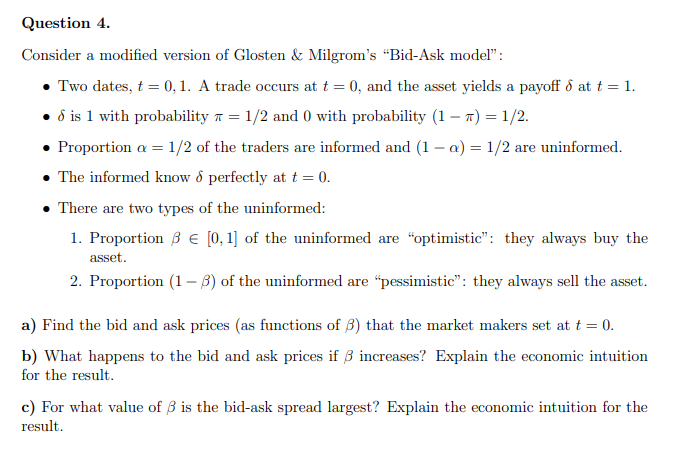
Question 4. Consider a modified version of Glosten & Milgrom's "Bid-Ask model": Two dates, t = 0, 1. A trade occurs at t = 0, and the asset yields a payoff dat t = 1. 8 is 1 with probability = 1/2 and 0 with probability (1 ) = 1/2. Proportion a = 1/2 of the traders are informed and (1-a) = 1/2 are uninformed. The informed know & perfectly at t = 0. There are two types of the uninformed: 1. Proportion 8 [0, 1] of the uninformed are "optimistic": they always buy the asset. 2. Proportion (1-3) of the uninformed are "pessimistic": they always sell the asset. a) Find the bid and ask prices (as functions of 3) that the market makers set at t = 0. b) What happens to the bid and ask prices if 8 increases? Explain the economic intuition for the result. c) For what value of is the bid-ask spread largest? Explain the economic intuition for the result. Question 4. Consider a modified version of Glosten & Milgrom's "Bid-Ask model": Two dates, t = 0, 1. A trade occurs at t = 0, and the asset yields a payoff dat t = 1. 8 is 1 with probability = 1/2 and 0 with probability (1 ) = 1/2. Proportion a = 1/2 of the traders are informed and (1-a) = 1/2 are uninformed. The informed know & perfectly at t = 0. There are two types of the uninformed: 1. Proportion 8 [0, 1] of the uninformed are "optimistic": they always buy the asset. 2. Proportion (1-3) of the uninformed are "pessimistic": they always sell the asset. a) Find the bid and ask prices (as functions of 3) that the market makers set at t = 0. b) What happens to the bid and ask prices if 8 increases? Explain the economic intuition for the result. c) For what value of is the bid-ask spread largest? Explain the economic intuition for the result
Step by Step Solution
There are 3 Steps involved in it

Get step-by-step solutions from verified subject matter experts