







Question: Question 4 For this question you can either answer option 1 or option 2 depending on what you studied in the course. You should not
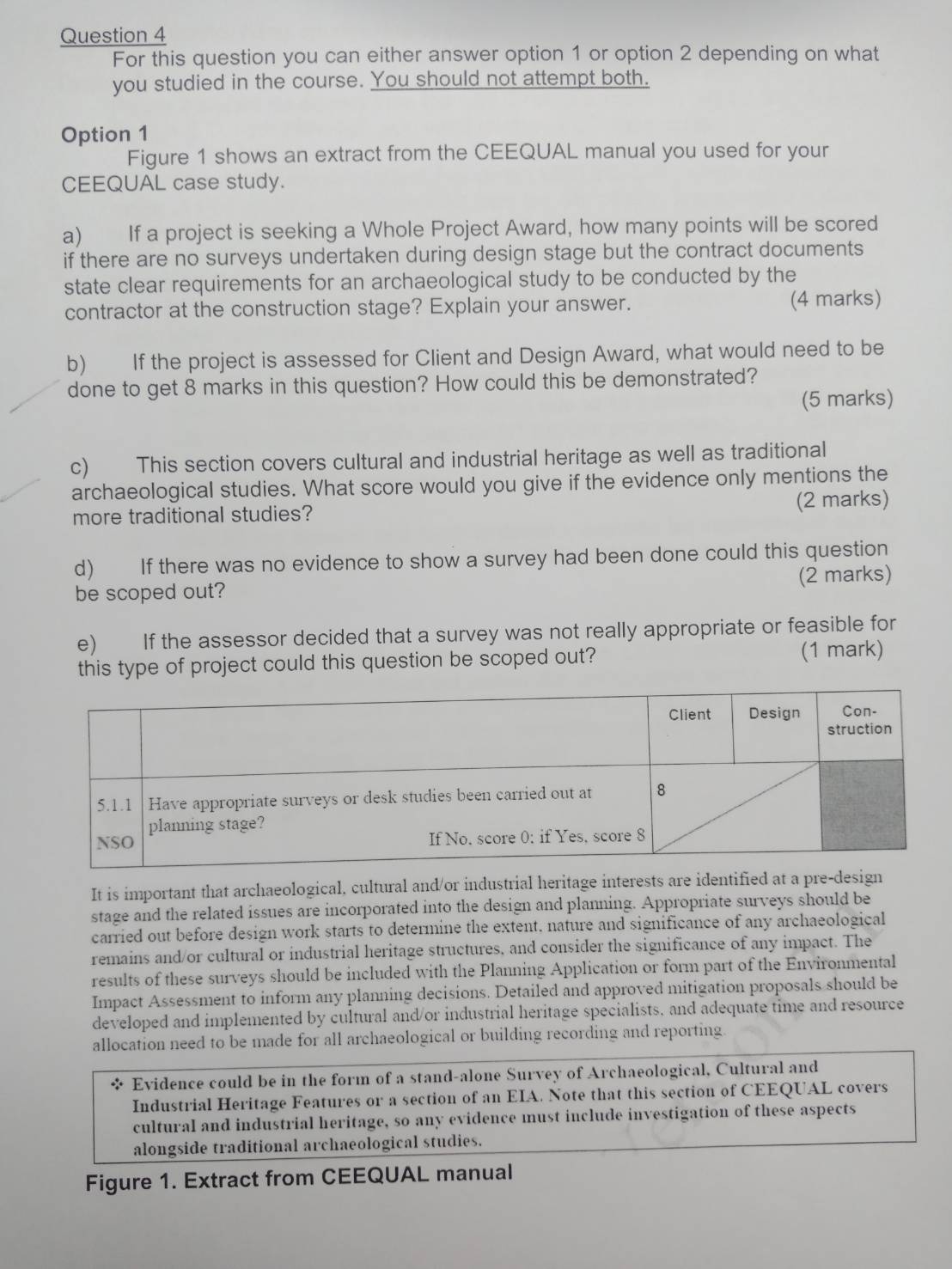
Question 4 For this question you can either answer option 1 or option 2 depending on what you studied in the course. You should not attempt both. Option 1 Figure 1 shows an extract from the CEEQUAL manual you used for your CEEQUAL case study. a) If a project is seeking a Whole Project Award, how many points will be scored if there are no surveys undertaken during design stage but the contract documents state clear requirements for an archaeological study to be conducted by the contractor at the construction stage? Explain your answer. (4 marks) b ) If the project is assessed for Client and Design Award, what would need to be done to get 8 marks in this question? How could this be demonstrated? (5 marks) C ) This section covers cultural and industrial heritage as well as traditional archaeological studies. What score would you give if the evidence only mentions the more traditional studies? (2 marks) d) If there was no evidence to show a survey had been done could this question be scoped out? (2 marks) e) If the assessor decided that a survey was not really appropriate or feasible for this type of project could this question be scoped out? (1 mark) Client Design Con struction 5.1.1 Have appropriate surveys or desk studies been carried out at 8 planning stage? NSO If No. score 0: if Yes, score 8 It is important that archaeological. cultural and/ or industrial heritage interests are identified at a pre-design stage and the related issues are incorporated into the design and planning. Appropriate surveys should be carried out before design work starts to determine the extent. nature and significance of any archaeological remains and/or cultural or industrial heritage structures, and consider the significance of any impact. The results of these surveys should be included with the Planning Application or form part of the Environmental Impact Assessment to inform any planning decisions. Detailed and approved mitigation proposals should be developed and implemented by cultural and or industrial heritage specialists. and adequate time and resource allocation need to be made for all archaeological or building recording and reporting Evidence could be in the form of a stand-alone Survey of Archaeological, Cultural and Industrial Heritage Features or a section of an ELA. Note that this section of CEEQUAL covers cultural and industrial heritage, so any evidence must include investigation of these aspects alongside traditional archaeological studies. Figure 1. Extract from CEEQUAL manual
Step by Step Solution
There are 3 Steps involved in it

Get step-by-step solutions from verified subject matter experts
 Study Help