







Question: Question 4 - Hypothesis Testing [16 pts.] A study was conducted to see whether maternal smoking was associated with the birth weight. There are 700
![Question 4 - Hypothesis Testing [16 pts.] A study was conducted](https://dsd5zvtm8ll6.cloudfront.net/si.experts.images/questions/2024/09/66f50c0017811_42366f50bff83a1f.jpg)
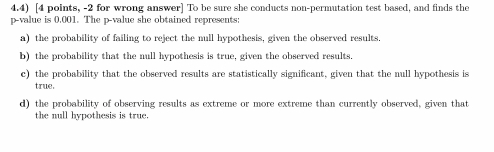
Question 4 - Hypothesis Testing [16 pts.] A study was conducted to see whether maternal smoking was associated with the birth weight. There are 700 non-smokers among the women in the sample and 450 smokers. Two hypothesis are as follows: Null hypothesis: In the population, the distribution of birth weights of babies is the same for mothers who don't smoke as for mothers who do. The difference in the sample is due to chance. Alternative hypothesis: In the population, the babies of the mothers who smoke have a lower birth weight, on average, than the babies of the non-smokers, 4.1) (1 points, -2 for wrong answer] Which of the following is the most appropriate test? a) a paired, two-sided test b) a paired, one-sided test c) a two independent sample, one-sided test d) a two independent sample, one-sided test e) none, 4.2) (4 points, -2 for wrong answer] The researcher set the significance level = 0.05. The level of significance is the probability a) that the alternative hypothesis is true. b) that the null hypothesis is true. c) of not rejecting a true mull hypothesis. d) of rejecting a true null hypothesis. 4.3) (4 points, -2 for wrong answer) The test statistic is the difference between the average weight of the smoking group - the average weight of the non-smoking group. The observed test statistic was -500 grams. The researcher performs a statistical a permutation test with 1000 samplings and calculate the p-value as 0.000001. At a significance level a = 0.05, a) you will reject the null b) you will fail to reject the null. c) you will think that a mistake must have occurred in calculation. d) cannot tell 4.4) (4 points, -2 for wrong answer) To be sure she conducts non-permutation test based, and finds the p-value is 0.001. The p-value she obtained represents: a) the probability of failing to reject the mill hypothesis, given the observed results. b) the probability that the null hypothesis is true, given the observed results. c) the probability that the observed results are statistically significant, given that the null hypothesis is true. d) the probability of observing results as extreme or more extreme than currently observed, given that the mull hypothesis is true
Step by Step Solution
There are 3 Steps involved in it

Get step-by-step solutions from verified subject matter experts
 Study Help