







Question: Question 4 - Join Implementation This problem will explore different join implementations and the associated IO costs for each model. Let R(a,b),S(b,c), and T(c,d) be
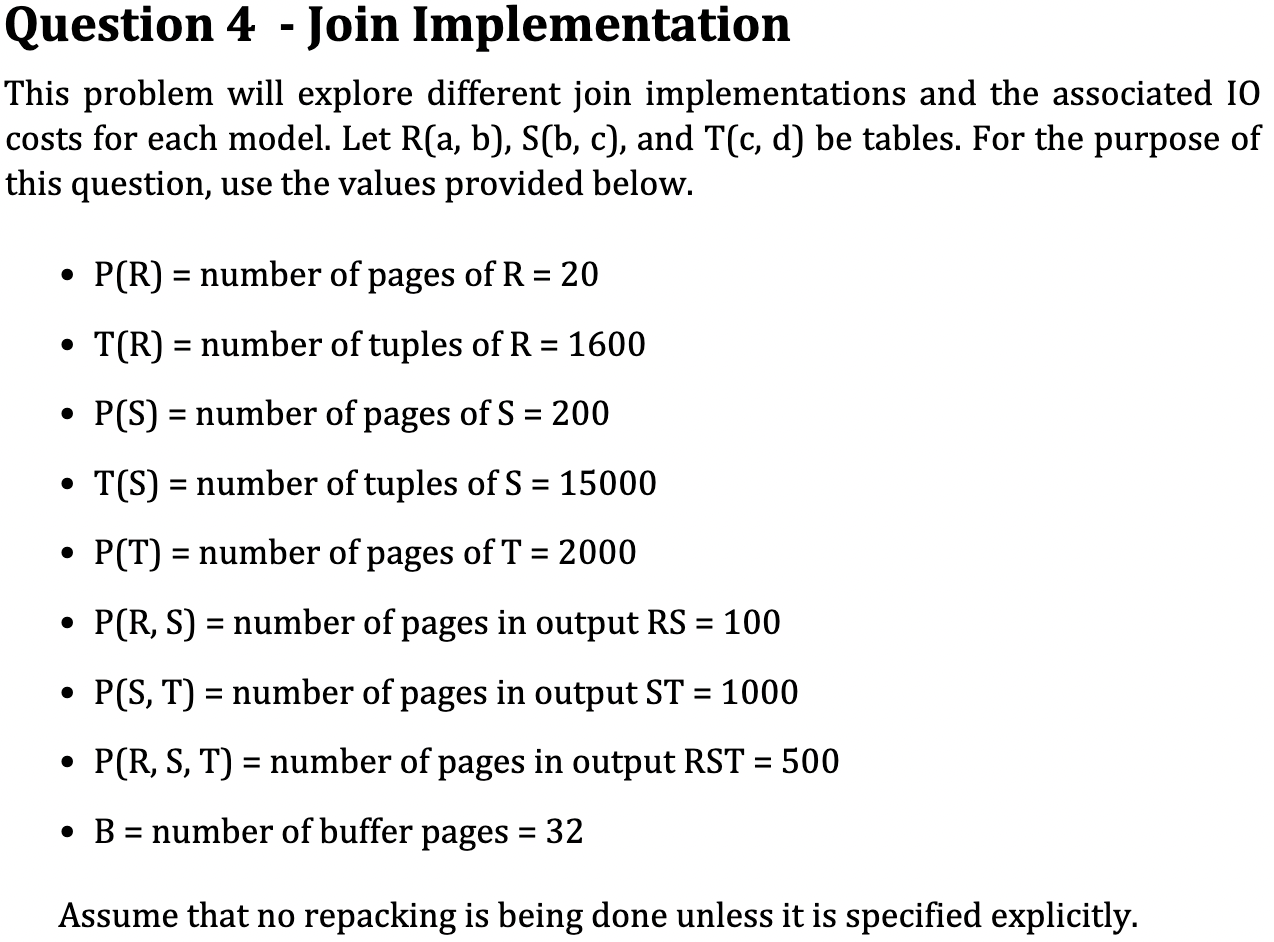
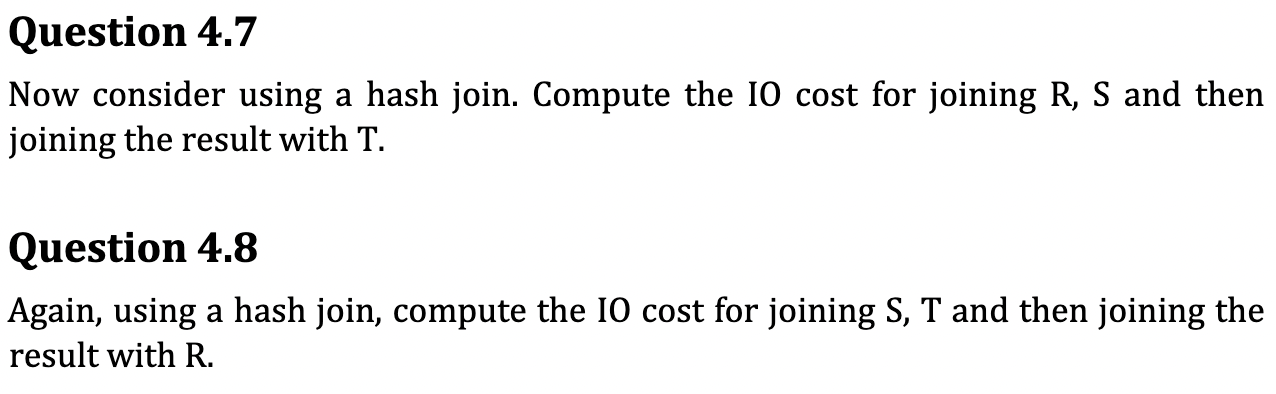
Question 4 - Join Implementation This problem will explore different join implementations and the associated IO costs for each model. Let R(a,b),S(b,c), and T(c,d) be tables. For the purpose of this question, use the values provided below. - P(R)= number of pages of R=20 - T(R)= number of tuples of R=1600 - P(S)= number of pages of S=200 - T(S)= number of tuples of S=15000 - P(T)= number of pages of T=2000 - P(R,S)= number of pages in output RS=100 - P(S,T)= number of pages in output ST=1000 - P(R,S,T)= number of pages in output RST=500 - B= number of buffer pages =32 Assume that no repacking is being done unless it is specified explicitly. Now consider using a hash join. Compute the IO cost for joining R,S and then joining the result with T. Question 4.8 Again, using a hash join, compute the IO cost for joining S, T and then joining the result with R
Step by Step Solution
There are 3 Steps involved in it

Get step-by-step solutions from verified subject matter experts
 Study Help