







Question: Question 4: More than one response variables. (30 points) The coded factor settings and results from an experiment are shown below. The objective is to
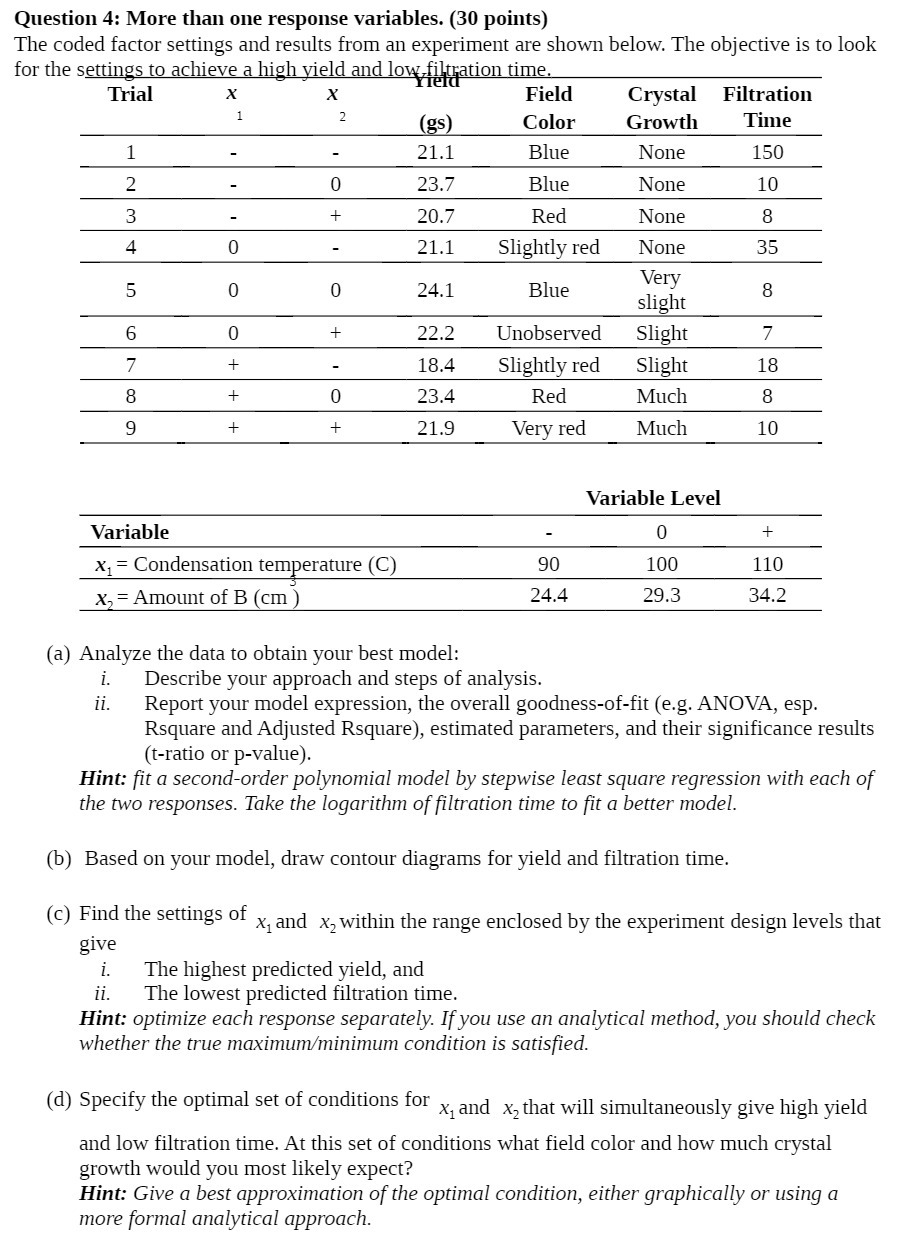
Question 4: More than one response variables. (30 points) The coded factor settings and results from an experiment are shown below. The objective is to look for the settings to achieve a high yield and logltaation time. Trial x X Field Crystal Filtration 1 2 5 Color Growth Time 1 - - 21.1 Blue None 150 2 - f} 23.? Blue None 10 3 - + 20.? Red None 8 4 U - 21.1 Slightly red None 35 Ve 5 o o 24.1 Blue 511;; 8 6 0 + 22.2 Unobserved Slight 7' 7 + - 18.4 Slightly red Slight 18 8 + 0 23.4 Red Much 8 9 + + 21.9 Very red Much 10 Variable Level Variable - 0 + x1 = Condensation temperature (C) 90 100 110I x2 = Amount of B {cm ) 24.4 29.3 34.2 (a) Analyze the data to obtain your best model: i. Describe your approach and steps of analysis. ii. Report your model expression, the overall goodness-of-fit (e. g. ANOVA, esp. quuare and Adjusted quuare), estimated parameters, and their significance results {t-ratio or p-value). Hint: t a secondorder polynomial model by stepwise least square regression with each of the two responses. Take the logarithm of filtration time to fit a better model. (b) Based on your model, draw contour diagrams for yield and filtration time. (c) Find the settings of give i. The highest predicted yield, and ii. The lowest predicted filtration time. Hint: optimize each response separately. If you use an analytical method, you should check whether the true maximunuminimum condition is satisfied. x1 and szithin the range enclosed by the experiment design levels that (d) SPECifY the optimal set 0f conditions for x1 and x2 that will simultaneously give high yield and low filtration time. At this set of conditions what field color and how much crystal growth would you most liltely expect? Hint: Give a best approximation of the optimal condition, either graphically or using a more formal analytical approach
Step by Step Solution
There are 3 Steps involved in it

Get step-by-step solutions from verified subject matter experts
 Study Help