







Question: Question 4 Suppose that Ms. Y has a valuable tree growing in her yard that she will harvest within the next four years, and people
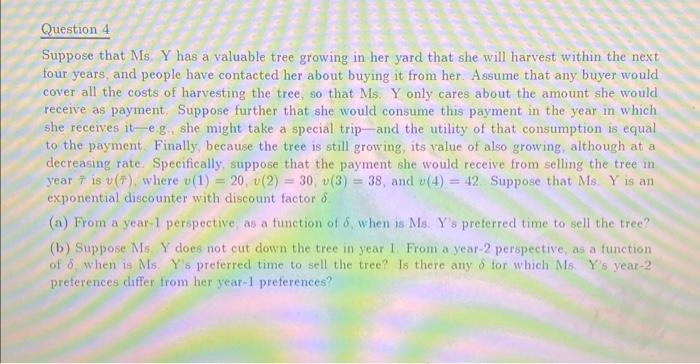
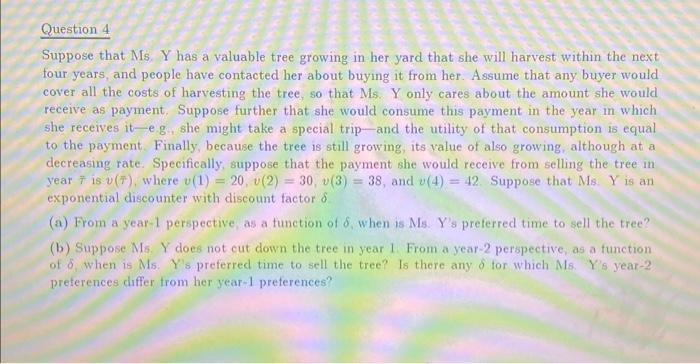
Question 4 Suppose that Ms. Y has a valuable tree growing in her yard that she will harvest within the next four years, and people have contacted her about buying it from her. Assume that any buyer would cover all the costs of harvesting the tree, so that Ms. Y only cares about the amount she would receive as payment. Suppose further that she would consume this payment in the year in which she receives it-e g , she might take a special trip and the utility of that consumption is equal to the payment. Finally, because the tree is still growing, its value of also growing, although at a decreasing rate. Specifically, suppose that the payment she would receive from selling the tree in year + is v(T), where v (1) = 20, v(2) = 30, v(3) = 38, and (4) = 42. Suppose that Ms. Y is an exponential discounter with discount factor & (a) From a year-1 perspective, as a function of 6, when is Ms. Y's preferred time to sell the tree? (b) Suppose Ms. Y does not cut down the tree in year 1. From a year-2 perspective, as a function of 6 when is Ms. Y's preferred time to sell the tree? Is there any o for which Ms. Y's year-2 preferences differ from her year-1 preferences?Question 4 Suppose that Ms. Y has a valuable tree growing in her yard that she will harvest within the next four years, and people have contacted her about buying it from her. Assume that any buyer would cover all the costs of harvesting the tree, so that Ms. Y only cares about the amount she would receive as payment. Suppose further that she would consume this payment in the year in which she receives it-e g , she might take a special trip and the utility of that consumption is equal to the payment. Finally, because the tree is still growing, its value of also growing, although at a decreasing rate. Specifically, suppose that the payment she would receive from selling the tree in year + is v(T), where v (1) = 20, v(2) = 30, v(3) = 38, and (4) = 42. Suppose that Ms. Y is an exponential discounter with discount factor & (a) From a year-1 perspective, as a function of 6, when is Ms. Y's preferred time to sell the tree? (b) Suppose Ms. Y does not cut down the tree in year 1. From a year-2 perspective, as a function of 6 when is Ms. Y's preferred time to sell the tree? Is there any o for which Ms. Y's year-2 preferences differ from her year-1 preferences
Step by Step Solution
There are 3 Steps involved in it

Get step-by-step solutions from verified subject matter experts
 Study Help