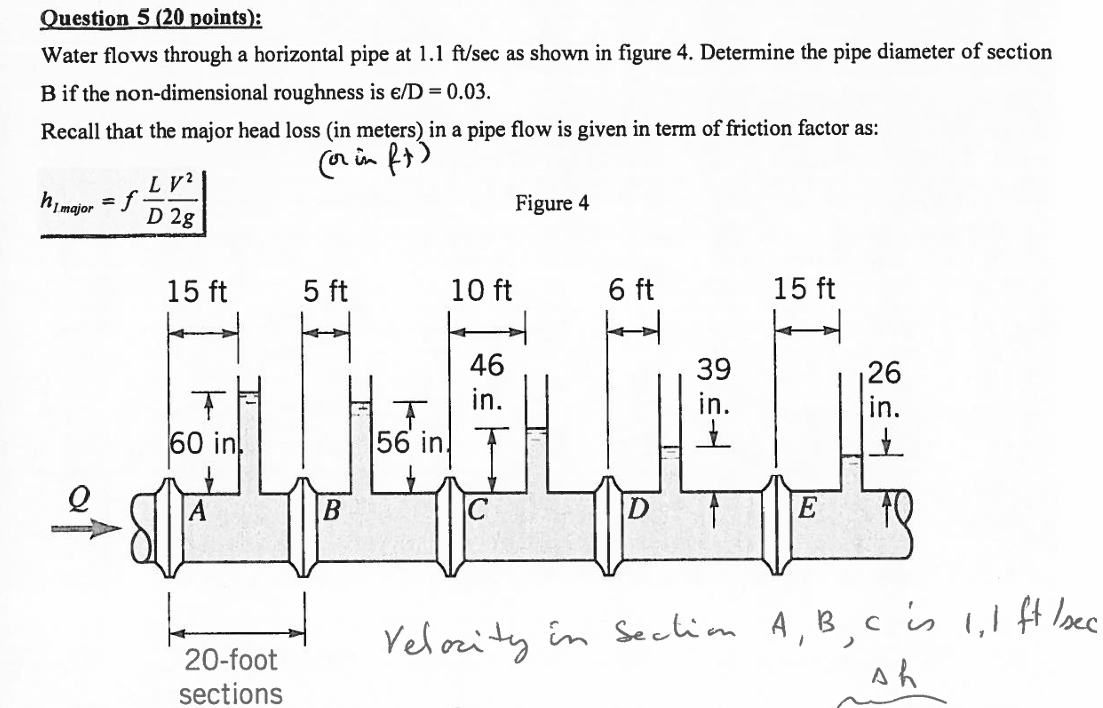
Question: Question 5 (20 points): Water flows through a horizontal pipe at 1.1 fi/sec as shown in figure 4. Determine the pipe diameter of section B
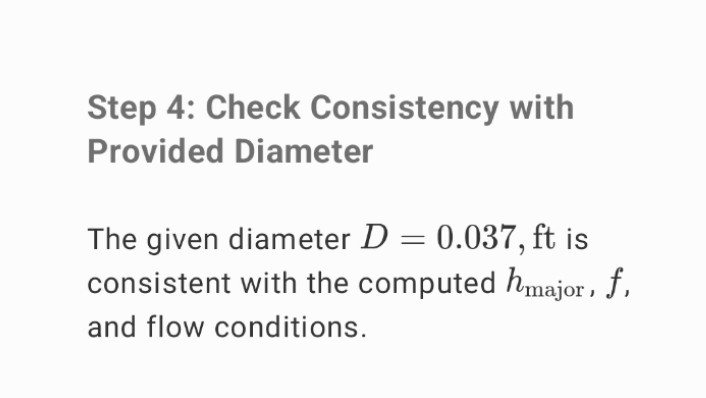
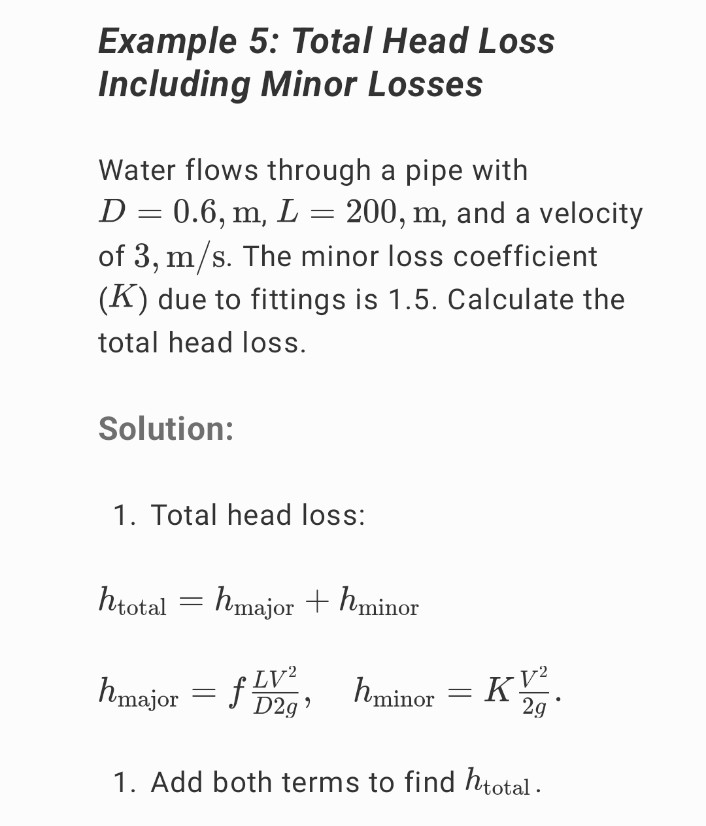
Question 5 (20 points): Water flows through a horizontal pipe at 1.1 fi/sec as shown in figure 4. Determine the pipe diameter of section B if the non-dimensional roughness is E/D = 0.03. Recall that the major head loss (in meters) in a pipe flow is given in term of friction factor as: (on in Rt ) L V2 hi major = f D 28 Figure 4 15 ft 5 ft 10 ft 6 ft 15 ft 46 39 26 in. in . in . 60 in 56 in A B C D E Velocity in Section A, B c is 1 , 1 filed 20-foot sections AhGiven Data 1. Velocity () in sections A, B, and C: 1.1, ft/s 2. Non-dimensional roughness: E/ D = 0.0. 3. Head loss equation: hmajor = f D29 . f: friction factor. L: length of the pipe (in feet). . V: velocity of water flow (in ft/s). . D: pipe diameter (in feet) g: gravitational acceleration (32.2, ft/s ) 1. D = 0.037, ft is provided as the pipe diameter. Steps to Verify the Solution Step 1: Calculate Reynolds Number The Reynolds number is used to determine the flow regime (laminar or turbulent) and to compute the friction factor f. Re = PVD p: density of water (62.4, 1b/fts). . M: dynamic viscosity of water (2.42 x 10 5, 1b/ft-s). Substituting values: Re - 62.4x1.1x0.037 2.42 X 10⁻⁵ \\text{Re} = 1.69 \\times 10^5 ] Since Re > 4000, the flow is turbulent. Step 2: Friction Factor (Darcy-Weisbach) For turbulent flow, the friction factor is calculated using the Colebrook-White equation: = -210g10 ( 3.7 + 2.5 Given E/ D = 0.0: 47 = -210810 (3.7 + 1.69x10⁵ 7) This is a nonlinear equation for f and is typically solved iteratively. Using standard computational methods, f ~0.038. Step 3: Verify Head Loss The head loss is computed using the given formula: hmajor = f D2g Substitute the known values: f = 0.038, . L = 15 + 5 + 10 + 6 + 15 = 51, ft (total length from figure), V = 1.1, ft/s, D = 0.037, ft, . g = 32.2, ft/s . 51x(1.1)2 hmajor = 0.038 0.037 x2x32.2 h_{\\text{major}} = 0.038 \\frac{51 \\times 1.21}{0.037 \\times 64.4} ] hmajor = 0.03851.72 h_(\\text{major}} = 0.038 \\times 25.89 = 0.983 , \\text(ft} ]Step 4: Check Consistency with Provided Diameter The given diameter D = 0.037, ft is consistent with the computed hmajc-r: 1, and flow conditions. Example 1: Head Loss in a Pipe Water flows through a 200-ft-long pipe with a diameter of D = 0.5, ft at a velocity of V = 4, ft/s. The non-dimensional roughness is E/D = 0.01. Calculate the head loss (hmajor). Solution: 1. Use the head loss equation: hmajor = f D29 1. Compute Re = PVD # , where: o p = 62.4, 1b/ft" ou = 2.42 x 10 5, 1b/ft-s, . D = 0.5, ft, o V = 4, ft/s. 2. Solve the Colebrook-White equation for f, and substitute all values into the head loss formula. Example 2: Diameter of Pipe A horizontal pipe carries water at a velocity of 2.5, m/s with a head loss of hmajor = 5, m over a length of L = 300, m. The pipe's roughness is E = 0.0002, m. Determine the pipe diameter D Solution: 1. Start with the head loss formula: hmajor = for D = f 2ghmajor 1. Substitute values and compute D. Example 3: Friction Factor A steel pipe with a diameter of 0.3, m and length 500, m carries water at 1.8, m/s. The head loss is 3, m. Determine the friction factor f. Solution: . Rearrange the head loss equation for f: hmajor D2g hmajor = 3, m, D = 0.3, m, . g = 9.81, m/s, . L = 500, m, . V = 1.8, m/s. 1. Compute f. Example 4: Flow Velocity A 100-ft-long pipe with a diameter of 1.2, ft and a roughness E/ D = 0.02 experiences a head loss of 2.5, ft. Find the flow velocity (V ). Solution: 1. Use the head loss formula: V= 2major D2g hmajor = 2.5, ft, D = 1.2, ft, . g = 32.2, ft/s2, . L = 100, ft. Example 5: Total Head Loss Including Minor Losse Water flows through a pipe with htotal = hmajor + hminor hmajor = f Dzg, hminor = K 2. 1. Add both terms to find htotal.Example 5: Total Head Loss Including Minor Losses Water flows through a pipe with D = 0.6,m, L = 200, m, and a velocity of 3, m/s. The minor loss coefficient (K) due to fittings is 1.5. Calculate the total head loss. Solution: 1. Total head loss: liotal Imnjor =+ Mminer o=y M= B 1. Add both terms to find Atotal
Step by Step Solution
There are 3 Steps involved in it
1 Expert Approved Answer
Step: 1 Unlock
Question Has Been Solved by an Expert!
Get step-by-step solutions from verified subject matter experts
Step: 2 Unlock
Step: 3 Unlock
Students Have Also Explored These Related Law Questions!











 Study Help