







Question: a) For each of the following functions, identify 1) its image and whether it is 2) injective, 3) surjective, 4) bijective; if your answer
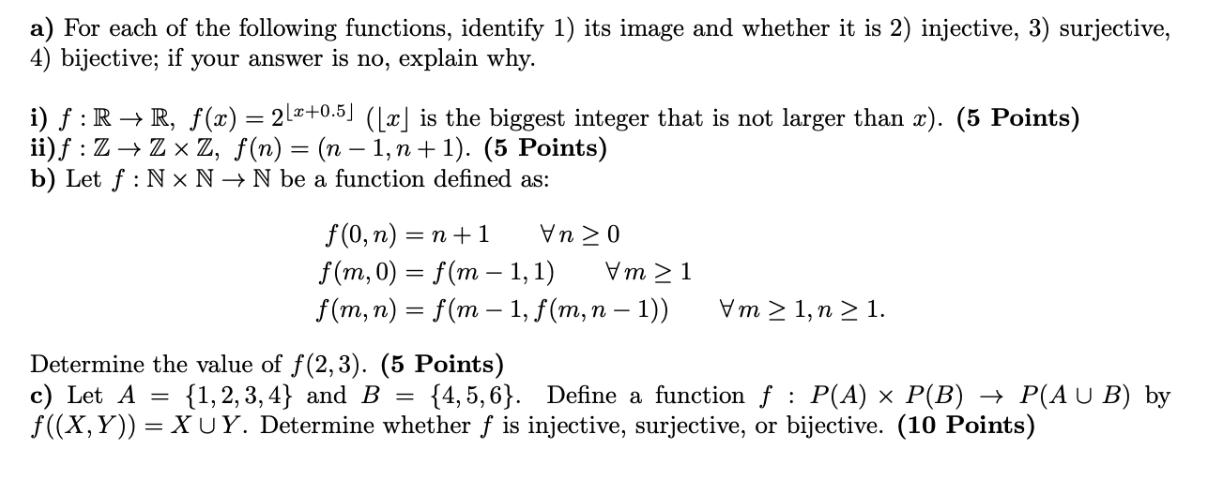
a) For each of the following functions, identify 1) its image and whether it is 2) injective, 3) surjective, 4) bijective; if your answer is no, explain why. i) : R R, (x) = 2l+0.5] ([x] is the biggest integer that is not larger than x). (5 Points) ii)f: Z ZxZ, f(n) = (n 1, n+1). (5 Points) b) Let f: Nx N N be a function defined as: Vn f(0, n) = n + 1 f(m, 0) = f(m-1, 1) Vm > 1 f(m, n) = f(m - 1, (m, n 1)) Vm 1, n 1. Determine the value of f(2,3). (5 Points) c) Let A = {1,2,3,4} and B {4,5,6). Define a function f : P(A) P(B) P(AUB) by f((X,Y)) = XUY. Determine whether f is injective, surjective, or bijective. (10 Points) =
Step by Step Solution
3.51 Rating (161 Votes )
There are 3 Steps involved in it
Answer a i Function f RR fx 2x 05 Image The image of the function is the set of all possible outputs In this case the image is the set of all real numbers Injective A function is injective if each ele... View full answer

Get step-by-step solutions from verified subject matter experts
 Study Help