







Question: QUESTION 5 (a) Consider a monopoly with a horizontal marginal cost schedule. If a tax t is imposed on the monopolist, derive formally the expressions
QUESTION 5
(a) Consider a monopoly with a horizontal marginal cost schedule. If a tax t is imposed on the
monopolist, derive formally the expressions that show how the price depends on the tax
(i) when the monopolist faces a linear demand curve p a bQ = - , where p stands for price,
Q stands for quantity and a and b are two positive constants; and
(ii) when the monopolist faces a demand schedule with constant elasticity ?d.
In both cases, provide also a graphical representation. (6 points)
(b) It is frequently asserted that taxes on cigarettes and beer are regressive, because the poor
individuals spend a larger fraction of their income on such items than do better-off
individuals. How would your estimate of the degree of regressivity be affected if you
thought these commodities were produced by (i) competitive industries with inelastic
supply schedules, (ii) competitive industries with perfectly elastic supply schedules, (iii) a
monopoly with a linear demand schedule, and (iv) a monopoly facing constant elasticity
of demand schedule with constant elasticity ?d=2? Provide a justification. (4 p
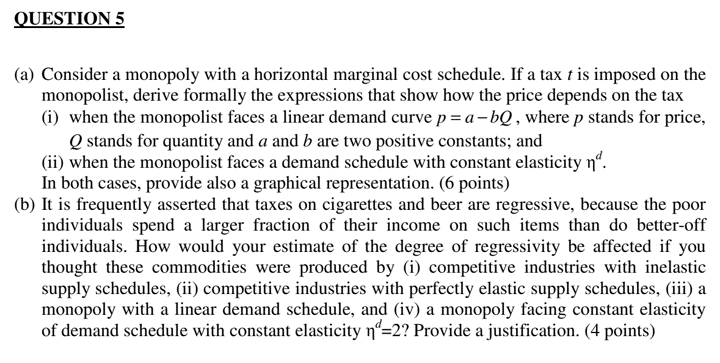
QUESTION 5 {a} Consider a monopoly.r with a horizontal marginal cost schedule. If a tax I is imposed on the monopolist, derive formallv the expressions that show how the price depends on the tax (i) when the monopolist faces a linear demand curve p = abQ , where p stands for price, Q stands for quantity and e and b are two positive constants; and (ii) when the monopolist faces a demand schedule with constant elasticity 11". In both cases, provide also a graphical representation. (6 points) {b} It is frequently asserted that taxes on cigarettes and beer are regressive. because the poor individuals spend a larger fraction of their income on such items than do betteroff individuals. How would your estimate of the degree of regnessivitgtr be affected if you thought these commodities were produced by (i) competitive industries with inelastic supplyr schedules, (ii) competitive industries with perfectly elastic supply schedules, (iii) a monopoly with a linear demand schedule, and {iv} a monopoly facing constant elasticity of demand schedule with constant elasticity nd=2'? Provide a justication. {4 points)
Step by Step Solution
There are 3 Steps involved in it

Get step-by-step solutions from verified subject matter experts
 Study Help