



Question: Question 5 An entrepreneur has access to two mutually exclusive investment projects (project A and project B). Both projects cost $60 million today. One year
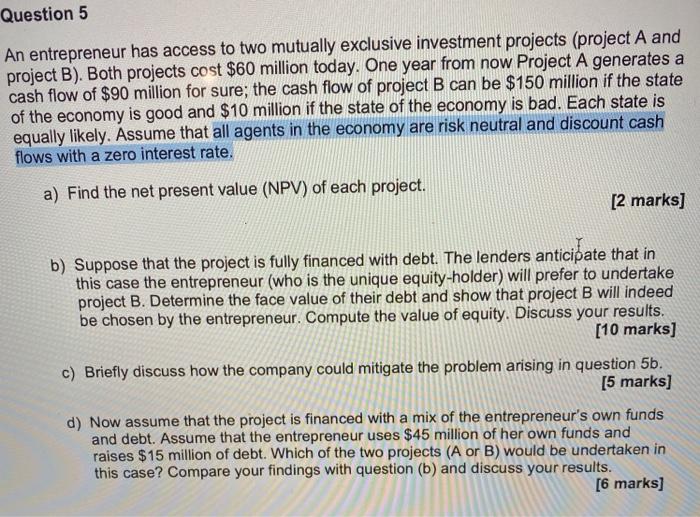
Question 5 An entrepreneur has access to two mutually exclusive investment projects (project A and project B). Both projects cost $60 million today. One year from now Project A generates a cash flow of $90 million for sure; the cash flow of project B can be $150 million if the state of the economy is good and $10 million if the state of the economy is bad. Each state is equally likely. Assume that all agents in the economy are risk neutral and discount cash flows with a zero interest rate. a) Find the net present value (NPV) of each project. [2 marks] b) Suppose that the project is fully financed with debt. The lenders anticipate that in this case the entrepreneur (who is the unique equity-holder) will prefer to undertake project B. Determine the face value of their debt and show that project B will indeed be chosen by the entrepreneur. Compute the value of equity. Discuss your results. [10 marks] c) Briefly discuss how the company could mitigate the problem arising in question 5b. (5 marks] d) Now assume that the project is financed with a mix of the entrepreneur's own funds and debt. Assume that the entrepreneur uses $45 million of her own funds and raises $15 million of debt. Which of the two projects (A or B) would be undertaken in this case? Compare your findings with question (b) and discuss your results. [6 marks] Question 5 An entrepreneur has access to two mutually exclusive investment projects (project A and project B). Both projects cost $60 million today. One year from now Project A generates a cash flow of $90 million for sure; the cash flow of project B can be $150 million if the state of the economy is good and $10 million if the state of the economy is bad. Each state is equally likely. Assume that all agents in the economy are risk neutral and discount cash flows with a zero interest rate. a) Find the net present value (NPV) of each project. [2 marks] b) Suppose that the project is fully financed with debt. The lenders anticipate that in this case the entrepreneur (who is the unique equity-holder) will prefer to undertake project B. Determine the face value of their debt and show that project B will indeed be chosen by the entrepreneur. Compute the value of equity. Discuss your results. [10 marks] c) Briefly discuss how the company could mitigate the problem arising in question 5b. (5 marks] d) Now assume that the project is financed with a mix of the entrepreneur's own funds and debt. Assume that the entrepreneur uses $45 million of her own funds and raises $15 million of debt. Which of the two projects (A or B) would be undertaken in this case? Compare your findings with question (b) and discuss your results. [6 marks]
Step by Step Solution
There are 3 Steps involved in it

Get step-by-step solutions from verified subject matter experts