Question: Question 5 (Extended Bezout theorem). For a1, . .., an E Z, not all 0, define the greatest common divisor to be: god(a1, . .
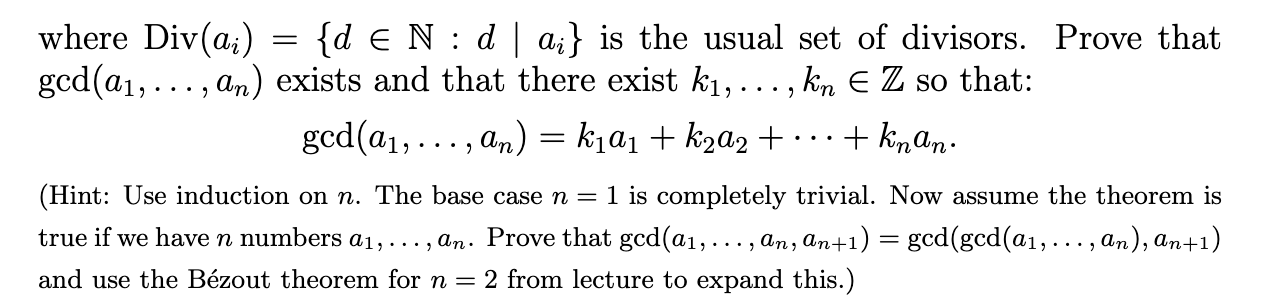
Question 5 (Extended Bezout theorem). For a1, . .., an E Z, not all 0, define the greatest common divisor to be: god(a1, . . ., an) = max Div(al ) n Div(a2) n . . . n Div(an)where Div(ai) = {d E N : d| ai} is the usual set of divisors. Prove that god(a1, . . ., an) exists and that there exist k1, . .., kn E Z so that: gcd(a1, . . . , an) = kia1 + kzaz + . . . + knan. (Hint: Use induction on n. The base case n = 1 is completely trivial. Now assume the theorem is true if we have n numbers a1, . .., an. Prove that god(al, . .., an, an+1) = god(gcd(a1, . .., an), an+1) and use the Bezout theorem for n = 2 from lecture to expand this.)
Step by Step Solution
There are 3 Steps involved in it
1 Expert Approved Answer
Step: 1 Unlock
Question Has Been Solved by an Expert!
Get step-by-step solutions from verified subject matter experts
Step: 2 Unlock
Step: 3 Unlock
Students Have Also Explored These Related Mathematics Questions!










 Study Help