



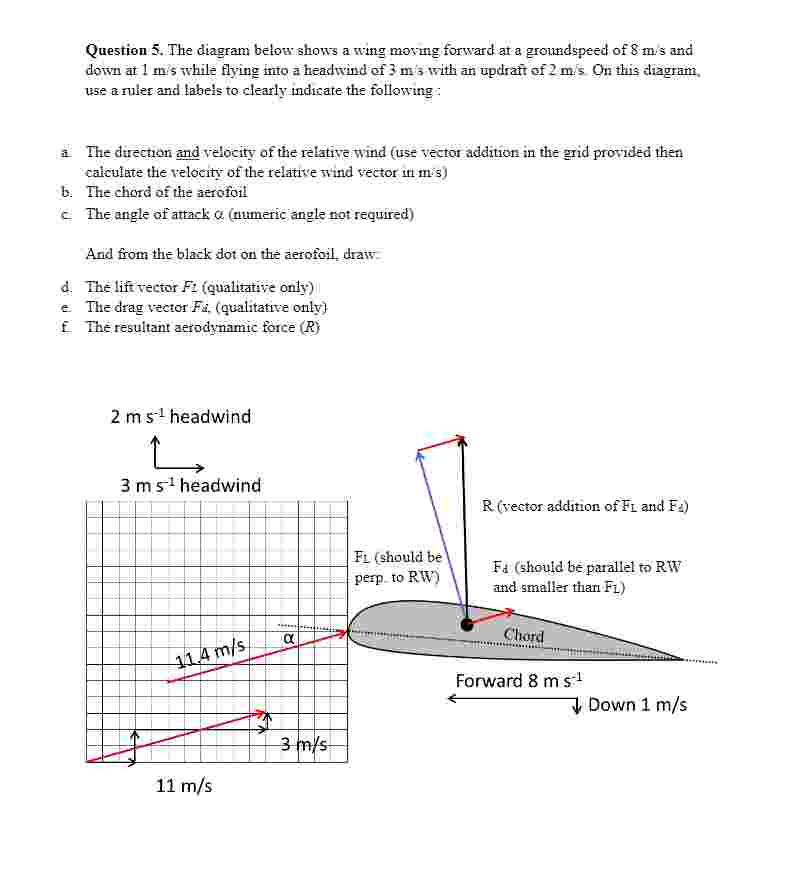
Question: Question 5 . The diagram below shows a wing moving forward at a groundspeed of ( 8 mathrm { ~m } /
Question The diagram below shows a wing moving forward at a groundspeed of mathrm~mmathrms and down at m s while flying into a headuind of m s with an updraft of mathrm~mmathrms On this diagram, use a ruler and labels to clearly indicate the following:
ai The diection and velocity of the relative wind use vector addition in the grid provided then calculate the velocity of the relative wind vector it mis
b The chard of the aerofoil
c The angle of attack alpha numencic angle not required
And from the black dot on the aerofoil draw
d The lift vector F qualitative only
e The drag vector Fiqualitative only
f The resultant aerodynamte force R
mathrm~ms headwind
mathrm~mmathrms
Forward mathrm~ms This diagram shows a crosssection through the tail fluke of a dolphin swmining forward at mathrm~mmathrms into an oncoming current of mathrm~mmathrms The tail is moving down at mathrm~mmathrms On this diagram, use a ruler and labels to clearly indicate the following marks:
a The direction of the relative water flow past the bydrofoil use vector addition in the grid provided
b The relative water velocity calculate velocity
c The chord of the hydrofoil
d The angle of attack alpha numetic angle not required
e The lift vector from the black dot, qualitative only
f The drag vector from the black dot, qualitative only
The resultant hydrodynamic force from the black dot
h Use the hydrodynamic resultant to show the forvard thrust component from black dot
Step by Step Solution
There are 3 Steps involved in it
1 Expert Approved Answer
Step: 1 Unlock

Question Has Been Solved by an Expert!
Get step-by-step solutions from verified subject matter experts
Step: 2 Unlock
Step: 3 Unlock