





Question: Question 5: What do we use for n in the compound interest formula when we use the term compound annually? Compound semi-anually? Comound quarterly? Compound
Question 5: What do we use for n in the compound
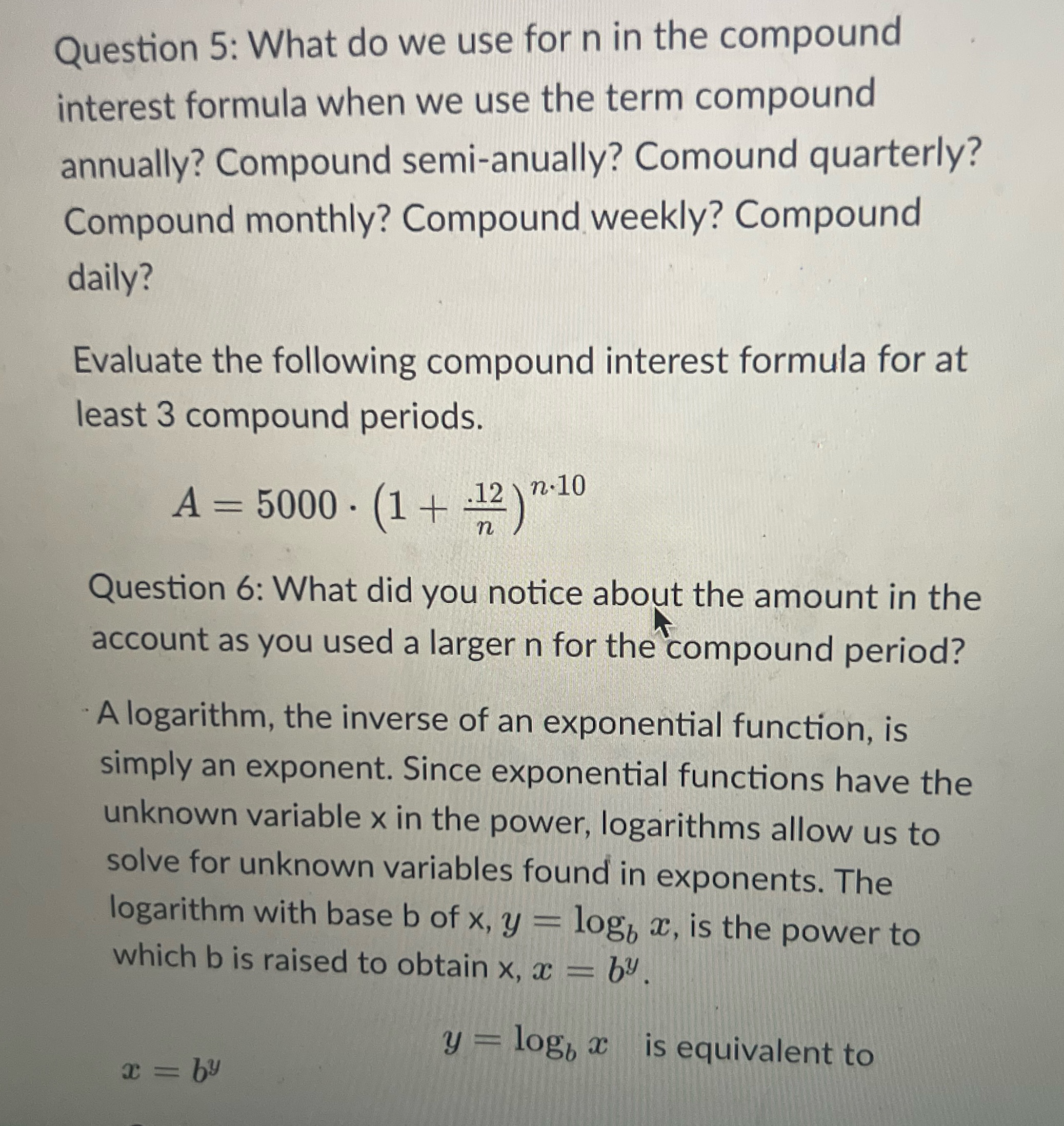
Question 5: What do we use for n in the compound interest formula when we use the term compound annually? Compound semi-anually? Comound quarterly? Compound monthly? Compound weekly? Compound daily? Evaluate the following compound interest formula for at least 3 compound periods. A = 5000 . (1 4 -12 ) 2.10 Question 6: What did you notice about the amount in the account as you used a larger n for the compound period? A logarithm, the inverse of an exponential function, is simply an exponent. Since exponential functions have the unknown variable x in the power, logarithms allow us to solve for unknown variables found in exponents. The logarithm with base b of x, y - log x, is the power to which b is raised to obtain x, a = by y - log a is equivalent to x = by

Step by Step Solution

There are 3 Steps involved in it

1 Expert Approved Answer
Step: 1 Unlock blur-text-image

Question Has Been Solved by an Expert!

Get step-by-step solutions from verified subject matter experts

Step: 2 Unlock
Step: 3 Unlock

Students Have Also Explored These Related Mathematics Questions!