







Question: QUESTION 6 Create a risk register for a project that you are familiar with. Capture at least (10) identified project risks. Demonstrate your understanding of

QUESTION 6
Create a risk register for a project that you are familiar with. Capture at least (10) identified project risks. Demonstrate your understanding of the contents of risk register. 20 marks
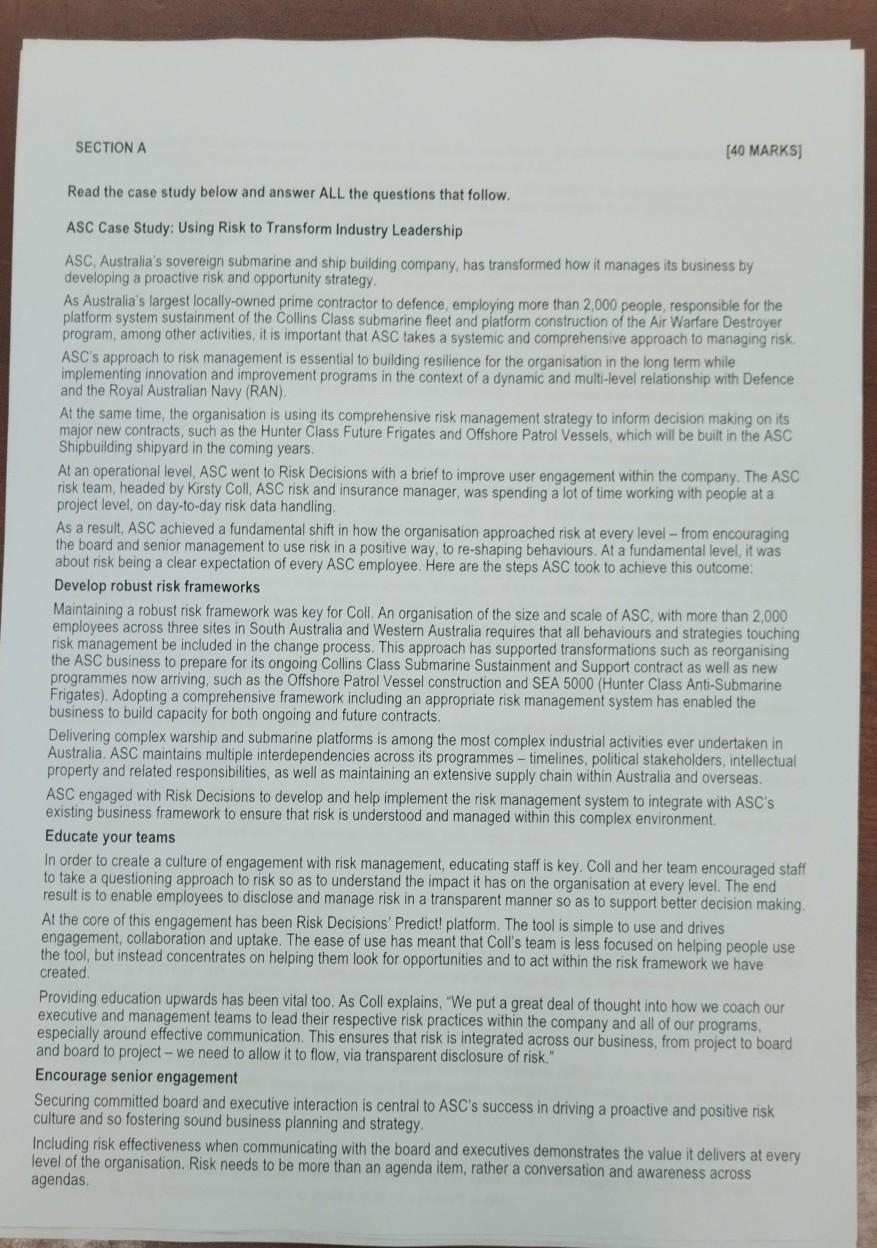
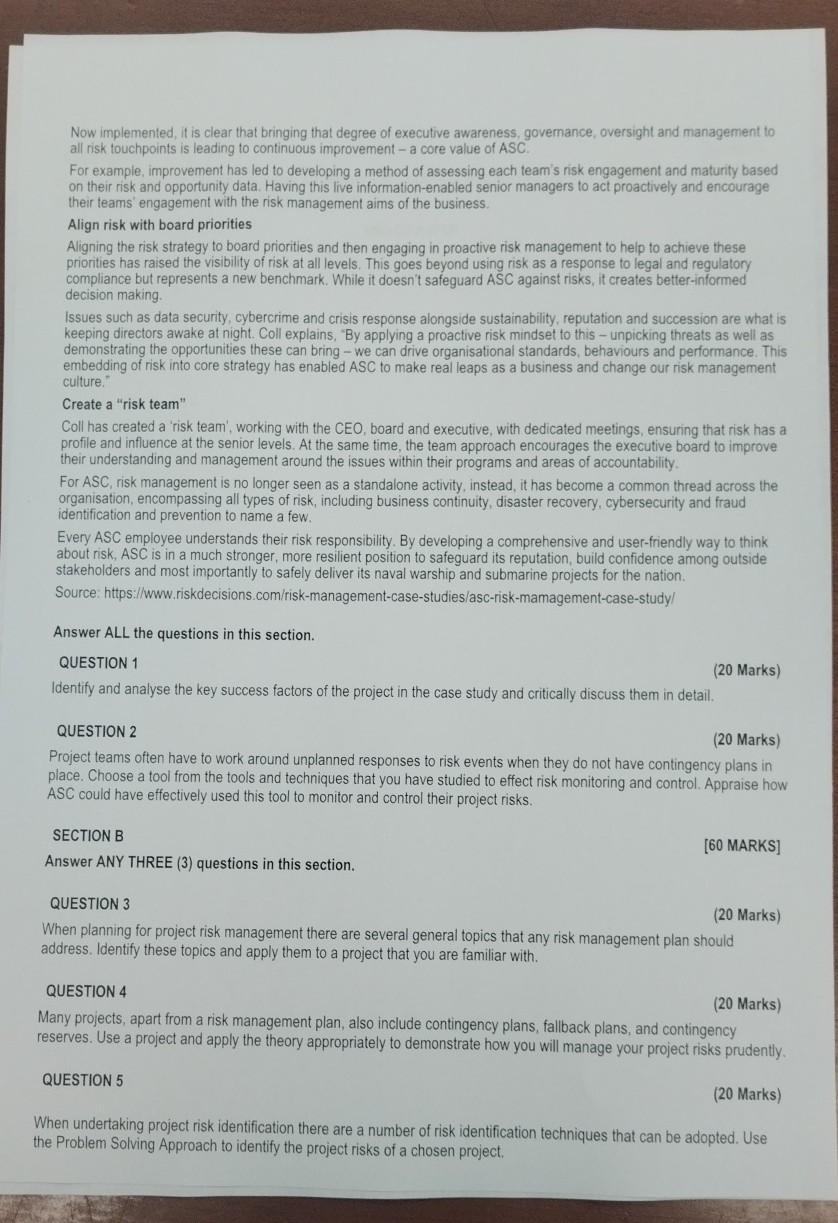
SECTION A [40 MARKS] Read the case study below and answer ALL the questions that follow. ASC Case Study: Using Risk to Transform Industry Leadership ASC, Australia's sovereign submarine and ship building company, has transformed how it manages its business by developing a proactive risk and opportunity strategy. As Australia's largest locally-owned prime contractor to defence, employing more than 2,000 people, responsible for the platform system sustainment of the Collins Class submarine fleet and platform construction of the Air Warfare Destroyer program, among other activities, it is important that ASC lakes a systemic and comprehensive approach to managing risk. ASC's approach to risk management is essential to building resilience for the organisation in the long lerm while implementing innovation and improvement programs in the context of a dynamic and multi-level relationship with Defence and the Royal Australian Navy (RAN). At the same time, the organisation is using its comprehensive risk management strategy to inform decision making on its major new contracts, such as the Hunter Class Future Frigates and Offshore Patrol Vessels, which will be built in the ASC Shipbuilding shipyard in the coming years. At an operational level, ASC went to Risk Decisions with a brief to improve user engagement within the company. The ASC risk team, headed by Kirsty Coll, ASC risk and insurance manager, was spending a lot of time working with people at a project level, on day-to-day risk data handling. As a result, ASC achieved a fundamental shift in how the organisation approached risk at every level-from encouraging the board and senior management to use risk in a positive way, to re-shaping behaviours. At a fundamental level, it was about risk being a clear expectation of every ASC employee. Here are the steps ASC took to achieve this outcome: Develop robust risk frameworks Maintaining a robust risk framework was key for Coll. An organisation of the size and scale of ASC, with more than 2,000 employees across three sites in South Australia and Western Australia requires that all behaviours and strategies touching risk management be included in the change process. This approach has supported transformations such as reorganising the ASC business to prepare for its ongoing Collins Class Submarine Sustainment and Support contract as well as new programmes now arriving, such as the Offshore Patrol Vessel construction and SEA 5000 (Hunter Class Anti-Submarine Frigates). Adopting a comprehensive framework including an appropriate risk management system has enabled the business to build capacity for both ongoing and future contracts. Delivering complex warship and submarine platforms is among the most complex industrial activities ever undertaken in Australia. ASC maintains multiple interdependencies across its programmes - timelines, political stakeholders, intellectual property and related responsibilities, as well as maintaining an extensive supply chain within Australia and overseas. ASC engaged with Risk Decisions to develop and help implement the risk management system to integrate with ASC's existing business framework to ensure that risk is understood and managed within this complex environment. Educate your teams In order to create a culture of engagement with risk management, educating staff is key. Coll and her team encouraged staff to take a questioning approach to risk so as to understand the impact it has on the organisation at every level. The end result is to enable employees to disclose and manage risk in a transparent manner so as to support better decision making. At the core of this engagement has been Risk Decisions' Predict! platform. The tool is simple to use and drives engagement, collaboration and uptake. The ease of use has meant that Coll's team is less focused on helping people use the tool, but instead concentrates on helping them look for opportunities and to act within the risk framework we have created. Providing education upwards has been vital too. As Coll explains, "We put a great deal of thought into how we coach our executive and management teams to lead their respective risk practices within the company and all of our programs, especially around effective communication. This ensures that risk is integrated across our business, from project to board and board to project - we need to allow it to flow, via transparent disclosure of risk." Encourage senior engagement Securing committed board and executive interaction is central to ASC's success in driving a proactive and positive risk ulture and so fostering sound business planning and strategy. cluding risk effectiveness when communicating with the board and executives demonstrates the value it delivers at every vel of the organisation. Risk needs to be more than an agenda item, rather a conversation and awareness across gendas. Now implemented, it is clear that bringing that degree of executive awareness, governance, oversight and management to all risk touchpoints is leading to continuous improvement - a core value of ASC. For example, improvement has led to developing a method of assessing each team's risk engagement and maturity based on their risk and opportunity data. Having this live information-enabled senior managers to act proactively and encourage their teams' engagement with the risk management aims of the business. Align risk with board priorities Aligning the risk strategy to board priorities and then engaging in proactive risk management to help to achieve these priorities has raised the visibility of risk at all levels. This goes beyond using risk as a response to legal and regulatory compliance but represents a new benchmark. While it doesn't safeguard ASC against risks, it creates better-informed decision making. Issues such as data security, cybercrime and crisis response alongside sustainability, reputation and succession are what is keeping directors awake at night. Coll explains, "By applying a proactive risk mindset to this - unpicking threats as well as demonstrating the opportunities these can bring - we can drive organisational standards, behaviours and performance. This embedding of risk into core strategy has enabled ASC to make real leaps as a business and change our risk management culture." Create a "risk team" Coll has created a 'risk team', working with the CEO, board and executive, with dedicated meetings, ensuring that risk has a profile and influence at the senior levels. At the same time, the team approach encourages the executive board to improve their understanding and management around the issues within their programs and areas of accountability. For ASC, risk management is no longer seen as a standalone activity, instead, it has become a common thread across the organisation, encompassing all types of risk, including business continuity, disaster recovery, cybersecurity and fraud identification and prevention to name a few. Every ASC employee understands their risk responsibility. By developing a comprehensive and user-friendly way to think about risk, ASC is in a much stronger, more resilient position to safeguard its reputation, build confidence among outside stakeholders and most importantly to safely deliver its naval warship and submarine projects for the nation. Source: https://www, riskdecisions.com/risk-management-case-studies/asc-risk-mamagement-case-study/ Answer ALL the questions in this section. QUESTION 1 (20 Marks) Identify and analyse the key success factors of the project in the case study and critically discuss them in detail. QUESTION 2 (20 Marks) Project teams often have to work around unplanned responses to risk events when they do not have contingency plans in place. Choose a tool from the tools and techniques that you have studied to effect risk monitoring and control. Appraise how ASC could have effectively used this tool to monitor and control their project risks. SECTION B [60 MARKS] Answer ANY THREE (3) questions in this section. QUESTION 3 (20 Marks) When planning for project risk management there are several general topics that any risk management plan should address. Identify these topics and apply them to a project that you are familiar with. QUESTION 4 (20 Marks) Many projects, apart from a risk management plan, also include contingency plans, fallback plans, and contingency reserves. Use a project and apply the theory appropriately to demonstrate how you will manage your project risks prudently. QUESTION 5 (20 Marks) When undertaking project risk identification there are a number of risk identification techniques that can be adopted. Use the Problem Solving Approach to identify the project risks of a chosen project. QUESTION 6 (20 Marks) Create a risk register for a project that you are familiar with. Capture at least ten (10) identified project risks. Demonstrate your understanding of the contents of the risk register. END OF PAPER
Step by Step Solution
There are 3 Steps involved in it

Get step-by-step solutions from verified subject matter experts
 Study Help