







Question: Question 7 1 pts Let i, j, k e Za and w, x, y e Zb with i, j, k all different from each other
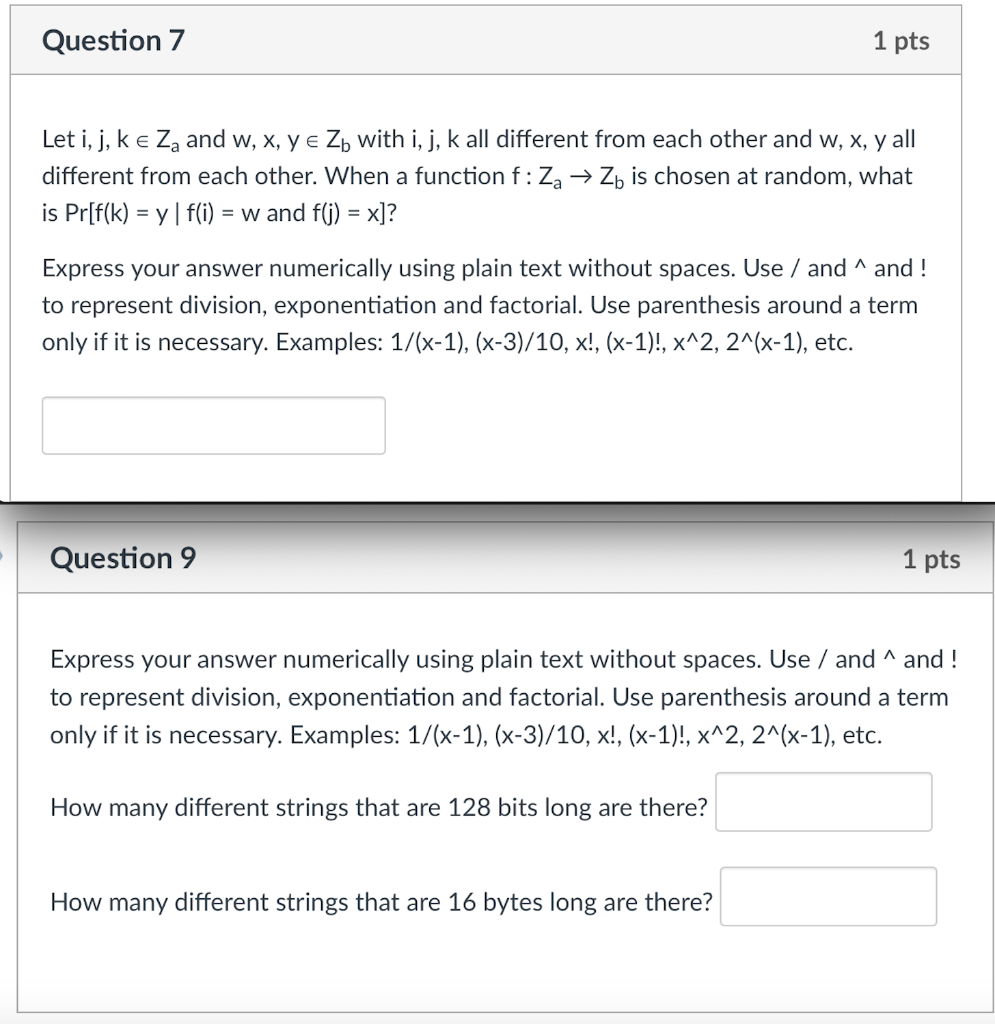
Question 7 1 pts Let i, j, k e Za and w, x, y e Zb with i, j, k all different from each other and w, x, y all different from each other. When a function f: Za Zb is chosen at random, what is Pr[f(k) = y | f(i) = w and f(j) = x]? Express your answer numerically using plain text without spaces. Use / and ^ and ! to represent division, exponentiation and factorial. Use parenthesis around a term only if it is necessary. Examples: 1/(x-1), (x-3)/10, x!, (x-1)!, x^2, 2^(x-1), etc. Question 9 1 pts Express your answer numerically using plain text without spaces. Use / and ^ and ! to represent division, exponentiation and factorial. Use parenthesis around a term only if it is necessary. Examples: 1/(x-1), (x-3)/10, x!, (x-1)!, x^2, 2^(x-1), etc. How many different strings that are 128 bits long are there? How many different strings that are 16 bytes long are there? Question 7 1 pts Let i, j, k e Za and w, x, y e Zb with i, j, k all different from each other and w, x, y all different from each other. When a function f: Za Zb is chosen at random, what is Pr[f(k) = y | f(i) = w and f(j) = x]? Express your answer numerically using plain text without spaces. Use / and ^ and ! to represent division, exponentiation and factorial. Use parenthesis around a term only if it is necessary. Examples: 1/(x-1), (x-3)/10, x!, (x-1)!, x^2, 2^(x-1), etc. Question 9 1 pts Express your answer numerically using plain text without spaces. Use / and ^ and ! to represent division, exponentiation and factorial. Use parenthesis around a term only if it is necessary. Examples: 1/(x-1), (x-3)/10, x!, (x-1)!, x^2, 2^(x-1), etc. How many different strings that are 128 bits long are there? How many different strings that are 16 bytes long are there
Step by Step Solution
There are 3 Steps involved in it

Get step-by-step solutions from verified subject matter experts
 Study Help