







Question: Question 7 6 pts Whenever you do a process flow problem, you should draw a picture. Arrows denote the flow of jobs. A triangle denotes
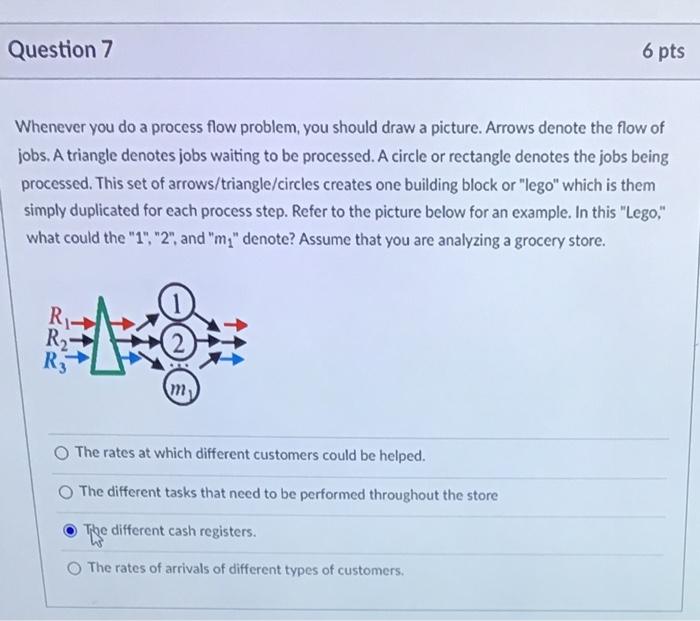
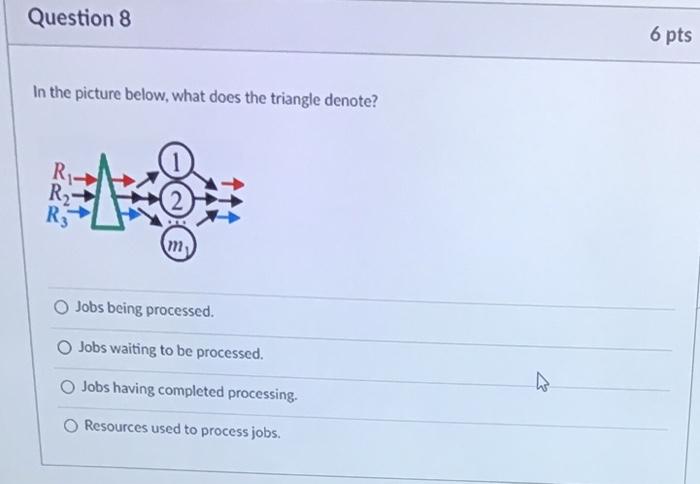
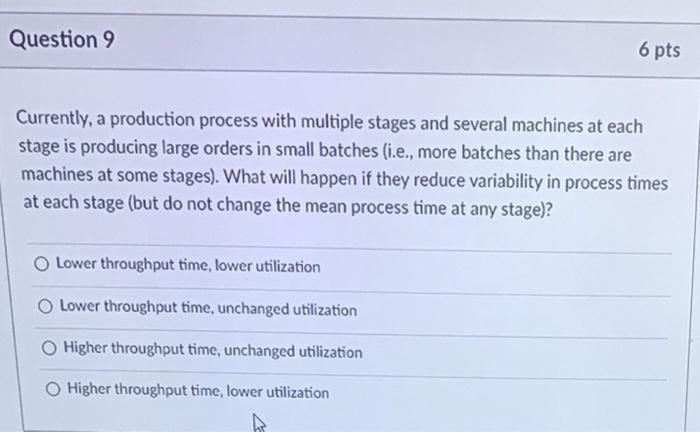
Question 7 6 pts Whenever you do a process flow problem, you should draw a picture. Arrows denote the flow of jobs. A triangle denotes jobs waiting to be processed. A circle or rectangle denotes the jobs being processed. This set of arrows/triangle/circles creates one building block or "lego" which is them simply duplicated for each process step. Refer to the picture below for an example. In this "Lego" what could the "1", "2", and "m" denote? Assume that you are analyzing a grocery store. 4308 R my The rates at which different customers could be helped. The different tasks that need to be performed throughout the store The different cash registers. The rates of arrivals of different types of customers. Question 8 6 pts In the picture below, what does the triangle denote? R * R3 m Jobs being processed. Jobs waiting to be processed. Jobs having completed processing. w O Resources used to process jobs. Question 9 6 pts Currently, a production process with multiple stages and several machines at each stage is producing large orders in small batches (i.e., more batches than there are machines at some stages). What will happen if they reduce variability in process times at each stage (but do not change the mean process time at any stage)? Lower throughput time, lower utilization Lower throughput time, unchanged utilization O Higher throughput time, unchanged utilization Higher throughput time, lower utilization
Step by Step Solution
There are 3 Steps involved in it

Get step-by-step solutions from verified subject matter experts
 Study Help