







Question: QUESTION 7 Using sample average returns and standard deviations of the volatility strategy discussed in class, calculate the optimal proportion that a mean-variance utility investor
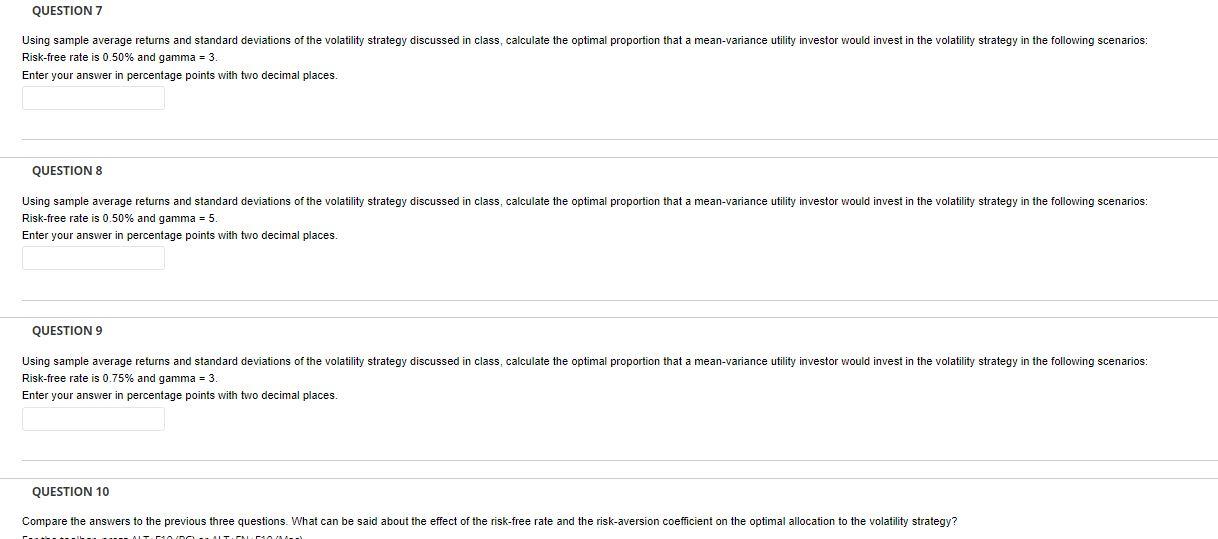
QUESTION 7 Using sample average returns and standard deviations of the volatility strategy discussed in class, calculate the optimal proportion that a mean-variance utility investor would invest in the volatility strategy in the following scenarios: Risk-free rate is 0.50% and gamma = 3. Enter your answer in percentage points with two decimal places. QUESTION 8 Using sample average returns and standard deviations of the volatility strategy discussed in class, calculate the optimal proportion that a mean-variance utility investor would invest in the volatility strategy in the following scenarios: Risk-free rate is 0.50% and gamma = 5. Enter your answer in percentage points with two decimal places. QUESTION 9 Using sample average returns and standard deviations of the volatility strategy discussed in class, calculate the optimal proportion that a mean-variance utility investor would invest in the volatility strategy in the following scenarios: Risk-free rate is 0.75% and gamma = 3. Enter your answer in percentage points with two decimal places. QUESTION 10 Compare the answers to the previous three questions. What can be said about the effect of the risk-free rate and the risk-aversion coefficient on the optimal allocation to the volatility strategy? QUESTION 7 Using sample average returns and standard deviations of the volatility strategy discussed in class, calculate the optimal proportion that a mean-variance utility investor would invest in the volatility strategy in the following scenarios: Risk-free rate is 0.50% and gamma = 3. Enter your answer in percentage points with two decimal places. QUESTION 8 Using sample average returns and standard deviations of the volatility strategy discussed in class, calculate the optimal proportion that a mean-variance utility investor would invest in the volatility strategy in the following scenarios: Risk-free rate is 0.50% and gamma = 5. Enter your answer in percentage points with two decimal places. QUESTION 9 Using sample average returns and standard deviations of the volatility strategy discussed in class, calculate the optimal proportion that a mean-variance utility investor would invest in the volatility strategy in the following scenarios: Risk-free rate is 0.75% and gamma = 3. Enter your answer in percentage points with two decimal places. QUESTION 10 Compare the answers to the previous three questions. What can be said about the effect of the risk-free rate and the risk-aversion coefficient on the optimal allocation to the volatility strategy
Step by Step Solution
There are 3 Steps involved in it

Get step-by-step solutions from verified subject matter experts
 Study Help