Question: QUESTION 8 (15 marks) Background A CBA has been conducted of a mine development project in British Columbia (BC) to supply a mineral for export.
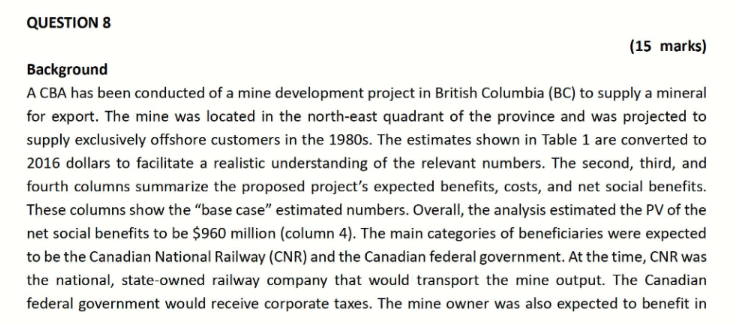
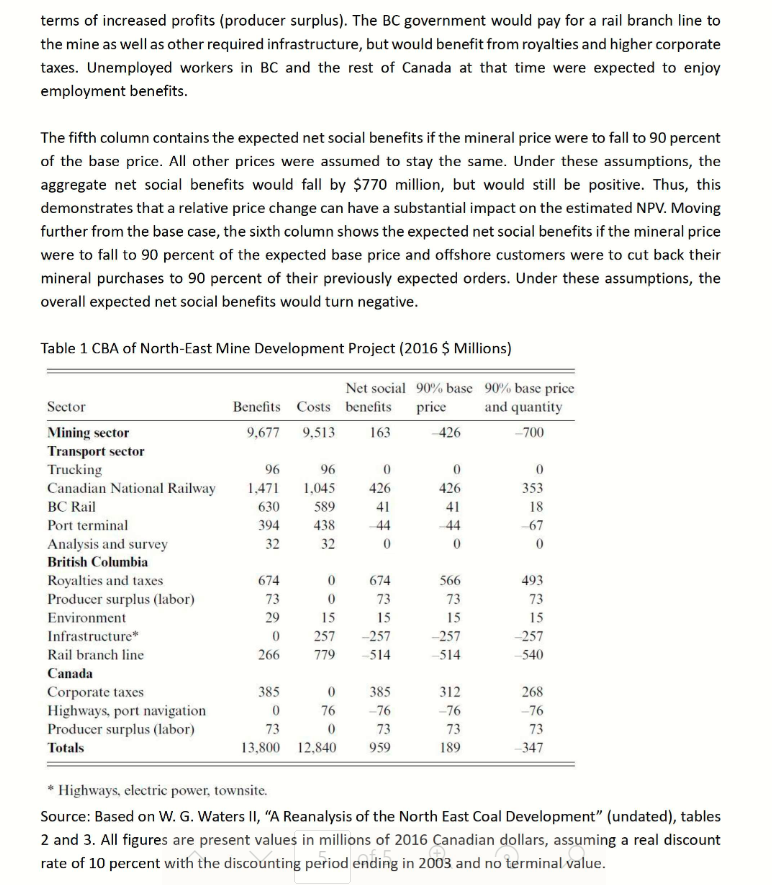
QUESTION 8 (15 marks) Background A CBA has been conducted of a mine development project in British Columbia (BC) to supply a mineral for export. The mine was located in the north-east quadrant of the province and was projected to supply exclusively offshore customers in the 1980s. The estimates shown in Table 1 are converted to 2016 dollars to facilitate a realistic understanding of the relevant numbers. The second, third, and fourth columns summarize the proposed project's expected benefits, costs, and net social benefits. These columns show the "base case" estimated numbers. Overall, the analysis estimated the PV of the net social benefits to be $960 million (column 4). The main categories of beneficiaries were expected to be the Canadian National Railway (CNR) and the Canadian federal government. At the time, CNR was the national, state-owned railway company that would transport the mine output. The Canadian federal government would receive corporate taxes. The mine owner was also expected to benefit interms of increased profits (producer surplus). The BC government would pay for a rail branch line to the mine as well as other required infrastructure, but would benefit from royalties and higher corporate taxes. Unemployed workers in BC and the rest of Canada at that time were expected to enjoy employment benefits. The fifth column contains the expected net social benefits if the mineral price were to fall to 90 percent of the base price. All other prices were assumed to stay the same. Under these assumptions, the aggregate net social benefits would fall by $770 million, but would still be positive. Thus, this demonstrates that a relative price change can have a substantial impact on the estimated NPV. Moving further from the base case, the sixth column shows the expected net social benefits if the mineral price were to fall to 90 percent of the expected base price and offshore customers were to cut back their mineral purchases to 90 percent of their previously expected orders. Under these assumptions, the overall expected net social benefits would turn negative. Table 1 CBA of North-East Mine Development Project (2016 $ Millions) Net social 90% base 90% base price Sector Benefits Costs benefits price and quantity Mining sector 9,677 9,513 163 426 -700 Transport sector Trucking 96 96 0 Canadian National Railway 1.471 1.045 426 426 353 BC Rail 630 589 41 41 18 Port terminal 394 438 44 44 67 Analysis and survey 32 32 0 British Columbia Royalties and taxes 674 0 674 566 493 Producer surplus (labor) 73 0 73 73 73 Environment 29 15 15 15 15 Infrastructure* 0 257 257 257 257 Rail branch line 266 779 514 514 540 Canada Corporate taxes 385 0 385 312 268 Highways, port navigation 0 76 -76 -76 -76 Producer surplus (labor) 73 73 73 73 Totals 13,800 12,840 959 189 -347 * Highways, electric power, townsite. Source: Based on W. G. Waters II, "A Reanalysis of the North East Coal Development" (undated), tables 2 and 3. All figures are present values in millions of 2016 Canadian dollars, assuming a real discount rate of 10 percent with the discounting period ending in 2003 and no terminal value.Task In under LOUD words, analyse the case and identify the major steps of EBA. Provide a detailed description of each major step. In any cases where information is incomplete, acknowledge the unavailability of data. Discuss whether you would describe this case as a distributional EBA. Why is there no consumer surplus included as a benefit? What weaknesses do you see in this EBA
Step by Step Solution
There are 3 Steps involved in it
1 Expert Approved Answer
Step: 1 Unlock
Question Has Been Solved by an Expert!
Get step-by-step solutions from verified subject matter experts
Step: 2 Unlock
Step: 3 Unlock
Students Have Also Explored These Related Accounting Questions!










 Study Help