





Question: Question 8 (25 pts): True or False? If False, explain (a) Shareholders can solve agency problems by selling their stock to other investors. (5 pts)
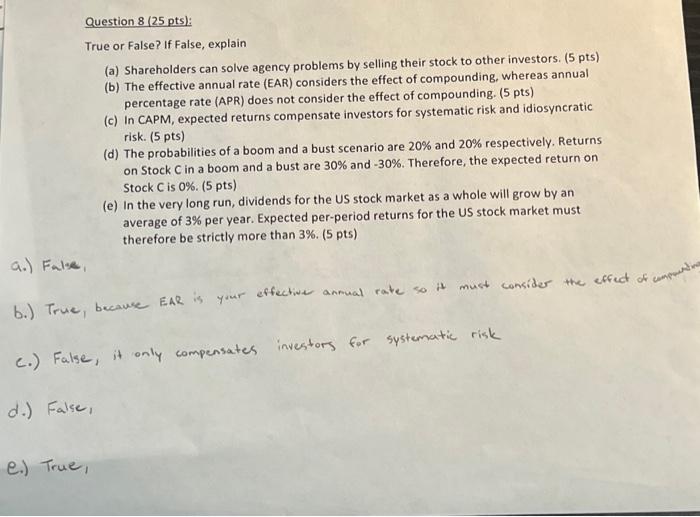
Question 8 (25 pts): True or False? If False, explain (a) Shareholders can solve agency problems by selling their stock to other investors. (5 pts) (b) The effective annual rate (EAR) considers the effect of compounding, whereas annual percentage rate (APR) does not consider the effect of compounding. (5 pts) (c) In CAPM, expected returns compensate investors for systematic risk and idiosyncratic risk. (5 pts) a.) False, b.) True, because EAR is your effective annual rate so it must consider the effect of compounding d.) False, (d) The probabilities of a boom and a bust scenario are 20% and 20% respectively. Returns on Stock C in a boom and a bust are 30% and -30%. Therefore, the expected return on Stock C is 0%. (5 pts) (e) In the very long run, dividends for the US stock market as a whole will grow by an average of 3% per year. Expected per-period returns for the US stock market must therefore be strictly more than 3%. (5 pts) C.) False, it only compensates investors for systematic risk e.) True,
Part B and C are correct so explain why Part A and D are false and then explain why Part E is true
 Question 8 (25 pts): True or False? If False, explain (a)

Question 8 (25 pts): True or False? If False, explain (a) Shareholders can solve agency problems by selling their stock to other investors. ( 5 pts) (b) The effective annual rate (EAR) considers the effect of compounding, whereas annual percentage rate (APR) does not consider the effect of compounding. (5 pts) (c) In CAPM, expected returns compensate investors for systematic risk and idiosyncratic risk. (5 pts) (d) The probabilities of a boom and a bust scenario are 20% and 20% respectively. Returns on Stock C in a boom and a bust are 30% and 30%. Therefore, the expected return on Stock C is 0%. (5 pts) (e) In the very long run, dividends for the US stock market as a whole will grow by an average of 3% per year. Expected per-period returns for the US stock market must therefore be strictly more than 3%. (5 pts)

Step by Step Solution

There are 3 Steps involved in it

1 Expert Approved Answer
Step: 1 Unlock blur-text-image
Question Has Been Solved by an Expert!

Get step-by-step solutions from verified subject matter experts

Step: 2 Unlock
Step: 3 Unlock

Students Have Also Explored These Related Finance Questions!