







Question: Question 8: The theoretical Bit Error Rate (BER) for MFSK and MPSK encoding techniques is illustrated in the following charts. Probability of bit error (BER)
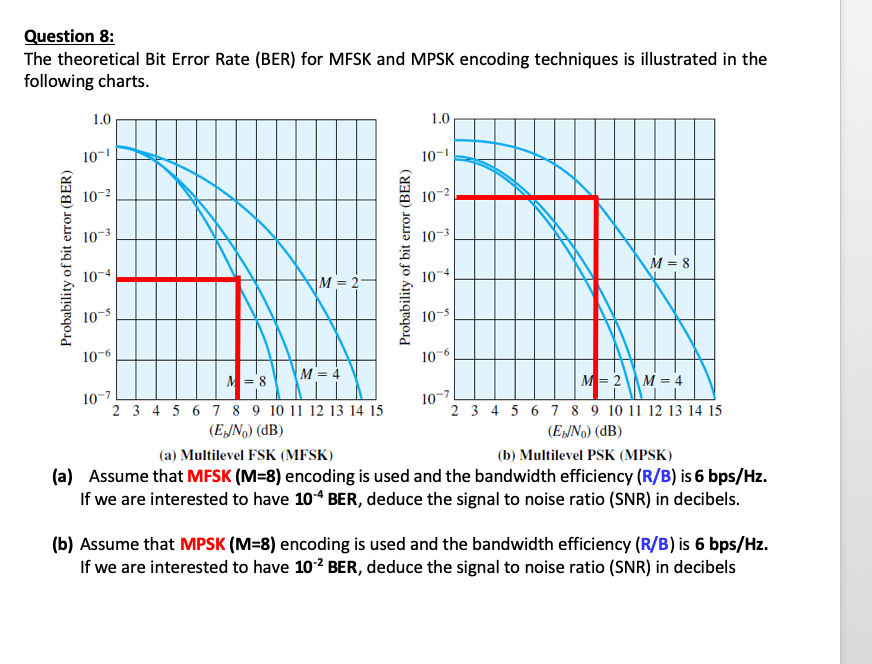
Question 8: The theoretical Bit Error Rate (BER) for MFSK and MPSK encoding techniques is illustrated in the following charts. Probability of bit error (BER) Probability of bit error (BER) M = 8 S YM=4 = 2 M = 4 10-7 2 3 4 5 6 7 8 9 10 11 12 13 14 15 1 2 3 4 5 6 7 8 9 10 11 12 13 14 15 ( EN) (dB) ( EN) (dB) (a) Multilevel FSK (MFSK) (b) Multilevel PSK (MPSK) (a) Assume that MFSK (M=8) encoding is used and the bandwidth efficiency (R/B) is 6 bps/Hz. If we are interested to have 10-4 BER, deduce the signal to noise ratio (SNR) in decibels. (b) Assume that MPSK (M=8) encoding is used and the bandwidth efficiency (R/B) is 6 bps/Hz. If we are interested to have 10-2 BER, deduce the signal to noise ratio (SNR) in decibels Question 8: The theoretical Bit Error Rate (BER) for MFSK and MPSK encoding techniques is illustrated in the following charts. Probability of bit error (BER) Probability of bit error (BER) M = 8 S YM=4 = 2 M = 4 10-7 2 3 4 5 6 7 8 9 10 11 12 13 14 15 1 2 3 4 5 6 7 8 9 10 11 12 13 14 15 ( EN) (dB) ( EN) (dB) (a) Multilevel FSK (MFSK) (b) Multilevel PSK (MPSK) (a) Assume that MFSK (M=8) encoding is used and the bandwidth efficiency (R/B) is 6 bps/Hz. If we are interested to have 10-4 BER, deduce the signal to noise ratio (SNR) in decibels. (b) Assume that MPSK (M=8) encoding is used and the bandwidth efficiency (R/B) is 6 bps/Hz. If we are interested to have 10-2 BER, deduce the signal to noise ratio (SNR) in decibels
Step by Step Solution
There are 3 Steps involved in it

Get step-by-step solutions from verified subject matter experts
 Study Help