







Question: QUESTION 9 0.5 points Save Answer Hard money: O) cannot always be used in transactions immediately, but is accessible. O includes cash. is the least
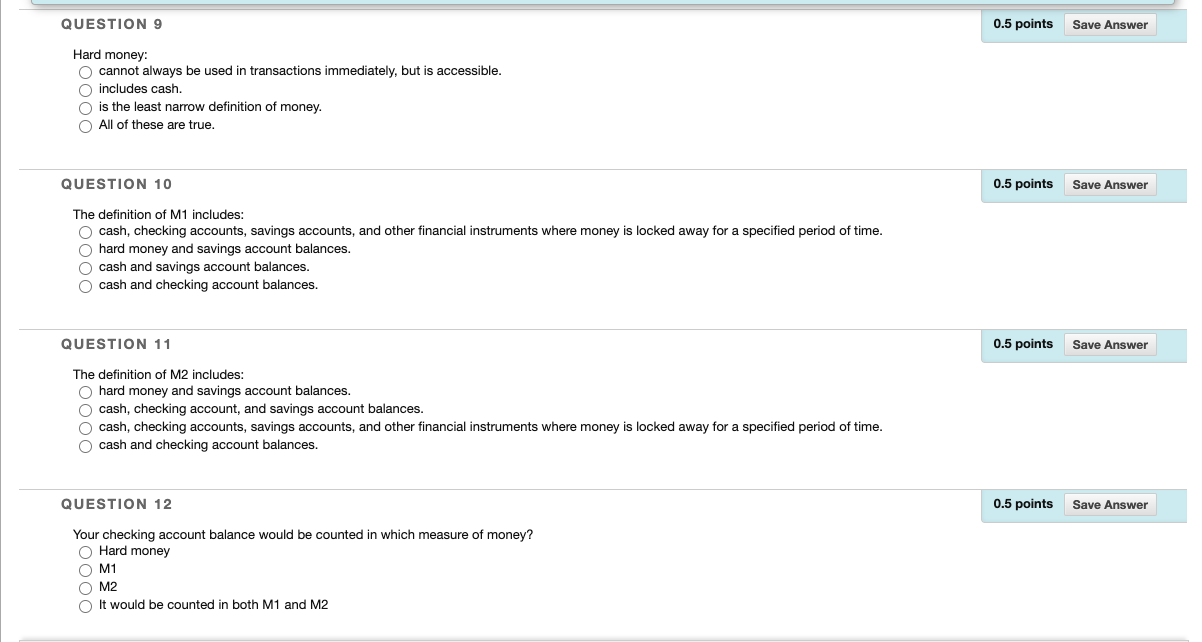

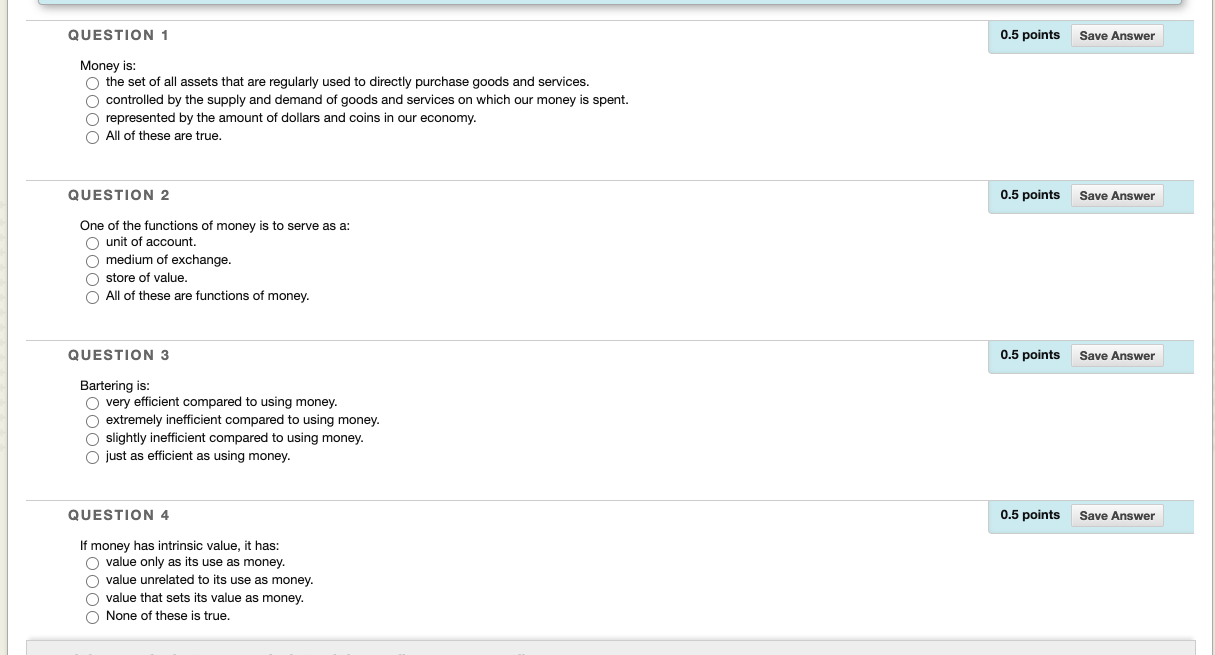
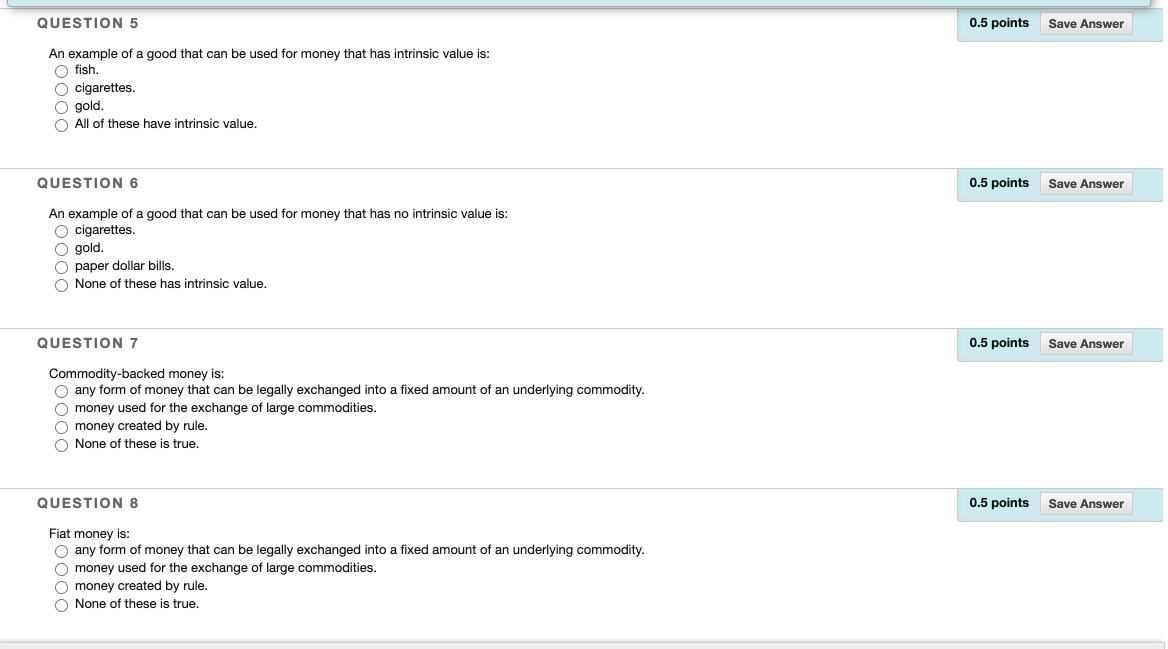
QUESTION 9 0.5 points Save Answer Hard money: O) cannot always be used in transactions immediately, but is accessible. O includes cash. is the least narrow definition of money. All of these are true. QUESTION 10 0.5 points Save Answer The definition of M1 includes: O cash, checking accounts, savings accounts, and other financial instruments where money is locked away for a specified period of time. O hard money and savings account balances. cash and savings account balances. O cash and checking account balances. QUESTION 11 0.5 points Save Answer The definition of M2 includes: O hard money and savings account balances. O cash, checking account, and savings account balances. cash, checking accounts, savings accounts, and other financial instruments where money is locked away for a specified period of time. O cash and checking account balances. QUESTION 12 0.5 points Save Answer Your checking account balance would be counted in which measure of money? O Hard money O M O M2 O It would be counted in both M1 and M2QUESTION 13 0.5 points Save Answer Your savings account balance would be counted in which measure of money? O M1 O Hard money M2 O It would be counted in both M1 and M2QUESTION 1 0.5 points Save Answer Money is: O the set of all assets that are regularly used to directly purchase goods and services. O controlled by the supply and demand of goods and services on which our money is spent. O represented by the amount of dollars and coins in our economy. O All of these are true. QUESTION 2 0.5 points Save Answer One of the functions of money is to serve as a: O unit of account O medium of exchange. O store of value. O All of these are functions of money. QUESTION 3 0.5 points Save Answer Bartering is: O very efficient compared to using money. O extremely inefficient compared to using money. O slightly inefficient compared to using money. just as efficient as using money. QUESTION 4 0.5 points Save Answer If money has intrinsic value, it has: O value only as its use as money. O value unrelated to its use as money. value that sets its value as money. O None of these is true.QUESTION 5 0.5 points Save Answer An example of a good that can be used for money that has intrinsic value is: O fish. O cigarettes. gold. All of these have intrinsic value. QUESTION 6 0.5 points Save Answer An example of a good that can be used for money that has no intrinsic value is: O cigarettes. O gold. paper dollar bills. None of these has intrinsic value. QUESTION 7 0.5 points Save Answer Commodity-backed money is: O any form of money that can be legally exchanged into a fixed amount of an underlying commodity. money used for the exchange of large commodities. money created by rule. None of these is true. QUESTION 8 0.5 points Save Answer Fiat money is: O any form of money that can be legally exchanged into a fixed amount of an underlying commodity. money used for the exchange of large commodities. money created by rule. None of these is true
Step by Step Solution
There are 3 Steps involved in it

Get step-by-step solutions from verified subject matter experts
 Study Help