







Question: Question 9. Given the root locus of a unity feedback system whose open-loop transfer function is, K G(s) = s(s+3)(s + 2s + 2)
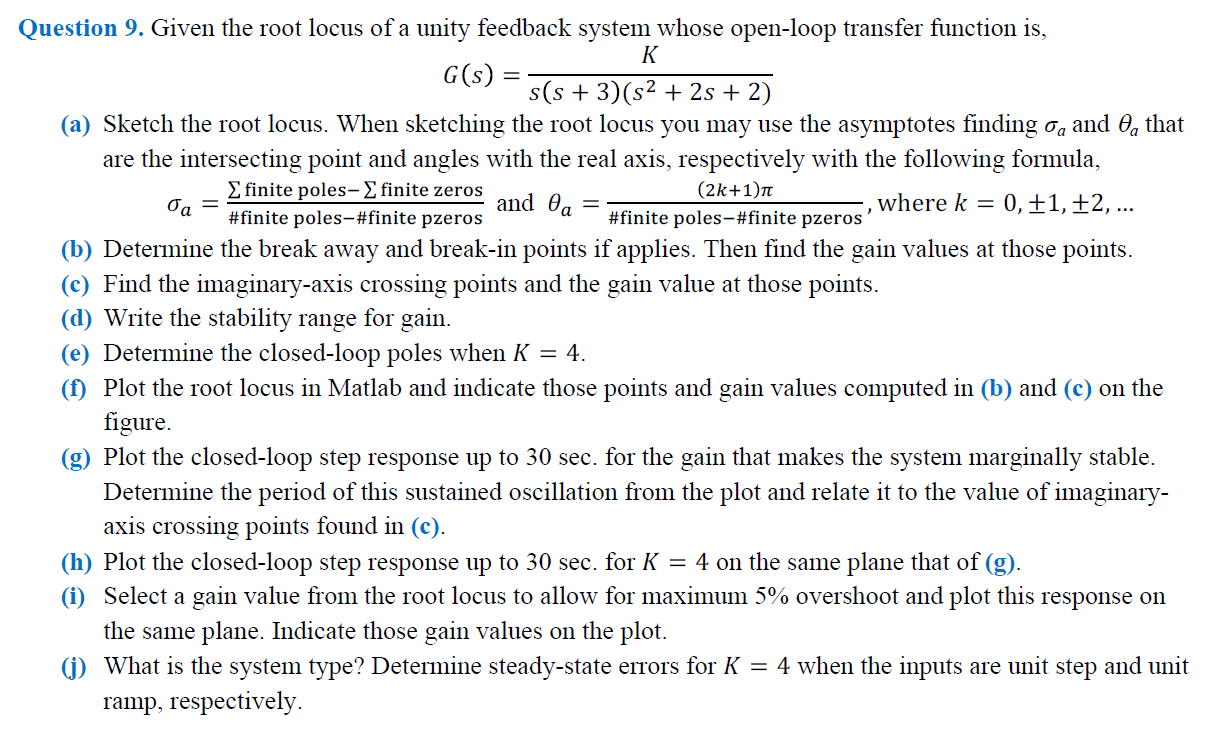
Question 9. Given the root locus of a unity feedback system whose open-loop transfer function is, K G(s) = s(s+3)(s + 2s + 2) (a) Sketch the root locus. When sketching the root locus you may use the asymptotes finding and that are the intersecting point and angles with the real axis, respectively with the following formula, (2k+1) and a = finite poles- finite zeros #finite poles-#finite pzeros where k = 0, +1, +2, ... #finite poles-#finite pzeros (b) Determine the break away and break-in points if applies. Then find the gain values at those points. (c) Find the imaginary-axis crossing points and the gain value at those points. (d) Write the stability range for gain. ) (e) Determine the closed-loop poles when K = 4. (f) Plot the root locus in Matlab and indicate those points and gain values computed in (b) and (c) on the figure. (g) Plot the closed-loop step response up to 30 sec. for the gain that makes the system marginally stable. Determine the period of this sustained oscillation from the plot and relate it to the value of imaginary- axis crossing points found in (c). (h) Plot the closed-loop step response up to 30 sec. for K = 4 on the same plane that of (g). (i) Select a gain value from the root locus to allow for maximum 5% overshoot and plot this response on the same plane. Indicate those gain values on the plot. (j) What is the system type? Determine steady-state errors for K = 4 when the inputs are unit step and unit ramp, respectively.
Step by Step Solution
3.51 Rating (161 Votes )
There are 3 Steps involved in it
To solve this problem Ill guide you through each part systematically a Sketching the Root Locus 1 Openloop Transfer Function Gs fracKss3s2 2s 2 2 Pole... View full answer

Get step-by-step solutions from verified subject matter experts
 Study Help