







Question: Question: A researcher wants to test whether production errors differ by time of day (Day, Evening, and Nigh shift). She randomly assigns a group of
Question:
A researcher wants to test whether production errors differ by time of day (Day, Evening, and Nigh shift). She randomly assigns a group of accountants to each of three different shifts and measures the number of errors they make per month. She obtains the following results:
Test for a difference at ? = .05
Day
?X = 11
?2 =23
n = 6
Evening
?X=27
?2=163
n = 6
Night
?X=36?
?2=273
n = 6
STEP 1: State the null and alternative hypotheses. (2 points)
STEP 2: Set up the criteria for making a decision. That is, find the critical value.(1 point)
STEP 3: Compute the appropriate test-statistic. Show your work! (12 points)
(I have computed SStot for you)
Rows: Source Between Within Total
Columns: SS df MS F
SS of within: 101.3
STEP 4: Evaluate the null hypothesis (based on your answers to the above steps).(1 point)
STEP 5: Based on your evaluation of the null hypothesis, what is your conclusion?(1point)
A. Based on your decision about the null in the previous problem, is it appropriate to conduct a post-hoc test? (1 point)
B. Calculate the magnitude of effect for the pQuestion:
A researcher wants to test whether production errors differ by time of day (Day, Evening, and Nigh shift). She randomly assigns a group of accountants to each of three different shifts and measures the number of errors they make per month. She obtains the following results:
Test for a difference at ? = .05
Day
?X = 11
?2 =23
n = 6
Evening
?X=27
?2=163
n = 6
Night
?X=36?
?2=273
n = 6
STEP 1: State the null and alternative hypotheses. (2 points)
STEP 2: Set up the criteria for making a decision. That is, find the critical value.(1 point)
STEP 3: Compute the appropriate test-statistic. Show your work! (12 points)
(I have computed SStot for you)
Rows: Source Between Within Total
Columns: SS df MS F
SS of within: 101.3
STEP 4: Evaluate the null hypothesis (based on your answers to the above steps).(1 point)
STEP 5: Based on your evaluation of the null hypothesis, what is your conclusion?(1point)
A. Based on your decision about the null in the previous problem, is it appropriate to conduct a post-hoc test? (1 point)
B. Calculate the magnitude of effect for the previous problem and interpret what it means. (2 points)revious problem and interpret what it means. (2 points)
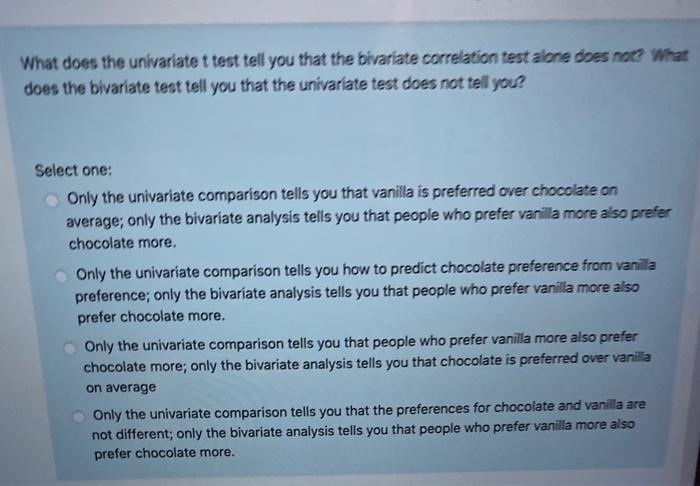
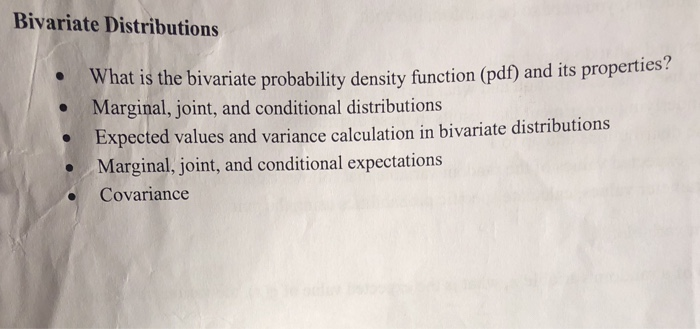
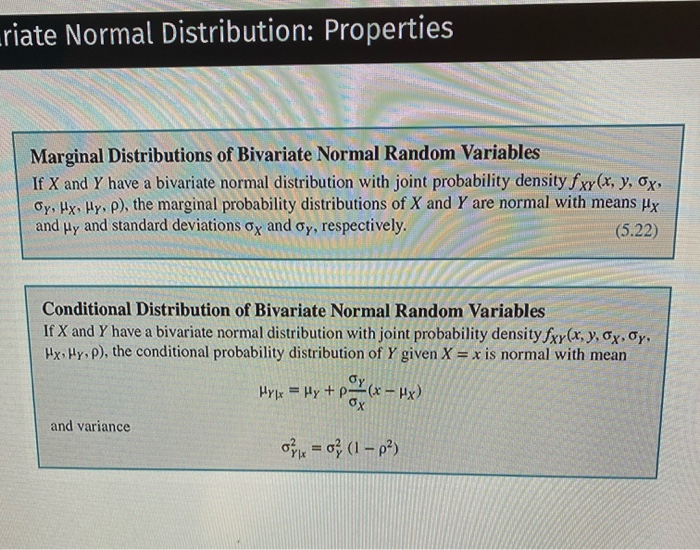
What does the univariate t test tell you that the bivariate correlation test alone does not? What does the bivariate test tell you that the univariate test does not tell you? Select one: Only the univariate comparison tells you that vanilla is preferred over chocolate on average; only the bivariate analysis tells you that people who prefer vanilla more also prefer chocolate more. Only the univariate comparison tells you how to predict chocolate preference from vanilla preference; only the bivariate analysis tells you that people who prefer vanilla more also prefer chocolate more. Only the univariate comparison tells you that people who prefer vanilla more also prefer chocolate more; only the bivariate analysis tells you that chocolate is preferred over vanilla on average Only the univariate comparison tells you that the preferences for chocolate and vanilla are not different; only the bivariate analysis tells you that people who prefer vanilla more also prefer chocolate more.Bivariate Distributions What is the bivariate probability density function (pdf) and its properties? Marginal, joint, and conditional distributions Expected values and variance calculation in bivariate distributions Marginal, joint, and conditional expectations Covarianceriate Normal Distribution: Properties Marginal Distributions of Bivariate Normal Random Variables If X and Y have a bivariate normal distribution with joint probability density fxy(x, y, ox. Oy, Hy, Hy, p), the marginal probability distributions of X and Y are normal with means Hy and py and standard deviations ox and oy, respectively. (5.22) Conditional Distribution of Bivariate Normal Random Variables If X and Y have a bivariate normal distribution with joint probability density fxy(x, y, ox. Or, Hx, Hy, p), the conditional probability distribution of Y given X = x is normal with mean Hylx = Hy + P- (x- Hx) and variance ONLY = o? (1 - p? )
Step by Step Solution
There are 3 Steps involved in it

Get step-by-step solutions from verified subject matter experts
 Study Help