







Question: Question: A researcher wants to test whether production errors differ by time of day (Day, Evening, and Nigh shift). She randomly assigns a group of
Question:
A researcher wants to test whether production errors differ by time of day (Day, Evening, and Nigh shift). She randomly assigns a group of accountants to each of three different shifts and measures the number of errors they make per month. She obtains the following results:
Test for a difference at ? = .05
Day
?X = 11
?2 =23
n = 6
Evening
?X=27
?2=163
n = 6
Night
?X=36?
?2=273
n = 6
STEP 1: State the null and alternative hypotheses. (2 points)
STEP 2: Set up the criteria for making a decision. That is, find the critical value.(1 point)
STEP 3: Compute the appropriate test-statistic. Show your work! (12 points)
(I have computed SStot for you)
Rows: Source Between Within Total
Columns: SS df MS F
SS of within: 101.3
STEP 4: Evaluate the null hypothesis (based on your answers to the above steps).(1 point)
STEP 5: Based on your evaluation of the null hypothesis, what is your conclusion?(1point)
A. Based on your decision about the null in the previous problem, is it appropriate to conduct a post-hoc test? (1 point)
B. Calculate the magnitude of effect for the previous problem and interpret what it means. (2 points)
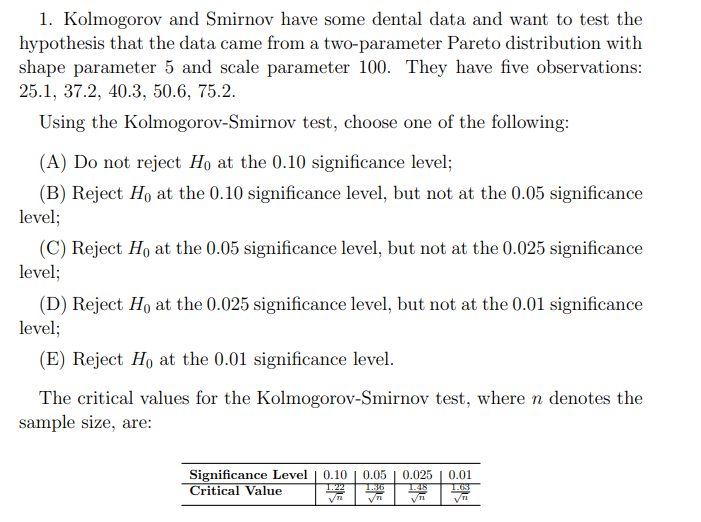
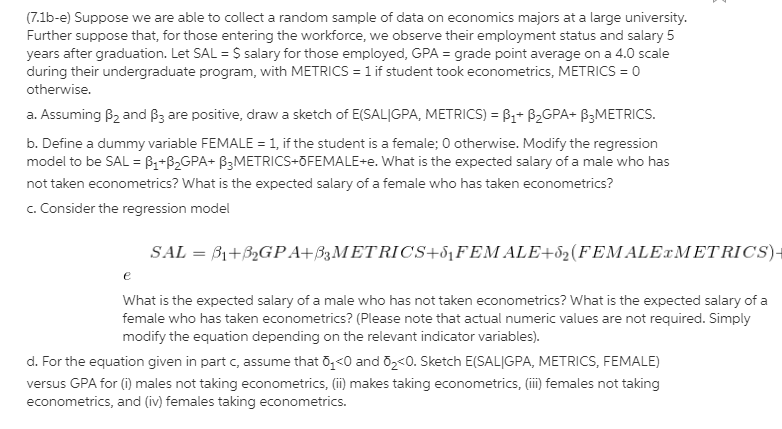
1. Kolmogorov and Smirnov have some dental data and want to test the hypothesis that the data came from a two-parameter Pareto distribution with shape parameter 5 and scale parameter 100. They have five observations: 25.1, 37.2, 40.3, 50.6, 75.2. Using the Kolmogorov-Smirnov test, choose one of the following: (A) Do not reject Ho at the 0.10 significance level; (B) Reject Ho at the 0.10 significance level, but not at the 0.05 significance level; (C) Reject Ho at the 0.05 significance level, but not at the 0.025 significance level; (D) Reject Ho at the 0.025 significance level, but not at the 0.01 significance level; (E) Reject Ho at the 0.01 significance level. The critical values for the Kolmogorov-Smirnov test, where n denotes the sample size, are: Significance Level | 0.10 | 0.05 | 0.025 0.01 Critical Value 1.22(7.1b-e) Suppose we are able to collect a random sample of data on economics majors at a large university. Further suppose that, for those entering the workforce, we observe their employment status and salary 5 years after graduation. Let SAL = $ salary for those employed, GPA = grade point average on a 4.0 scale during their undergraduate program, with METRICS = 1 if student took econometrics, METRICS = 0 otherwise. a. Assuming B2 and B; are positive, draw a sketch of E(SALIGPA, METRICS) = By+ $2GPA+ B; METRICS. b. Define a dummy variable FEMALE = 1, if the student is a female; 0 otherwise. Modify the regression model to be SAL = B,+B2GPA+ B; METRICS+OFEMALE+e. What is the expected salary of a male who has not taken econometrics? What is the expected salary of a female who has taken econometrics? c. Consider the regression model SAL = 1+BGPA+3METRICS+6, FEMALE+52 (FEMALE:METRICS)- e What is the expected salary of a male who has not taken econometrics? What is the expected salary of a female who has taken econometrics? (Please note that actual numeric values are not required. Simply modify the equation depending on the relevant indicator variables). d. For the equation given in part c, assume that 6,
Step by Step Solution
There are 3 Steps involved in it

Get step-by-step solutions from verified subject matter experts
 Study Help