







Question: Question a,b,c and d Assignment Booklet 7 Unit 7: Logarithmic Functions 10. The Spanish flu was a worldwide epidemic that began in 1918 and lasted
Question a,b,c and d
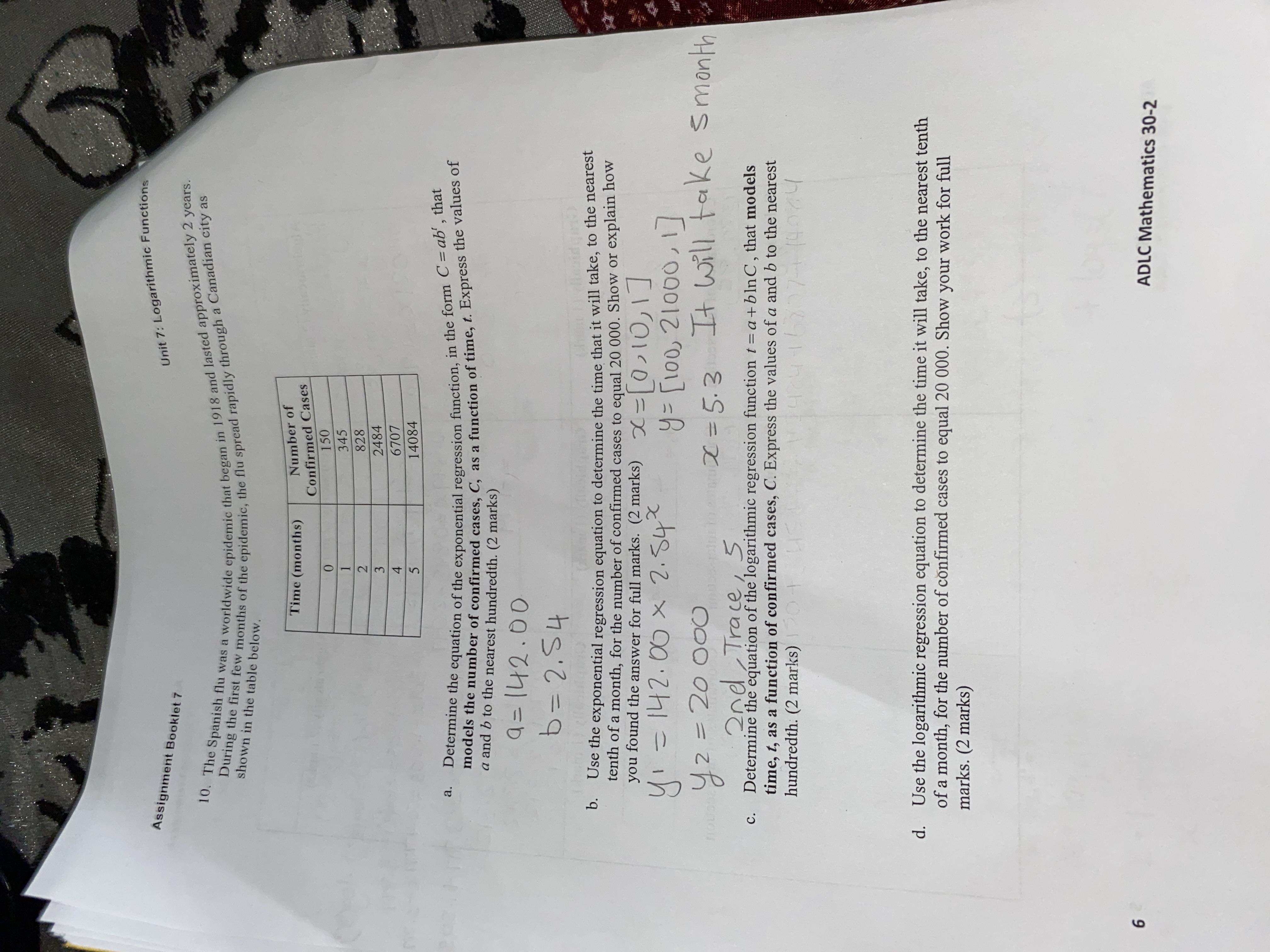
Assignment Booklet 7 Unit 7: Logarithmic Functions 10. The Spanish flu was a worldwide epidemic that began in 1918 and lasted approximately 2 years During the first few months of the epidemic, t shown in the table below. epidemic, the flu spread rapidly through a Canadian city as Time (months) Number of Confirmed Cases 150 345 828 2484 6707 14084 a. Determine the equation of the exponential regression function, in the form C = ab' , that models the number of confirmed cases, C, as a function of time, t. Express the values of a and b to the nearest hundredth. (2 marks) 9 = 142.00 6 = 2.54 b. Use the exponential regression equation to determine the time that it will take, to the nearest tenth of a month, for the number of confirmed cases to equal 20 000. Show or explain how you found the answer for full marks. (2 marks) = [0- 10, 17 41 = 142. 00 x 2.54x yz = 20 000 y= [100, 21000 , 1 ] C . and, Trace, 5 X = 5.3 It will take smonth Determine the equation of the logarithmic regression function t = a + bInC, that models time, t, as a function of confirmed cases, C. Express the values of a and b to the nearest hundredth. (2 marks) 14084 d. Use the logarithmic regression equation to determine the time it will take, to the nearest tenth marks. (2 marks) of a month, for the number of confirmed cases to equal 20 000. Show your work for full ADLC Mathematics 30-2
Step by Step Solution
There are 3 Steps involved in it

Get step-by-step solutions from verified subject matter experts
 Study Help