







Question: Question about complete graphs and shortest path. I understand somewhat the first a) and b), but I am having a problem to come up with
Question about complete graphs and shortest path. I understand somewhat the first a) and b), but I am having a problem to come up with an example for c) , and how to do d).
thank you in adance!
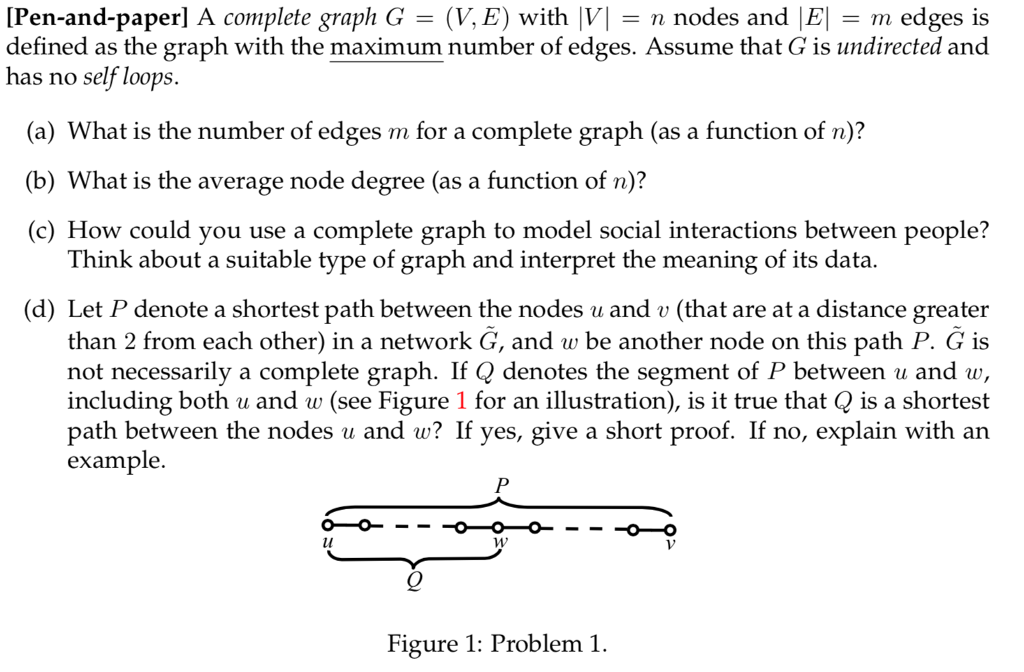
[Pen-and-paper] A complete graph G -V, E) with V nodes and |E edges is defined as the graph with the maximum number of edges. Assume that G is undirected and has no self loops. (a) What is the number of edges m for a complete graph (as a function of n)? (b) What is the average node degree (as a function of n)? (c) How could you use a complete graph to model social interactions between people? Think about a suitable type of graph and interpret the meaning of its data. (d) Let P denote a shortest path between the nodes u and v (that are at a distance greater than 2 from each other) in a network G, and w be another node on this path P. G is not necessarily a complete graph. If Q denotes the segment of P between u and w, including both u and w (see Figure 1 for an illustration), is it true that Q is a shortest path between the nodes u and w? If yes, give a short proof. If no, explain with an example. Figure 1: Problem 1
Step by Step Solution
There are 3 Steps involved in it

Get step-by-step solutions from verified subject matter experts
 Study Help