







Question: Question: Aggregate Demand and Aggregate Supply Table 1: (1) (2) (3) (4) (5) (6) Price Aggregate Total Output Output Output Level Output Employment Demanded Demanded
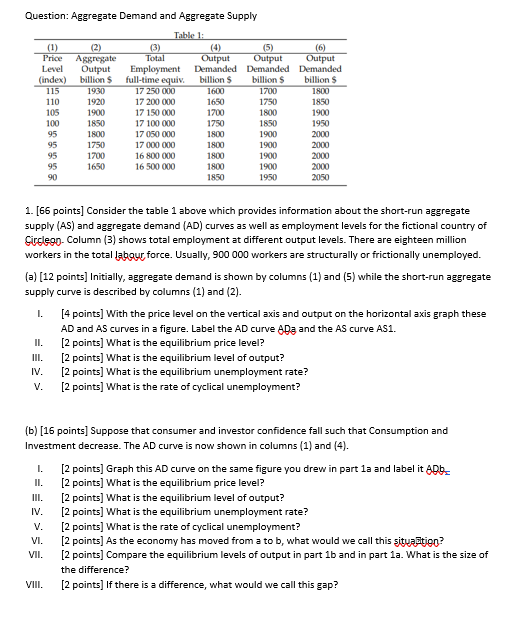
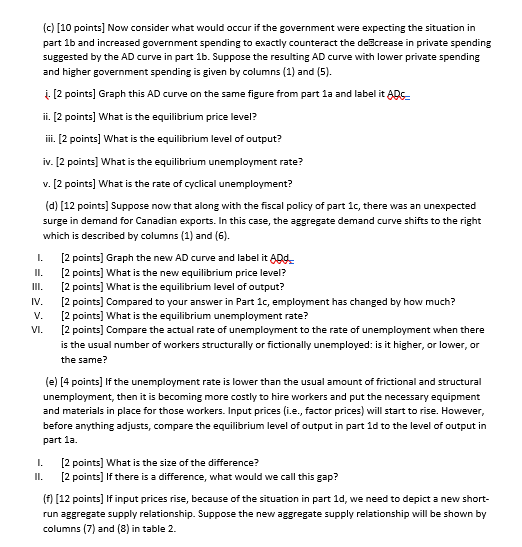
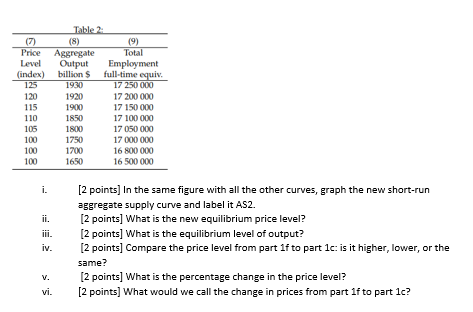
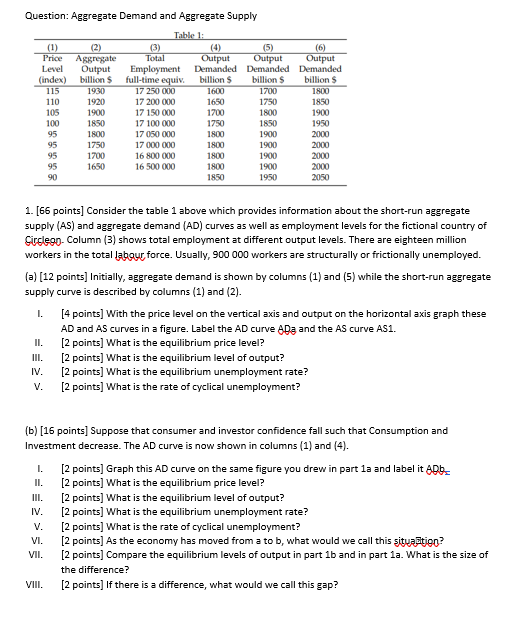
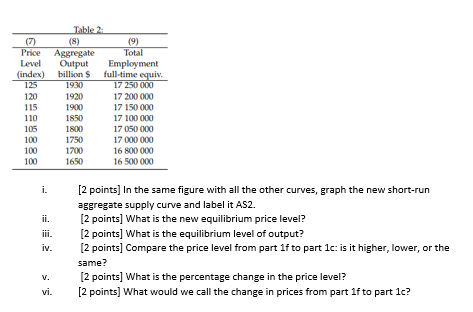
Question: Aggregate Demand and Aggregate Supply Table 1: (1) (2) (3) (4) (5) (6) Price Aggregate Total Output Output Output Level Output Employment Demanded Demanded Demanded (index) billion $ full-time equiv billion $ billion $ billion $ 115 1930 17 250 000 1600 170 1800 110 1920 17 200 000 1650 1750 1850 105 1900 17 150 000 1700 1800 1900 100 1850 17 100 000 1750 1850 1950 95 1800 17 050 000 1800 1900 2000 95 1750 17 000 000 1800 1900 2000 95 1700 16 800 000 1800 1900 2000 95 1650 16 500 000 1:800 1900 2000 90 1850 1950 2050 1. [66 points] Consider the table 1 above which provides information about the short-run aggregate supply (AS) and aggregate demand (AD) curves as well as employment levels for the fictional country of Circleon- Column (3) shows total employment at different output levels. There are eighteen million workers in the total labour force. Usually, 900 000 workers are structurally or frictionally unemployed. (a) [12 points] Initially, aggregate demand is shown by columns (1) and (5) while the short-run aggregate supply curve is described by columns (1) and (2). 1. [4 points] With the price level on the vertical axis and output on the horizontal axis graph these AD and AS curves in a figure. Label the AD curve 808 and the AS curve AS1. II. [2 points] What is the equilibrium price level? III. [2 points] What is the equilibrium level of output? IV. [2 points] What is the equilibrium unemployment rate? V. [2 points] What is the rate of cyclical unemployment? (b) [16 points] Suppose that consumer and investor confidence fall such that Consumption and Investment decrease. The AD curve is now shown in columns (1) and (4). 1. [2 points] Graph this AD curve on the same figure you drew in part la and label it 60b II. [2 points] What is the equilibrium price level? III. [2 points] What is the equilibrium level of output? IV. [2 points] What is the equilibrium unemployment rate? V. [2 points] What is the rate of cyclical unemployment? VI. [2 points] As the economy has moved from a to b, what would we call this situation? VII. [2 points] Compare the equilibrium levels of output in part 1b and in part 1a. What is the size of the difference? VIII. [2 points] If there is a difference, what would we call this gap?(c) [10 points] Now consider what would occur if the government were expecting the situation in part 16 and increased government spending to exactly counteract the decrease in private spending suggested by the AD curve in part 1b. Suppose the resulting AD curve with lower private spending and higher government spending is given by columns (1) and (5). i. [2 points] Graph this AD curve on the same figure from part 1a and label it 806- ii. [2 points] What is the equilibrium price level? iii. [2 points] What is the equilibrium level of output? iv. [2 points] What is the equilibrium unemployment rate? v. [2 points] What is the rate of cyclical unemployment? (d) [12 points] Suppose now that along with the fiscal policy of part 1c, there was an unexpected surge in demand for Canadian exports. In this case, the aggregate demand curve shifts to the right which is described by columns (1) and (6). 1. [2 points] Graph the new AD curve and label it 80d II. [2 points] What is the new equilibrium price level? III. [2 points] What is the equilibrium level of output? IV. [2 points] Compared to your answer in Part 1c, employment has changed by how much? V. [2 points] What is the equilibrium unemployment rate? VI. [2 points] Compare the actual rate of unemployment to the rate of unemployment when there is the usual number of workers structurally or fictionally unemployed: is it higher, or lower, or the same? (e) [4 points] If the unemployment rate is lower than the usual amount of frictional and structural unemployment, then it is becoming more costly to hire workers and put the necessary equipment and materials in place for those workers. Input prices (i.e., factor prices) will start to rise. However, before anything adjusts, compare the equilibrium level of output in part 1d to the level of output in part 1a. 1. [2 points] What is the size of the difference? II. [2 points] If there is a difference, what would we call this gap? (f) [12 points] If input prices rise, because of the situation in part 1d, we need to depict s new short- run aggregate supply relationship. Suppose the new aggregate supply relationship will be shown by columns (7) and (8) in table 2.Table 2 (7) (9) Price Aggregate Total Level Output Employment (index) billion $ full-time equiv. 125 1930 17 250 000 120 1920 17 200 000 115 1900 17 150 000 110 1850 17 100 000 105 1800 17 050 000 100 1750 17 000 000 100 1700 16 800 000 100 1650 16 500 000 i. [2 points] In the same figure with all the other curves, graph the new short-run aggregate supply curve and label it AS2. ii. [2 points] What is the new equilibrium price level? ili. [2 points] What is the equilibrium level of output? iv. [2 points] Compare the price level from part if to part 1c: is it higher, lower, or the same? V. [2 points] What is the percentage change in the price level? vi. [2 points] What would we call the change in prices from part if to part 1c
Step by Step Solution
There are 3 Steps involved in it

Get step-by-step solutions from verified subject matter experts
 Study Help