







Question: Question: Assuming that acetaminophen does not affect social pain at all (i.e., assuming the null hypothesis is true), creat a distribution of sample mean differences
Question:
Assuming that acetaminophen does not affect social pain at all (i.e., assuming the null hypothesis is true), creat a distribution of sample mean differences based on the two sample sizes of ndrug = 31 and ncontrol = 31. This distribution represents the frequency of all possible sample mean differences when both sample sizes are 31. You should label the frequency histogram so that it is centered on the sample mean difference you expect if the null is true. Look back at your answer to Question 6 to determine what the mean of the distribution of sample means should be if the null hypothesis is true.
After you label the mean, label each standard error of the mean to the right and left of the mean. You computed the standard error of the mean in Question 8.
Next, use the independent t formula to determine the t score associated with each sample mean difference. In other words, convert each raw mean difference score on the distribution into a t value.
Finally, label the critical t value and shade the critical region. You will need to consult a critical t value table to locate the critical value of t.
QUESTION: What would happen to the probability of each of the following if a one-tailed, ? = .01 significance test was used instead of a one-tailed, ? = .05 significance test? Indicate if each would increase, decrease, or stay the same.
Type I error:?Increase?Decrease?Stay the same
Type II error:?Increase?Decrease?Stay the same
Statistical power:?Increase?Decrease?Stay the same
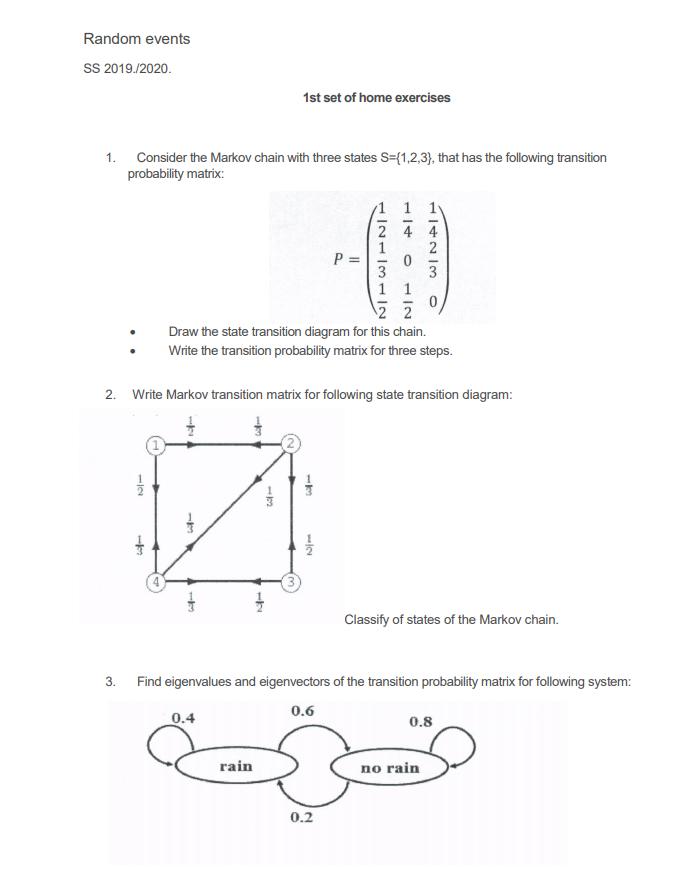
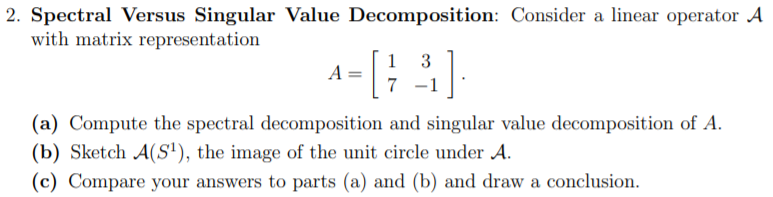
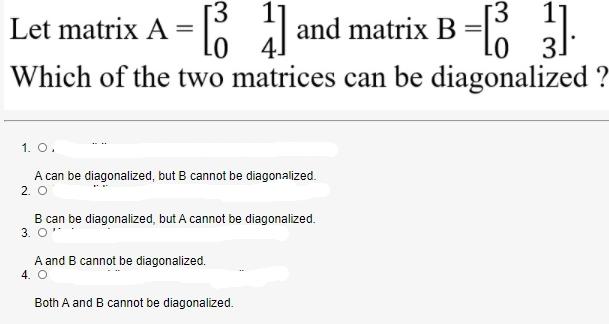
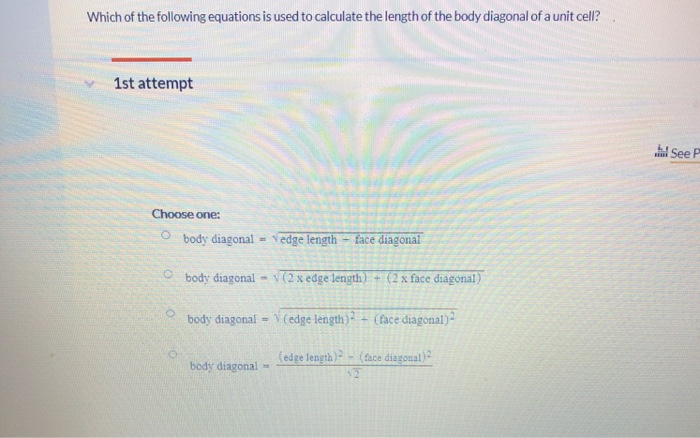
Random events SS 2019./2020. 1st set of home exercises 1. Consider the Markov chain with three states S=(1,2,3), that has the following transition probability matrix: WINPIE P = N/H O O Draw the state transition diagram for this chain. Write the transition probability matrix for three steps. 2. Write Markov transition matrix for following state transition diagram: 4 Classify of states of the Markov chain. 3. Find eigenvalues and eigenvectors of the transition probability matrix for following system: 0.4 0.6 0.8 rain no rain 0.22. Spectral Versus Singular Value Decomposition: Consider a linear operator A with matrix representation 1 3 A _ [7 _1] (a) Compute the spectral decomposition and singular 1mlue decomposition of A. (1:) Sketch ANSI}, the image of the unit circle under .A. (c) Compare your answers to parts (a) and {b} and draw a conclusion. Let matrix A : and matrix B Which of the two matrices can be diagonalized ? 1. 0 . A can be diagonalized, but B cannot be diagonalized. 2. O B can be diagonalized, but A cannot be diagonalized. 3. OF A and B cannot be diagonalized. 4. O Both A and B cannot be diagonalized.Which of the following equations is used to calculate the length of the body diagonal of a unit cell? 1st attempt will See P Choose one: body diagonal = vedge length - face diagonal body diagonal = \\ (2 x edge length) + (2 x face diagonal) body diagonal = \\ (edge length)- + (face diagonal )- O (edge length)- - ( face diagonal )= body diagonal =
Step by Step Solution
There are 3 Steps involved in it

Get step-by-step solutions from verified subject matter experts
 Study Help