







Question: QUESTION: ASSUMPTIONS AND MISSING INFORMATION in step two you will list important information not contained in the case, why that information might be useful, and
QUESTION: ASSUMPTIONS AND MISSING INFORMATION
in step two you will list important information not contained in the case, why that information might be useful, and how you might go about acquiring it. This is more than just a wish list. The items included here should considered thoroughly. The list should contain pieces of information that would help shore up or fill gaps in your SWOT analysis. Some of the materials may be available from secondary sources, such as U.S. Department of Commerce reports, the Bureau of the Census, or trade publications such as Sales & Marketing Management Magazine. Internal records will contain much of the needed strength/weakness information, such as employee turnover or historical sales levels.
Some of the information that is not available can be addressed through assumptions. One might assume that if information about the firms advertising budget were not available, it would be equal to industry averages. The same assumptions might be made for other costs and revenues. It is critical that these assumptions be realistic and clearly identified before and during the case analysis. This list should contain only those items that will be truly useful in enhancing the quality of the decisions made. It should not be a list of things that would be interesting to know. The quality of your analysis will depend on your coverage of the framework, the depth of your analysis, and the degree to which you can defend your recommendations.
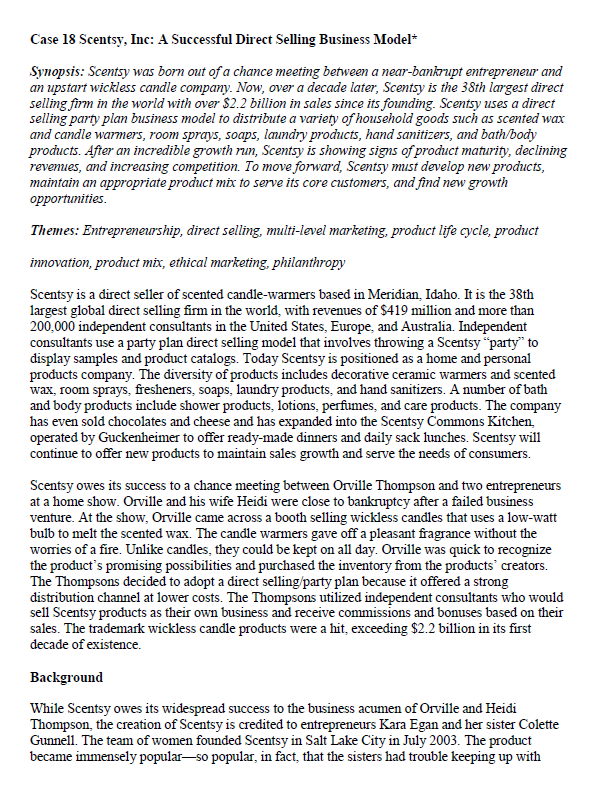
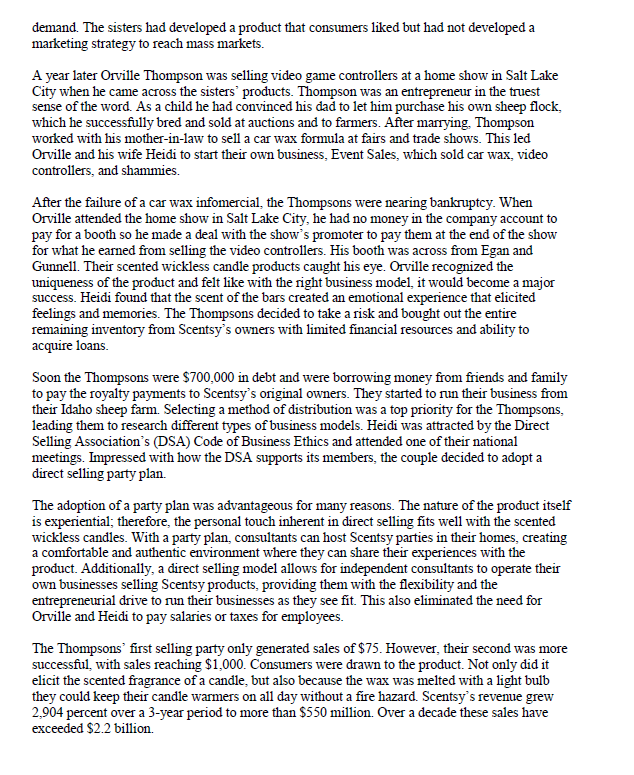
Case 18 Scentsy, Inc: A Successful Direct Selling Business Model* Synopsis: Scentsy was born out of a chance meeting between a near-bankrupt entrepreneur and an upstart wickless candle company. Now, over a decade later, Scentsy is the 38th largest direct selling firm in the world with over $2.2 billion in sales since its founding. Scentsy uses a direct selling party plan business model to distribute a variety of household goods such as scented wax and candle warmers, room sprays, soaps, laundry products, hand sanitizers, and bath/body products. After an incredible growth run, Scentsy is showing signs of product maturity, declining revenues, and increasing competition. To move forward, Scentsy must develop new products, maintain an appropriate product mix to serve its core customers, and find new growth opportunities. Themes: Entrepreneurship, direct selling, multi-level marketing, product life cycle, product innovation, product mix, ethical marketing, philanthropy Scentsy is a direct seller of scented candle-warmers based in Meridian Idaho. It is the 38th largest global direct selling firm in the world, with revenues of $419 million and more than 200,000 independent consultants in the United States, Europe, and Australia. Independent consultants use a party plan direct selling model that involves throwing a Scentsy "partyto display samples and product catalogs. Today Scentsy is positioned as a home and personal products company. The diversity of products includes decorative ceramic warmers and scented wax, room sprays, fresheners, soaps, laundry products, and hand sanitizers. A number of bath and body products include shower products, lotions, perfumes, and care products. The company has even sold chocolates and cheese and has expanded into the Scentsy Commons Kitchen, operated by Guckenheimer to offer ready-made dinners and daily sack lunches. Scentsy will continue to offer new products to maintain sales growth and serve the needs of consumers. Scentsy owes its success to a chance meeting between Orville Thompson and two entrepreneurs at a home show. Orville and his wife Heidi were close to bankruptcy after a failed business venture. At the show, Orville came across a booth selling wickless candles that uses a low-watt bulb to melt the scented wax. The candle warmers gave off a pleasant fragrance without the worries of a fire. Unlike candles, they could be kept on all day. Orville was quick to recognize the product's promising possibilities and purchased the inventory from the products creators. The Thompsons decided to adopt a direct selling party plan because it offered a strong distribution channel at lower costs. The Thompsons utilized independent consultants who would sell Scentsy products as their own business and receive commissions and bonuses based on their sales. The trademark wickless candle products were a hit, exceeding $2.2 billion in its first decade of existence. Background While Scentsy owes its widespread success to the business acumen of Orville and Heidi Thompson, the creation of Scentsy is credited to entrepreneurs Kara Egan and her sister Colette Gunnell. The team of women founded Scentsy in Salt Lake City in July 2003. The product became immensely popularso popular, in fact, that the sisters had trouble keeping up with demand. The sisters had developed a product that consumers liked but had not developed a marketing strategy to reach mass markets. A year later Orville Thompson was selling video game controllers at a home show in Salt Lake City when he came across the sisters products. Thompson was an entrepreneur in the truest sense of the word. As a child he had convinced his dad to let him purchase his own sheep flock, which he successfully bred and sold at auctions and to farmers. After marrying. Thompson worked with his mother-in-law to sell a car wax formula at fairs and trade shows. This led Orville and his wife Heidi to start their own business, Event Sales, which sold car wax, video controllers, and shammies. After the failure of a car wax infomercial , the Thompsons were nearing bankruptcy. When Orville attended the home show in Salt Lake City, he had no money in the company account to pay for a booth so he made a deal with the show's promoter to pay them at the end of the show for what he earned from selling the video controllers. His booth was across from Egan and Gunnell. Their scented wickless candle products caught his eye. Orville recognized the uniqueness of the product and felt like with the right business model, it would become a major success. Heidi found that the scent of the bars created an emotional experience that elicited feelings and memories. The Thompsons decided to take a risk and bought out the entire remaining inventory from Scentsy's owners with limited financial resources and ability to acquire loans. Soon the Thompsons were $700,000 in debt and were borrowing money from friends and family to pay the royalty payments to Scentsy's original owners. They started to run their business from their Idaho sheep farm. Selecting a method of distribution was a top priority for the Thompsons, leading them to research different types of business models. Heidi was attracted by the Direct Selling Association's (DSA) Code of Business Ethics and attended one of their national meetings. Impressed with how the DSA supports its members, the couple decided to adopt a direct selling party plan. The adoption of a party plan was advantageous for many reasons. The nature of the product itself is experiential; therefore, the personal touch inherent in direct selling fits well with the scented wickless candles. With a party plan, consultants can host Scentsy parties in their homes, creating a comfortable and authentic environment where they can share their experiences with the product. Additionally, a direct selling model allows for independent consultants to operate their own businesses selling Scentsy products, providing them with the flexibility and the entrepreneurial drive to run their businesses as they see fit. This also eliminated the need for Orville and Heidi to pay salaries or taxes for employees. The Thompsons' first selling party only generated sales of $75. However, their second was more successful, with sales reaching $1,000. Consumers were drawn to the product. Not only did it elicit the scented fragrance of a candle, but also because the wax was melted with a light bulb they could keep their candle warmers on all day without a fire hazard. Scentsy's revenue grew 2,904 percent over a 3-year period to more than $550 million. Over a decade these sales have exceeded $2.2 billionStep by Step Solution
There are 3 Steps involved in it

Get step-by-step solutions from verified subject matter experts
 Study Help