







Question: question attached - game theory 4. Consider the following version of nth price auction, n 2 1. There are n or more bidders, and an
question attached - game theory
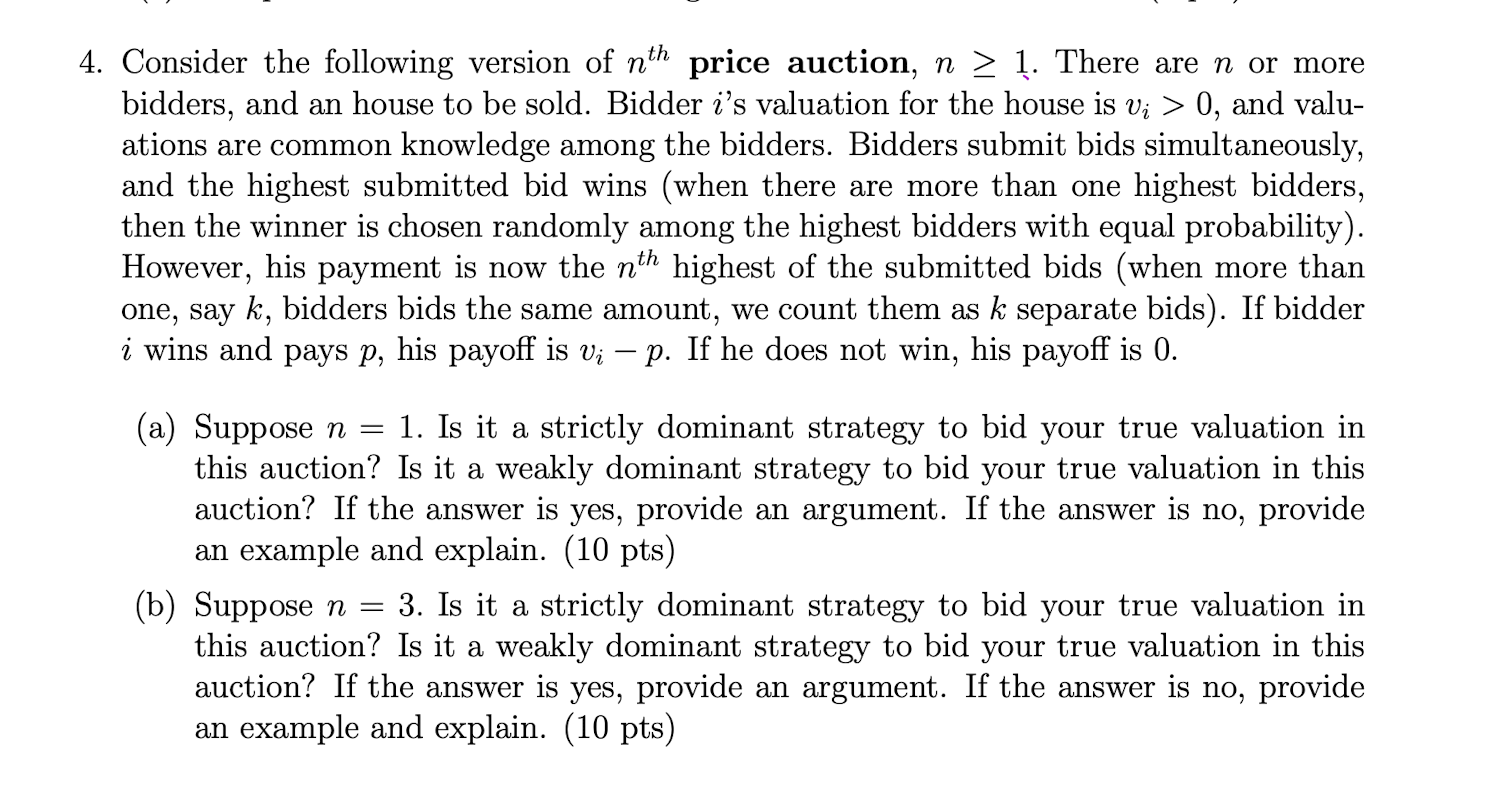
4. Consider the following version of nth price auction, n 2 1. There are n or more bidders, and an house to be sold. Bidder i's valuation for the house is v,- > 0, and valu- ations are common knowledge among the bidders. Bidders submit bids simultaneously, and the highest submitted bid wins (when there are more than one highest bidders, then the Winner is chosen randomly among the highest bidders with equal probability). However, his payment is now the nth highest of the submitted bids (when more than one, say 16, bidders bids the same amount, we count them as k separate bids). If bidder 2' wins and pays 19, his payoff is v,- p. If he does not win, his payoff is 0. (a) Suppose n = 1. Is it a strictly dominant strategy to bid your true valuation in this auction? Is it a weakly dominant strategy to bid your true valuation in this auction? If the answer is yes, provide an argument. If the answer is no, provide an example and explain. (10 pts) (b) Suppose n = 3. Is it a strictly dominant strategy to bid your true valuation in this auction? Is it a weakly dominant strategy to bid your true valuation in this auction? If the answer is yes, provide an argument. If the answer is no, provide an example and explain. (10 pts)
Step by Step Solution
There are 3 Steps involved in it

Get step-by-step solutions from verified subject matter experts
 Study Help