







Question: This assignment covers game theory, vertical integration, and transfer pricing. Please answer the questions below, which are related to Chapters 11 and 13 of P&R.
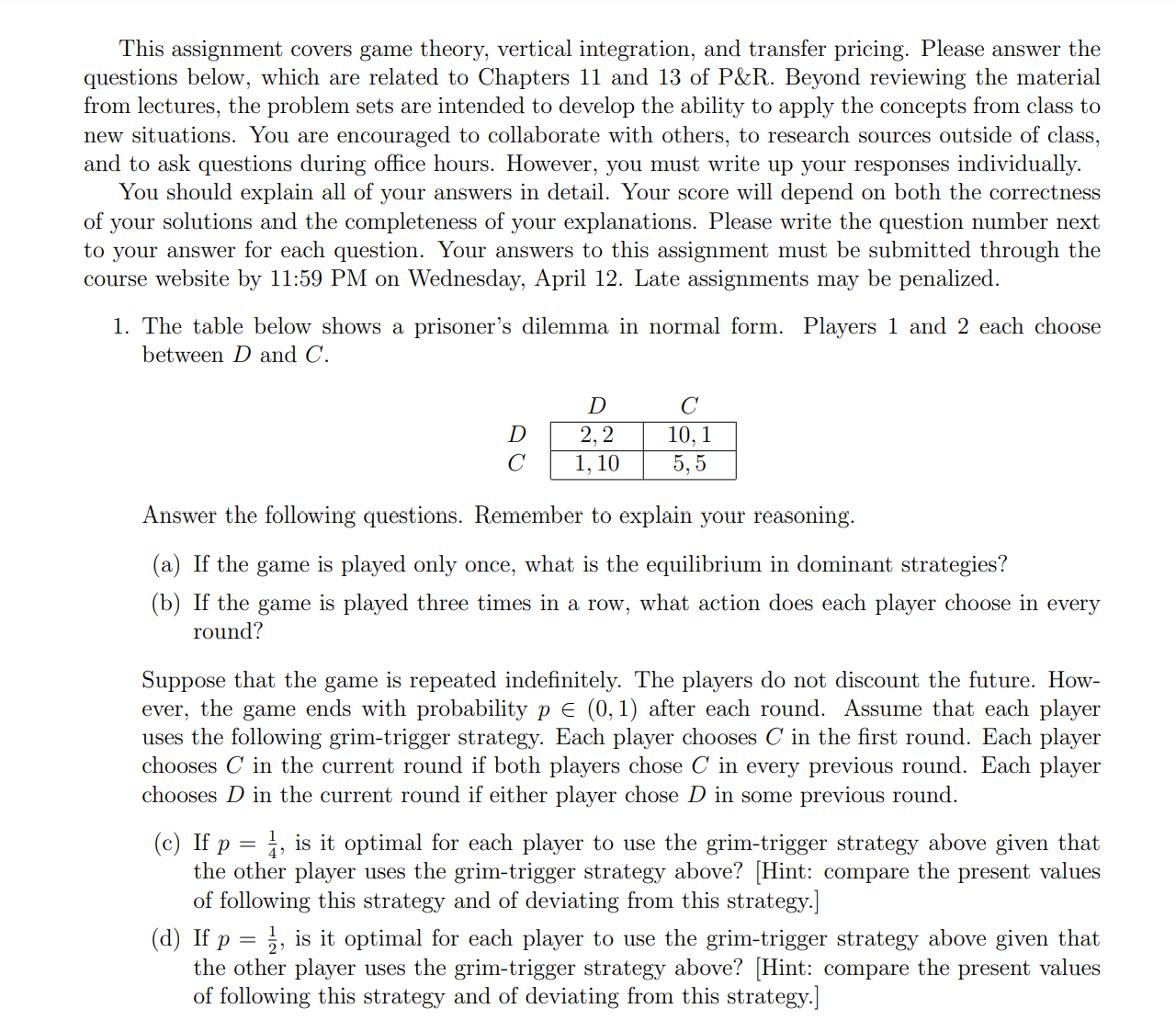
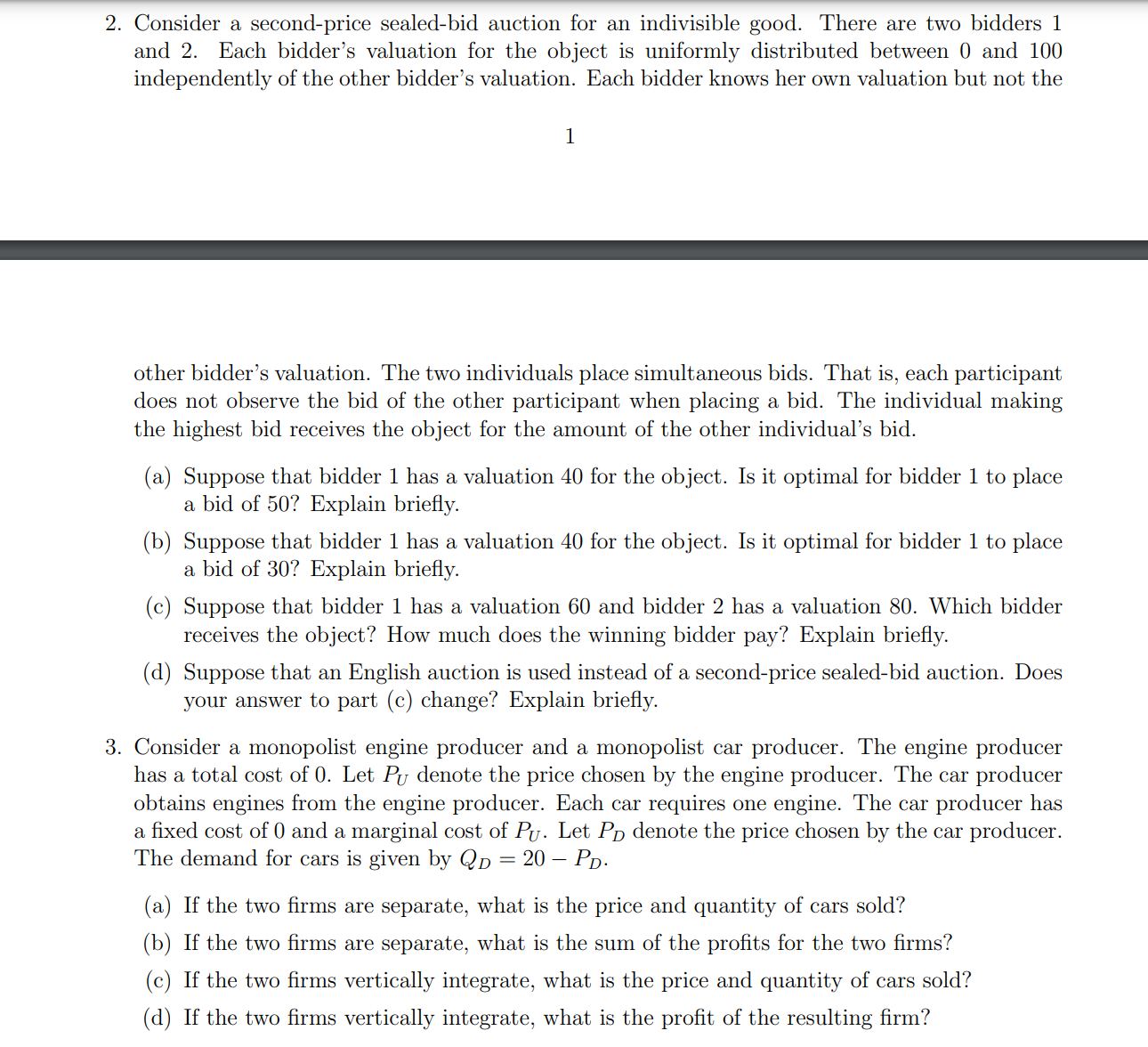
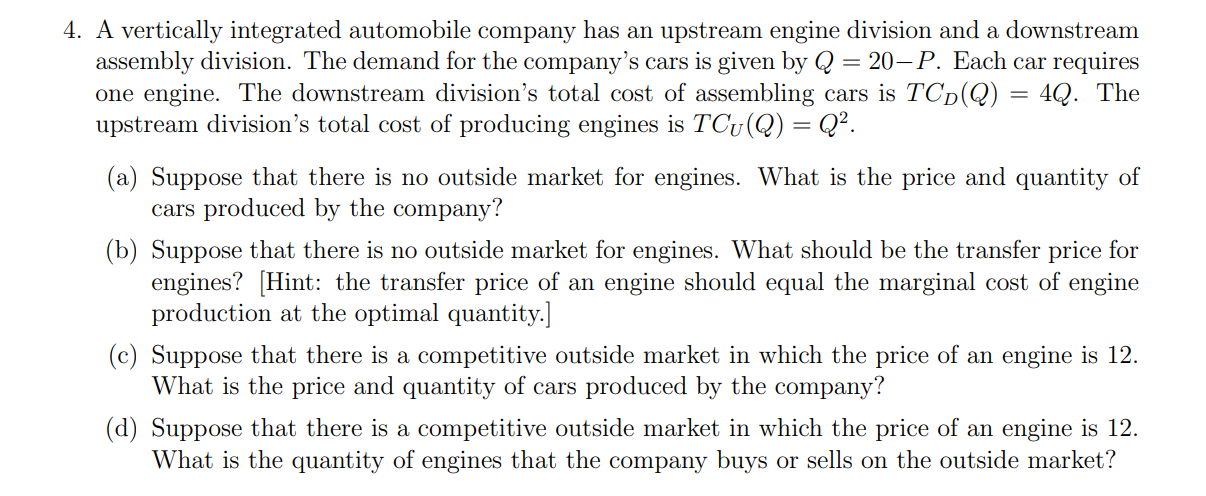
This assignment covers game theory, vertical integration, and transfer pricing. Please answer the questions below, which are related to Chapters 11 and 13 of P&R. Beyond reviewing the material from lectures, the problem sets are intended to develop the ability to apply the concepts from class to new situations. You are encouraged to collaborate with others, to research sources outside of class, and to ask questions during ofce hours. However, you must write up your responses individually. You should explain all of your answers in detail. Your score will depend on both the correctness of your solutions and the completeness of your explanations. Please write the question number next to your answer for each question. Your answers to this assignment must be submitted through the course website by 11:59 PM on W'ednesday, April 12. Late assignments may be penalized. 1. The table below shows a prisoner's dilemma in normal form. Players 1 and 2 each choose between D and C. D C D 2, 2 10,1 0 1,10 5,5 Answer the following questions. Remember to explain your reasoning. (a) If the game is played only once, what is the equilibrium in dominant strategies? (b) If the game is played three times in a row, what action does each player choose in every round? Suppose that the game is repeated indenitely. The players do not discount the future. How ever, the game ends with probability p 6 (0,1) after each round. Assume that each player uses the following grimtrigger strategy. Each player chooses C in the rst round. Each player chooses C in the current round if both players chose 6' in every previous round. Each player chooses D in the current round if either player chose D in some previous round. (c) If p = i, is it optimal for each player to use the grimetrigger strategy above given that the other player uses the grimtrigger strategy above? [Hint: compare the present values of following this strategy and of deviating from this strategy] (d) If p = i is it optimal for each player to use the grimtrigger strategy above given that the other player uses the grimtrigger strategy above? [Hint: compare the present values of following this strategy and of deviating from this strategy] 2. Consider a secondeprice sealedebid auction for an indivisible good. There are two bidders 1 and 2. Each bidder's valuation for the object is uniformly distributed between 0 and 100 independently of the other bidder's valuation. Each bidder knows her own valuation but not the other bidder's valuation. The two individuals place simultaneous bids. That is, each participant does not observe the bid of the other participant when placing a bid. The individual making the highest bid receives the object for the amount of the other individual's bid. (a) Suppose that bidder 1 has a valuation 40 for the object. Is it optimal for bidder 1 to place a bid of 50? Explain briey. (b) Suppose that bidder 1 has a valuation 40 for the object. Is it optimal for bidder 1 to place a bid of 30? Explain briey. (c) Suppose that bidder 1 has a valuation 60 and bidder 2 has a valuation 80. Which bidder receives the object? How much does the winning bidder pay? Explain briey. (d) Suppose that an English auction is used instead of a secondeprice sealedebid auction. Does your answer to part (c) change? Explain briey. 3. Consider a monopolist engine producer and a monopolist car producer. The engine producer has a total cost of 0. Let PU denote the price chosen by the engine producer. The car producer obtains engines from the engine producer. Each car requires one engine. The car producer has a xed cost of U and a marginal cost of PU. Let PD denote the price chosen by the car producer. The demand for cars is given by QD = 20 7 PD. (a If the two rms are separate, what is the price and quantity of cars sold? (b (c (d If the two rms vertically integrate, what is the prot of the resulting rm? If the two rms are separate, what is the sum of the prots for the two rms? If the two rms vertically integrate, what is the price and quantity of cars sold? ) ) ) ) 4. A vertically integrated automobile company has an upstream engine division and a downstream assembly division. The demand for the company's cars is given by Q = 20 P. Each car requires one engine. The downstream division's total cost of assembling cars is TCD(Q) = 4Q. The upstream division's total cost of producing engines is TCU(Q) = Q2. (a) Suppose that there is no outside market for engines. What is the price and quantity of cars produced by the company? (In) Suppose that there is no outside market for engines. What should be the transfer price for engines? [Hint: the transfer price of an engine should equal the marginal cost of engine production at the optimal quantity] (c) Suppose that there is a competitive outside market in which the price of an engine is 12. What is the price and quantity of cars produced by the company? (d) Suppose that there is a competitive outside market in which the price of an engine is 12. What is the quantity of engines that the company buys or sells on the outside market
Step by Step Solution
There are 3 Steps involved in it

Get step-by-step solutions from verified subject matter experts
 Study Help