







Question: A discrete time sequence r(n) is described by the following difference equation a) a(n) = 0.8(n 1) + v(n) where v(n) is a zero-mean
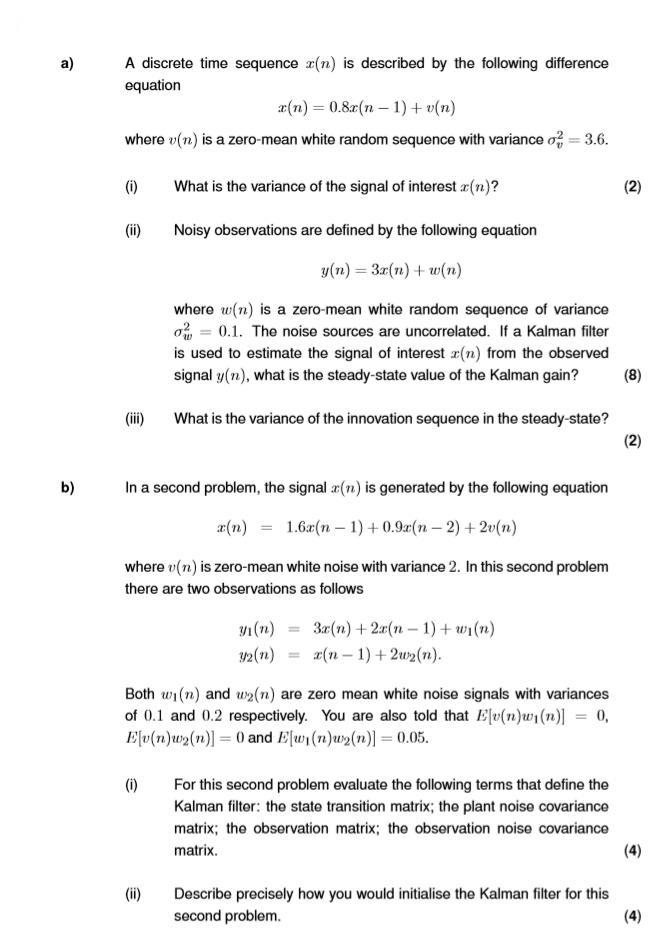
A discrete time sequence r(n) is described by the following difference equation a) a(n) = 0.8(n 1) + v(n) where v(n) is a zero-mean white random sequence with variance of = 3.6. (i) What is the variance of the signal of interest r(n)? (2) (ii) Noisy observations are defined by the following equation y(n) = 3r(n) + w(n) where w(n) is a zero-mean white random sequence of variance o = 0.1. The noise sources are uncorrelated. If a Kalman filter is used to estimate the signal of interest r(n) from the observed signal y(n), what is the steady-state value of the Kalman gain? (8) (ii) What is the variance of the innovation sequence in the steady-state? (2) b) In a second problem, the signal a(n) is generated by the following equation r(n) 1.6r(n 1) + 0.9r(n 2) + 20(n) %3D where v(n) is zero-mean white noise with variance 2. In this second problem there are two observations as follows (n) 3x(n) + 2r(n- 1)+ wi(n) 2(n) x(n 1) + 2w2(n). Both wi(n) and w2(n) are zero mean white noise signals with variances of 0.1 and 0.2 respectively. You are also told that Eu(n)wi(n)] = 0, E[v(n)w2(n)] = 0 and E[w1(n)w2(n)] = 0.05. For this second problem evaluate the following terms that define the Kalman filter: the state transition matrix; the plant noise covariance (i) matrix; the observation matrix; the observation noise covariance matrix. (4) (ii) Describe precisely how you would initialise the Kalman filter for this second problem. (4)
Step by Step Solution
3.51 Rating (161 Votes )
There are 3 Steps involved in it
Lets address the given problems step by step a Problem Details The signal xn is given by xn 08xn1 vn where vn is a zeromean white noise sequence with ... View full answer

Get step-by-step solutions from verified subject matter experts
 Study Help