



Question: question c and d Question 3 The suspension system in a car (Figure 3) can be modelled by a simple mass-spring system. Each wheel is
 question c and d
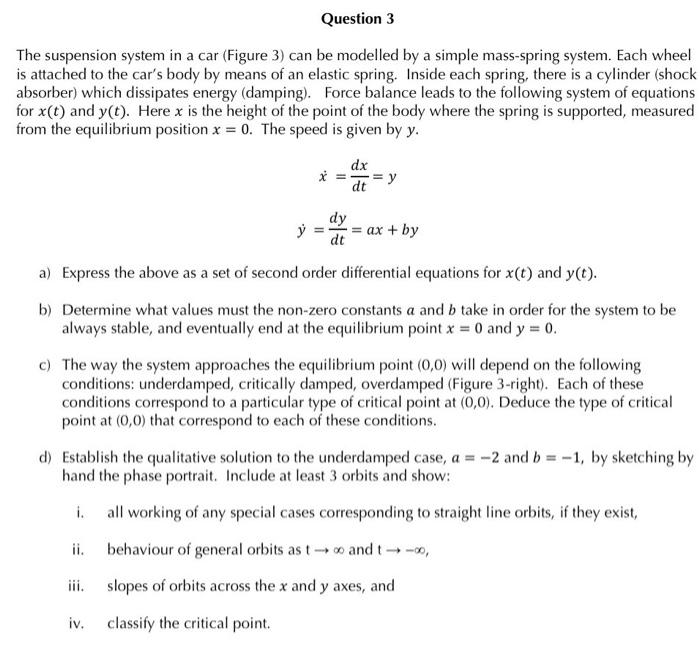
Question 3 The suspension system in a car (Figure 3) can be modelled by a simple mass-spring system. Each wheel is attached to the car's body by means of an elastic spring. Inside each spring, there is a cylinder (shock absorber) which dissipates energy (damping). Force balance leads to the following system of equations for x(t) and y(t). Here x is the height of the point of the body where the spring is supported, measured from the equilibrium position x = 0. The speed is given by y. dx dt y dy = ax + by dt a) Express the above as a set of second order differential equations for x(t) and y(t). b) Determine what values must the non-zero constants a and b take in order for the system to be always stable, and eventually end at the equilibrium point x = 0 and y = 0. c) The way the system approaches the equilibrium point (0,0) will depend on the following conditions: underdamped, critically damped, overdamped (Figure 3-right). Each of these conditions correspond to a particular type of critical point at (0,0). Deduce the type of critical point at (0,0) that correspond to each of these conditions. d) Establish the qualitative solution to the underdamped case, a = -2 and b = -1, by sketching by hand the phase portrait. Include at least 3 orbits and show: i. all working of any special cases corresponding to straight line orbits, if they exist, ii. behaviour of general orbits as t - and t -0, iii. slopes of orbits across the x and y axes, and iv. classify the critical point Question 3 The suspension system in a car (Figure 3) can be modelled by a simple mass-spring system. Each wheel is attached to the car's body by means of an elastic spring. Inside each spring, there is a cylinder (shock absorber) which dissipates energy (damping). Force balance leads to the following system of equations for x(t) and y(t). Here x is the height of the point of the body where the spring is supported, measured from the equilibrium position x = 0. The speed is given by y. dx dt y dy = ax + by dt a) Express the above as a set of second order differential equations for x(t) and y(t). b) Determine what values must the non-zero constants a and b take in order for the system to be always stable, and eventually end at the equilibrium point x = 0 and y = 0. c) The way the system approaches the equilibrium point (0,0) will depend on the following conditions: underdamped, critically damped, overdamped (Figure 3-right). Each of these conditions correspond to a particular type of critical point at (0,0). Deduce the type of critical point at (0,0) that correspond to each of these conditions. d) Establish the qualitative solution to the underdamped case, a = -2 and b = -1, by sketching by hand the phase portrait. Include at least 3 orbits and show: i. all working of any special cases corresponding to straight line orbits, if they exist, ii. behaviour of general orbits as t - and t -0, iii. slopes of orbits across the x and y axes, and iv. classify the critical point
Step by Step Solution
There are 3 Steps involved in it

Get step-by-step solutions from verified subject matter experts